
NASA's Roman Telescope Launched by SpaceX Falcon Heavy, Photographed Crossing Sun
A photographer shares the dramatic story of capturing NASA's Roman Space Telescope during a SpaceX Falcon Heavy launch, a rare alignment requiring precise timing and a daring move.

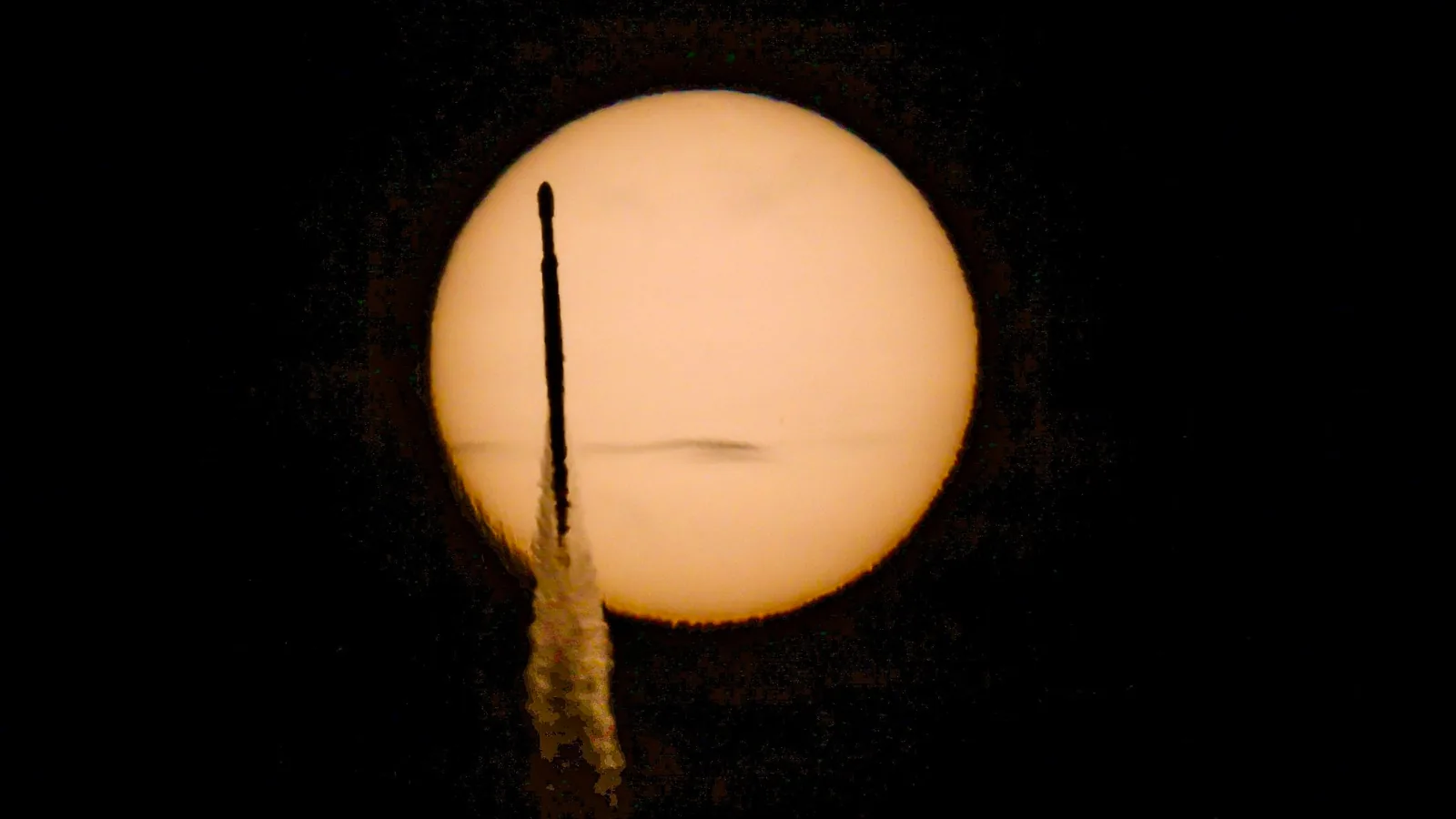
CAPE CANAVERAL, Fla. — Amidst the pre-dawn quiet of Florida's Space Coast on Sunday, August 30, 2026, a unique celestial ballet unfolded as SpaceX's powerful Falcon Heavy rocket ascended, carrying NASA's Nancy Grace Roman Space Telescope. For a select group of photographers, including the author, the mission's success was not just about reaching orbit, but about capturing an extraordinary photographic opportunity: the rocket transiting the face of the sun. Liftoff occurred precisely at 07:26:49 a.m. EDT (11:26:49 GMT) from Launch Complex-39A at NASA's Kennedy Space Center, an "instantaneous" launch window where every second counted.
The precise timing was crucial not only for the telescope's orbital trajectory but also for the photographers aiming to document the event. An early launch meant the sun, having risen only about 20 minutes prior, was still low enough in the sky to potentially align with the rocket's path. This rare phenomenon, a rocket flying directly in front of the sun, is notoriously difficult to predict and capture. It requires specific vantage points along the Atlantic coast that align with eastward launch trajectories. Advanced planning tools like FlightClub.io, PhotoPills, and The Photographer's Ephemeris are essential for enthusiasts hoping to line up such near-impossible shots.
The author recounts the split-second decision to leave the official press site at Kennedy Space Center, a mere three miles from the launchpad, to reach a specific viewing spot in Titusville's Hobby Lobby parking lot, approximately 12 miles away. This daring move was prompted by the potential for the solar transit and encouragement from fellow photographers. "No guts, no glory," was the sentiment echoed, as David Diebold, a photographer from Space Scout, advised, "Of course he was going to try for the shot." The weather forecast for Sunday offered only a 50% chance of favorable conditions, with clouds threatening to obscure the view.
The Calculated Risk
The urgency to depart was amplified by the fact that the Falcon Heavy, a less frequent flyer compared to SpaceX's workhorse Falcon 9, was launching. A few minutes' delay in launch time could mean the difference between a spectacular solar transit and a missed opportunity, as the sun shifts its position on the horizon. The author, initially focused on other aspects of the mission coverage, was drawn into the excitement of the potential solar transit photo. This meant sacrificing a front-row seat to the launch in favor of a potentially once-in-a-lifetime shot.
Upon arrival at the Hobby Lobby location, the author joined a gathering of fellow photographers, including Andrew McCarthy and Max Evans, who offered last-minute advice. Equipped with a Canon R5 Mark II camera and an RF100-400mm lens, and crucially, a solar filter borrowed from Diebold, the author prepared for the imminent launch. Exposure settings were dialed down to 1/20000 of a second with an aperture of F16, optimizing for the intense sunlight. As the final countdown neared, the clouds that had loomed on the horizon surprisingly began to clear.
At the moment of liftoff, a hushed silence fell over the crowd. The author, without looking up, focused on waiting for the predicted moment. Seconds later, the Falcon Heavy rocket appeared, a dark silhouette briefly obscuring the bright solar disk. The shot was secured by holding down the shutter button, a testament to meticulous planning and a willingness to take calculated risks. This capture, alongside the successful deployment of the Nancy Grace Roman Space Telescope, highlights the dedication involved in documenting space exploration.
Rocket launches, inherently risky endeavors involving millions of dollars in technology and the volatile nature of controlled explosions, are undertaken to push the boundaries of human knowledge. The Roman telescope, designed to capture the widest views of the universe ever recorded and map exoplanets, represents a new era of discovery, particularly in understanding dark matter and dark energy. The successful transit photo, achieved through a blend of technical skill, predictive software, and personal daring, underscores the profound rewards that can be reaped from venturing into the unknown. As the author put it, the pursuit of such extraordinary moments in space exploration is often driven by the principle of "no guts, no glory."