
Saturn's South Pole Hosts Massive 10-Sided Cloud Pattern, Hubble Reveals
Astronomers have detected a colossal 10-sided wave pattern in Saturn's southern polar clouds, larger and more dynamic than the planet's famed hexagonal storm. This discovery, made using the Hubble Space Telescope, offers new insights into gas giant atmospheric dynamics.

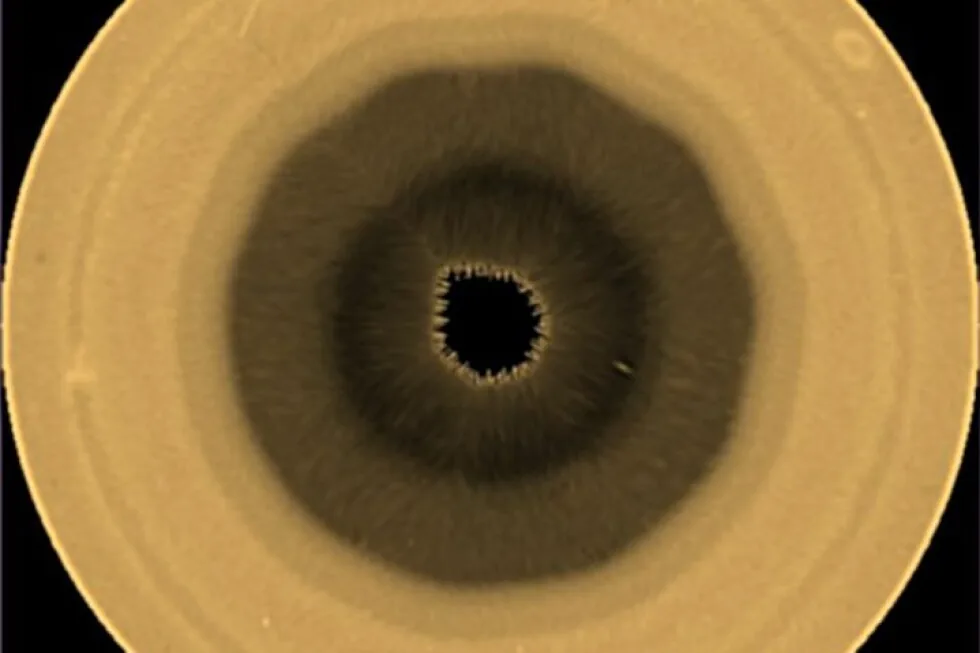
Scientists have identified a massive, 10-sided wave pattern swirling within the frigid ammonia clouds encircling Saturn’s south pole. This colossal "decagon" formation is reportedly even larger and more volatile than the well-known hexagonal cloud system observed at the planet's north pole by NASA's Voyager spacecraft in the 1980s. A Spanish-led research team announced the discovery on Wednesday, noting the pattern emerged in images captured by the Hubble Space Telescope in 2023 after previous observations failed to detect it. Researchers believe this unusual atmospheric phenomenon likely materialized between 2017 and 2023, a period when Saturn’s south pole was oriented away from Earth and thus obscured from view. The decagon may still be in a state of flux, with individual sides alone extending over 10,000 miles (16,700 kilometers).
The implications of this finding are significant, as it suggests that the "unique" hexagon is not as extraordinary a feature as previously thought, according to lead author Agustin Sanchez-Lavega of the University of the Basque Country. His team's findings were published in the journal Science Advances. While wave-generating disturbances are common on all planets in the solar system that possess atmospheres, Saturn is unique in exhibiting these formations as distinct polygons. Both the decagon and the hexagon are situated on powerful jet streams. However, while the northern hexagon remains largely stationary, the southern decagon drifts eastward at a modest pace of approximately 6 mph (10 kph).
Understanding Planetary Weather Dynamics
"Saturn still has the ability to surprise us," stated Leigh Fletcher from the University of Leicester in a separate announcement. Fletcher was involved in measuring the wind speeds within the decagon using the European Southern Observatory’s Very Large Telescope located in Chile. By comparing these two distinct polar formations, scientists aim to deepen their understanding of the complex weather systems that govern giant gas planets. "This is a highly interesting phenomenon that appears to be unique to Saturn, and we want to know why," Sanchez-Lavega emphasized. He further speculated whether these polygonal cloud structures might be connected to the polygonal arrangements observed in Jupiter's cyclones.
Enhanced observations of Saturn’s southern hemisphere over the coming years are expected to provide more detailed imagery of the decagon. This increased data may help astronomers unravel this "intriguing atmospheric mystery," Sanchez-Lavega added. It remains uncertain whether the newly discovered decagon will persist for as long as the northern hexagon, which has been a consistent feature observed by spacecraft for more than four decades. For context, one Saturnian year is equivalent to 30 Earth years. "For the time being, all I can confirm is that the decagon is still there," Sanchez-Lavega concluded, indicating that this remarkable atmospheric feature continues to be present on the ringed planet.