
SpaceX Falcon 9 Rocket Set for Lunar Impact This Week
A discarded SpaceX Falcon 9 rocket stage is on a collision course with the Moon, aiming for an impact on August 5. The event could create a debris plume visible from Earth.

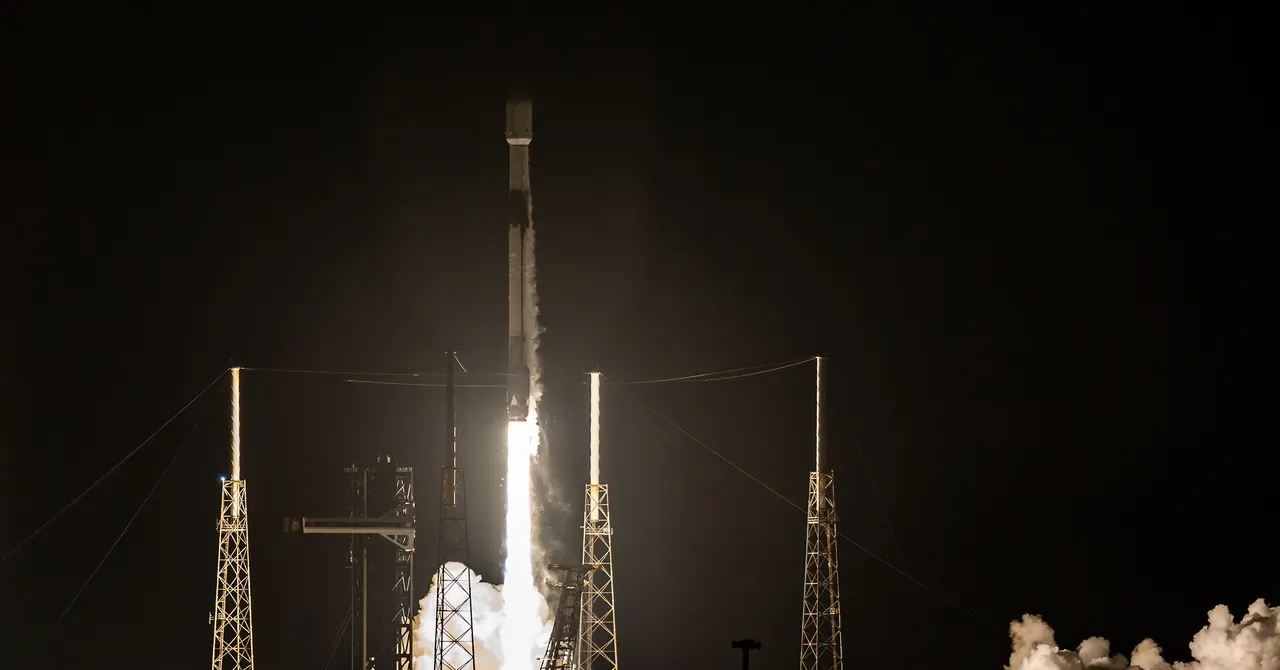
A defunct SpaceX Falcon 9 rocket stage is on an unavoidable collision course with the Moon, with its impact scheduled for Wednesday, August 5, around 6:34 AM UTC. The upper stage is expected to strike the lunar surface near the Einstein crater at a velocity exceeding 5,400 miles per hour. If predictions hold true, the collision could generate a debris plume bright enough to be observed from Earth using appropriate telescopic equipment, marking a first for lunar impacts on the sunlit side of the Moon. Scientists anticipate the crash could kick up dust, creating a noticeable spectacle against the backdrop of space.
The potential visibility of the impact is largely based on two recent preprint studies. One, led by William Jo, a doctoral candidate at the University of Texas at Austin's Cockrell School of Engineering, utilized a high-resolution physics simulation to forecast the scale of the impact. The simulation modeled the collision of the 3,900-kilogram rocket stage with the lunar surface, differing significantly from meteorite impacts due to its hollow nature and concentrated engine mass.
"It's like an eggshell, because it had all the fuel in it, and there is a rocket engine at one end that's denser," explained David Goldstein, an aerospace engineering professor at UT Austin who supervised Jo's work. Unlike a dense object that would burrow, the rocket stage is expected to collapse, throwing up a wide curtain of soil, potentially up to 183 kilometers across, along with an upward plume. Jo's simulation suggests approximately 12,700 kilograms of debris could be displaced.
Assessing Visibility and Lunar Exploration Implications
However, Jo cautioned that his simulation represents an "optimistic best-case" scenario, as it was a two-dimensional model assuming a direct, engine-first descent. The actual impact is more likely to be at an angle, potentially resulting in a smaller, less dramatic debris cloud. "I would view our study as the most optimistic in terms of generating sprays," Goldstein added, noting that a glancing blow would likely produce a dimmer plume without a significant upward spike.
Astronomer Laurence Trafton of UT Austin indicated that while a plume could reach 50 kilometers past the lunar limb, making it theoretically resolvable by small telescopes, its actual visibility remains uncertain. The plume's estimated brightness is significantly fainter than the Moon itself, posing a challenge for observation, especially with scattered moonlight. Trafton advised that a "very steady mount" would be necessary, and the peak visibility is expected about 90 seconds after impact, offering a window for observation.
Geographical location will also play a role. Viewers north of a line extending from Massachusetts to Texas may find observation difficult due to atmospheric conditions. The US Southeast offers the most favorable viewing conditions, according to Trafton. The event has garnered attention from both professional and amateur astronomers, with observation plans being shared by experts like Bill Gray of Project Pluto, who initially flagged the impact.
Beyond the spectacle, scientists are keenly interested in what the impact can reveal about the Moon. Past experiments, such as NASA's 1999 and 2009 missions that intentionally impacted the lunar surface, aimed to detect resources like water ice. While a 2022 impact, initially attributed to SpaceX, was later identified as a Chinese booster, such events provide valuable data. This upcoming collision offers a unique opportunity to study the behavior of debris from lunar hardware, which is crucial as humanity prepares for a new era of lunar exploration.
With NASA planning to return astronauts to the Moon and China also pursuing lunar missions, understanding the mechanics of returning hardware is paramount. "We're going to be colonizing the moon apparently pretty soon," Jo stated. He highlighted concerns about ejected particles and abrasive lunar dust, which could pose challenges for astronauts. Goldstein likened the situation to the early Apollo missions, where astronauts were visibly covered in lunar dust, underscoring the persistent problem of dust control during future lunar operations.