
Venus and Jupiter Align for Dazzling Near-Touch Conjunction June 9
Skywatchers will witness a rare celestial event on June 9, 2026, as Venus and Jupiter appear to nearly touch in the post-sunset sky. The two brightest planets will be visible less than a thumb's width apart.

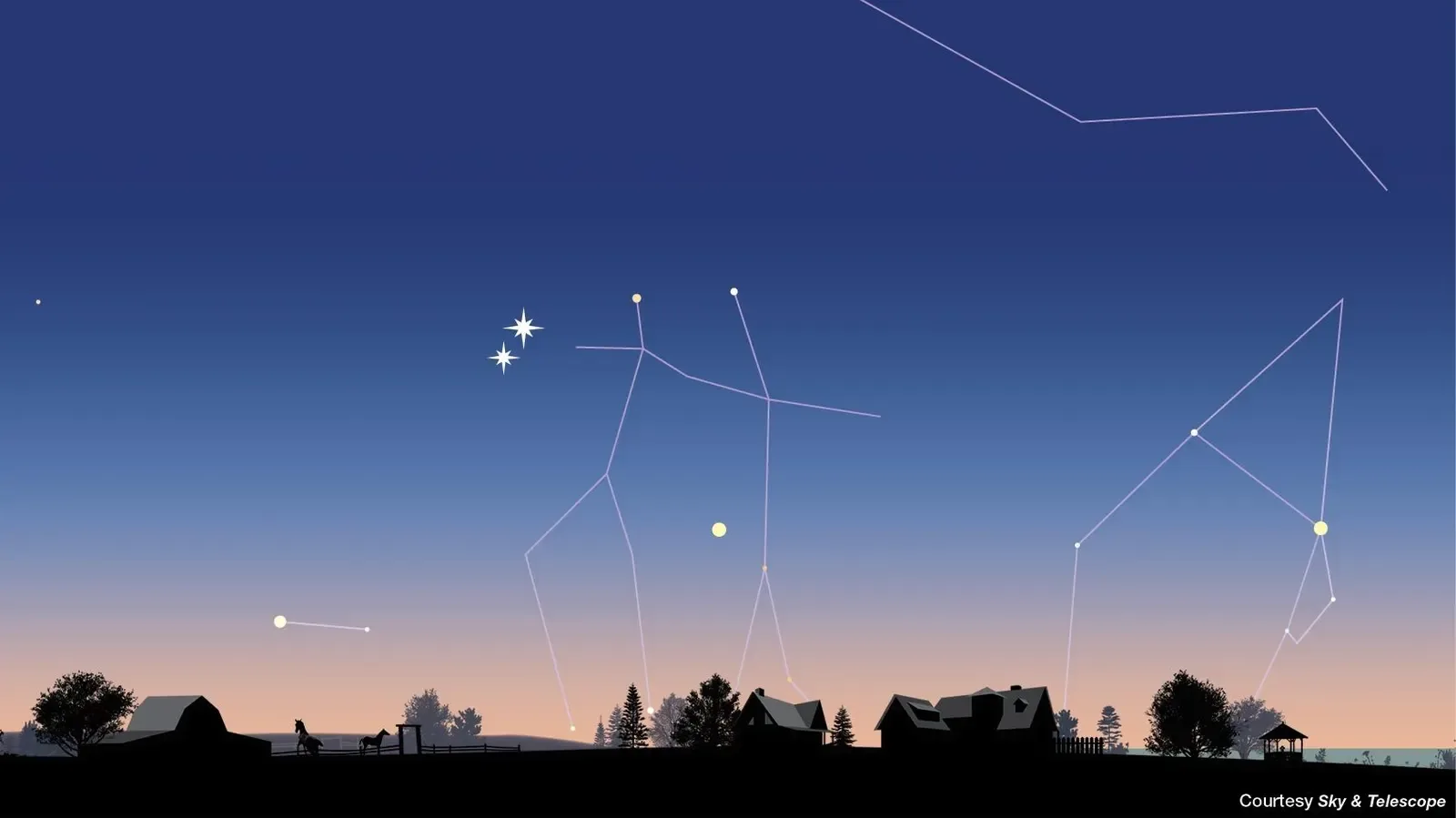
Stargazers across the United States will have a remarkable opportunity to witness a spectacular celestial event this week: a close conjunction of Venus and Jupiter. On Tuesday, June 9, the two brightest planets in our solar system will appear to nearly touch in the western sky shortly after sunset. This dazzling display, considered one of the highlights of 2026, will see Venus and Jupiter aligning at a separation of less than the width of a thumb held at arm’s length, making them appear as a single, brilliant object.
While the visual proximity is striking, it is purely an optical illusion. At the time of the conjunction, Venus will be approximately 110 million miles (180 million kilometers) from Earth. Jupiter, a much larger gas giant, will be significantly farther away, around 560 million miles (900 million kilometers) distant. Planetary conjunctions occur when planets align in the sky from our perspective on Earth, a result of their orbits around the sun occurring on a similar plane.
The rarity of this specific pairing stems from the exceptional brightness of both celestial bodies. Venus, often nicknamed the "Evening Star," will shine with a magnitude of -4.0, outshining Jupiter's magnitude -1.9 by a factor of seven. Despite Jupiter's immense size—more than ten times that of Earth—Venus's closeness to our planet and its highly reflective cloud cover contribute to its superior brilliance. As an added treat, the elusive planet Mercury may also be visible, appearing lower on the horizon, to the right of Venus and Jupiter, before it sets.
A Triple Planet Parade
The planets will be located within the constellation Gemini, positioned to the left of its recognizable stars, Castor and Pollux. For those without optical aid, the naked eye will suffice to observe this extraordinary alignment against the fading twilight. However, using binoculars will offer a more detailed view of the brilliant pairing. Small telescopes will provide an even more intimate experience, potentially revealing Jupiter's four largest moons as tiny pinpricks of light and Venus as a partially illuminated disk.
Although June 9 marks the peak of the conjunction, Venus and Jupiter will remain in close proximity, within five degrees of each other, from June 4 through June 14. This extended viewing window offers multiple chances to catch the celestial show. The astronomical spectacle will become even more picturesque between June 16-17 when a slender, waxing crescent moon joins the planetary procession, adding another layer of beauty to the night sky. Following the conjunction, Jupiter will gradually descend toward the horizon, while Venus will ascend higher into the western sky, remaining a dominant and increasingly bright fixture throughout the summer months. This event offers a fantastic opportunity for amateur astronomers and casual observers alike to connect with the cosmos and appreciate the grand ballet of planets in our solar system.