
Webb Telescope Reveals Massive Star Clusters Leave Nurseries in 5 Million Years
The James Webb Space Telescope has observed nearly 9,000 young star clusters, finding that the most massive ones emerge from their gas clouds about 5 million years after birth, a timing crucial for galaxy evolution models.

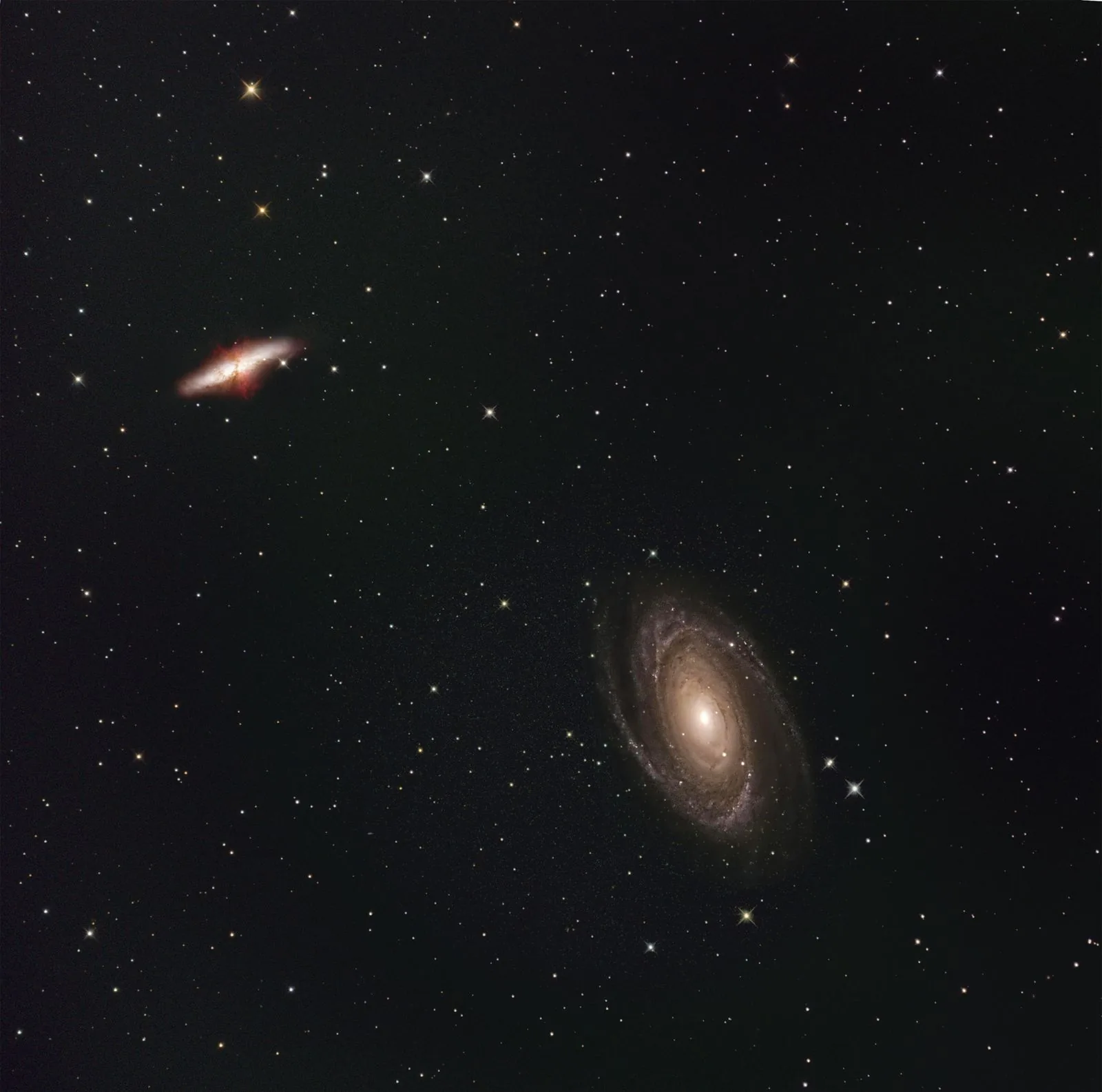
The James Webb Space Telescope (JWST) has provided astronomers with unprecedented insights into the early lives of star clusters, revealing that the most massive among them break free from their gas and dust nurseries significantly faster than previously assumed. In a recent study published in Nature Astronomy, researchers combined data from JWST and the Hubble Space Telescope to analyze approximately 9,000 young star clusters across four nearby galaxies: Messier 51, Messier 83, NGC 628, and NGC 4449. This comprehensive survey allows for a detailed examination of star cluster evolution at a population level.
The study uncovered an unexpected pattern: the most massive star clusters consistently cleared their surrounding natal gas within about 5 million years. In contrast, less massive clusters typically remained embedded in their birth clouds for 7 to 8 million years before emerging. This finding challenges simpler models, which might intuitively suggest that larger, denser environments would take longer to disperse. However, the immense power of massive star clusters, driven by their numerous massive stars, produces intense ultraviolet radiation, powerful stellar winds, and eventually supernova explosions. This combined "stellar feedback" can rapidly break apart and clear out the surrounding material.
Timing's Critical Role in Galaxy Formation
The precise timing of a star cluster's emergence from its birth cocoon has profound implications for understanding galaxy evolution. For every two to three million years a cluster remains embedded, its ultraviolet radiation is absorbed by the dense gas, limiting its impact on the wider galaxy. Conversely, an earlier emergence allows that energetic radiation to escape sooner. This process is particularly relevant to the cosmic reionization era, a pivotal period in the early universe when neutral hydrogen was ionized. While the study doesn't definitively solve the mystery of what powered reionization, it strengthens the case for massive young star clusters as significant contributors of ionizing radiation, potentially escaping their birth clouds earlier than some cosmological models have accounted for.
This discovery offers a critical constraint for sophisticated computer simulations that model galaxy formation. These models rely heavily on accurate representations of stellar feedback—how quickly young stars disrupt surrounding gas, how this gas fuels subsequent star formation, and how galaxies regulate their own growth. The observational data from JWST and Hubble suggests that existing simulations may need refinement, particularly concerning the timescale of star cluster emergence. Errors in this fundamental clockwork can cascade into inaccuracies in estimates of star formation rates, gas reservoirs, radiation escape mechanisms, and the chemical enrichment of galaxies over billions of years.
The implications of this timing also extend to the formation of planets. Young stars often reside within protoplanetary disks, swirling disks of gas and dust from which planets coalesce. Intense ultraviolet radiation from nearby massive stars can erode these disks, diminishing the material available for planet formation and potentially shortening the window for planets to accrete gas and dust. If massive clusters disperse their natal clouds earlier, the protoplanetary disks around less massive stars in their vicinity might be exposed to this harsh radiation sooner, influencing the conditions for planet formation, especially in dense stellar environments. This highlights that the immediate cosmic neighborhood of a star, even in its early stages, plays a more significant role than a quiescent, isolated view might suggest.
The James Webb Space Telescope, already celebrated for its views of distant galaxies and hidden star-forming regions, is proving instrumental in unraveling more nuanced aspects of galactic history. Most stars are born in clusters, and the behavior of these clusters in their first few million years is key to understanding how gas is heated, redistributed, or preserved for future star generations. JWST’s infrared capabilities allow astronomers to probe these crucial early phases, even when obscured by dust. Future research aims to expand these surveys to a wider range of galaxies and environments, including dwarf galaxies, which may offer clues to early universe conditions. The ultimate goal is to determine if the physics observed locally scales back to the universe's formative first half-billion years, potentially shedding light on the sources of cosmic reionization.