
AI Models Analyze Prehistoric Human Bones in Tucson Archaeological Site
Researchers in Tucson are using machine learning to rapidly analyze newly discovered prehistoric human remains, revealing insights into ancient migration and settlement patterns in the Southwest.

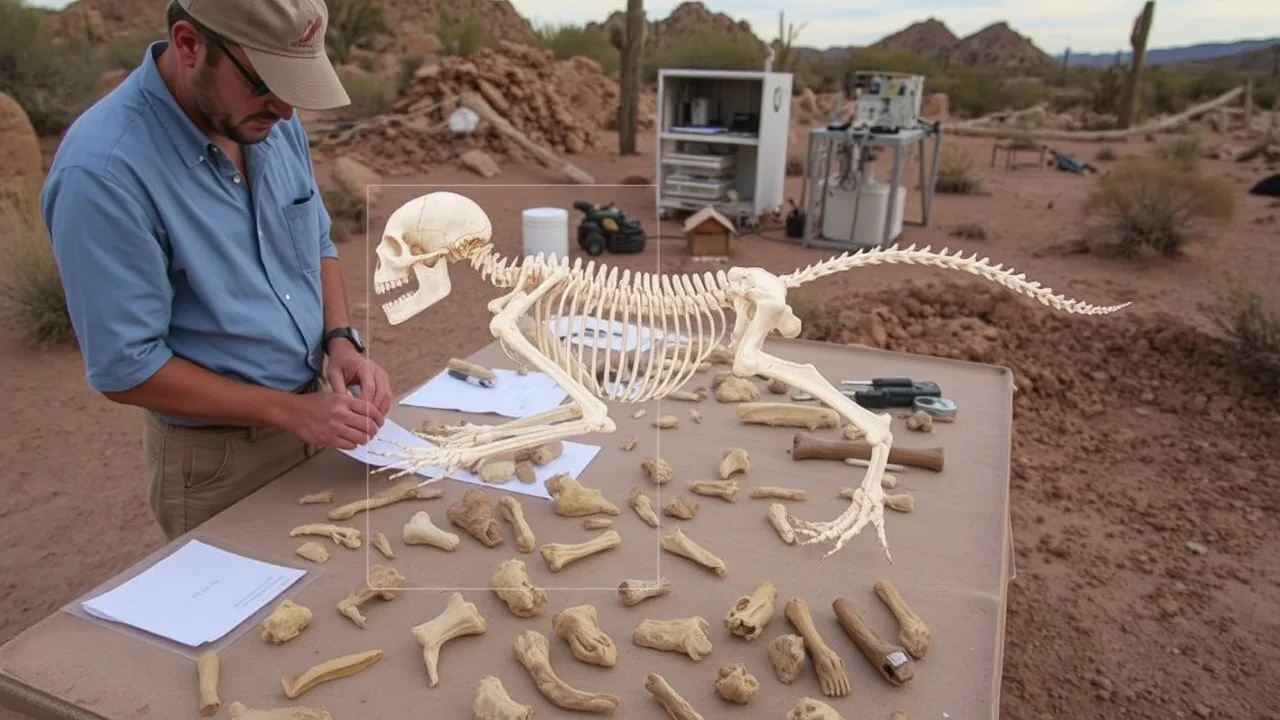
A team of archaeologists at the University of Arizona announced this week that they have deployed advanced artificial intelligence models to analyze a collection of prehistoric human bones discovered at a dig site near Tucson. The skeletal remains, estimated to be between 8,000 and 12,000 years old, represent one of the largest single-site collections of early human remains found in Arizona in the past decade.
The bones were uncovered during a routine survey in May 2026 at a location approximately 40 miles north of downtown Tucson. Initial excavation recovered over 300 bone fragments and several intact long bones from what researchers believe was a communal burial site used across multiple generations.
Dr. Elena Vasquez, lead researcher on the project, stated in a recent interview: "Machine learning has allowed us to process morphological data from these bones in weeks rather than months. We can now identify age, sex, and health markers with unprecedented speed and consistency, which helps us build a clearer picture of how these early peoples lived."
How AI Accelerates Bone Analysis
Traditional archaeological analysis of human skeletal material relies on visual inspection, manual measurement, and comparative anatomy. A single skeleton can require 30 to 50 hours of specialist labor to document fully. The AI system deployed by Vasquez's team uses computer vision and trained neural networks to segment individual bones, measure key dimensions, and flag anomalies.
The model was trained on a dataset of over 5,000 modern reference skeletons and 2,000 archaeological specimens held at major U.S. museums. Researchers fed high-resolution 3D scans of each bone into the system, which then generated automated reports on estimated age at death, biological sex, pathological conditions, and dietary stress markers.
The archaeology team validated the AI predictions against expert human analysis on a subset of 50 bones. Accuracy rates exceeded 87 percent for age estimates and 91 percent for sex determination, comparable to or better than single-observer accuracy rates documented in peer-reviewed studies.
Beyond classification, the AI system identified three individuals showing evidence of healed fractures and two showing signs of nutritional deficiency. These health markers suggest the population faced periodic resource scarcity, a finding that informs broader theories about early Southwest settlement.
Implications for Human Evolution and Migration
The Tucson site adds critical data to the long-standing debate about human evolution and migration into North America. Genetic and archaeological evidence indicates that modern humans first arrived in the Americas between 15,000 and 20,000 years ago, though the exact timing and routes remain contested.
Preliminary stable isotope analysis of three teeth from the Tucson remains suggests diet heavy in C3 plants and terrestrial game, consistent with forager-hunter economies documented elsewhere in the Great Basin and Southwest during this period. The isotope work, conducted at Arizona State University, is ongoing.
Radiocarbon dating of bone collagen from six specimens returned calibrated ages clustering around 10,300 years before present, placing this burial site firmly in the Archaic period. This timing aligns with a known expansion of human populations across the American Southwest following the end of the Younger Dryas cold snap.
"What the AI analysis gives us," said Dr. Vasquez, "is a demographic snapshot. We now know this site was used by approximately 18 to 22 individuals over a span of perhaps 300 to 500 years. That level of detail from burial archaeology is rare and informs how we model ancient history in the region."
Next Steps and Broader Applications
The University of Arizona team plans to complete analysis of the remaining bone fragments by September 2026 and will submit findings to the Journal of Archaeological Science. Full skeletal inventory, pathological documentation, and isotopic analysis will accompany the submission.
In parallel, collaborators at Northern Arizona University are developing an improved version of the bone-analysis model incorporating data from 40 additional archaeological sites across the Southwest. The goal is to create a public, open-source tool that smaller institutions and independent researchers can use without expensive proprietary software.
The application of machine learning to osteoarchaeology represents a broader trend. Over the past three years, major universities have invested in digitizing bone collections and training specialized AI models. Results have been mixed but generally encouraging, with success rates improving as training datasets grow larger and more diverse.
The Tucson discovery demonstrates that AI is not replacing human expertise in archaeology but rather amplifying it. Automated analysis handles routine measurements and categorization, freeing specialists to focus on interpretation, context, and the bigger questions about how ancient people lived.