
Floating Robot Companion Offers Safe, Friendly Human Interaction
Researchers have developed a new lighter-than-air robotic companion inspired by fictional characters, designed for safe and emotionally engaging human interaction.

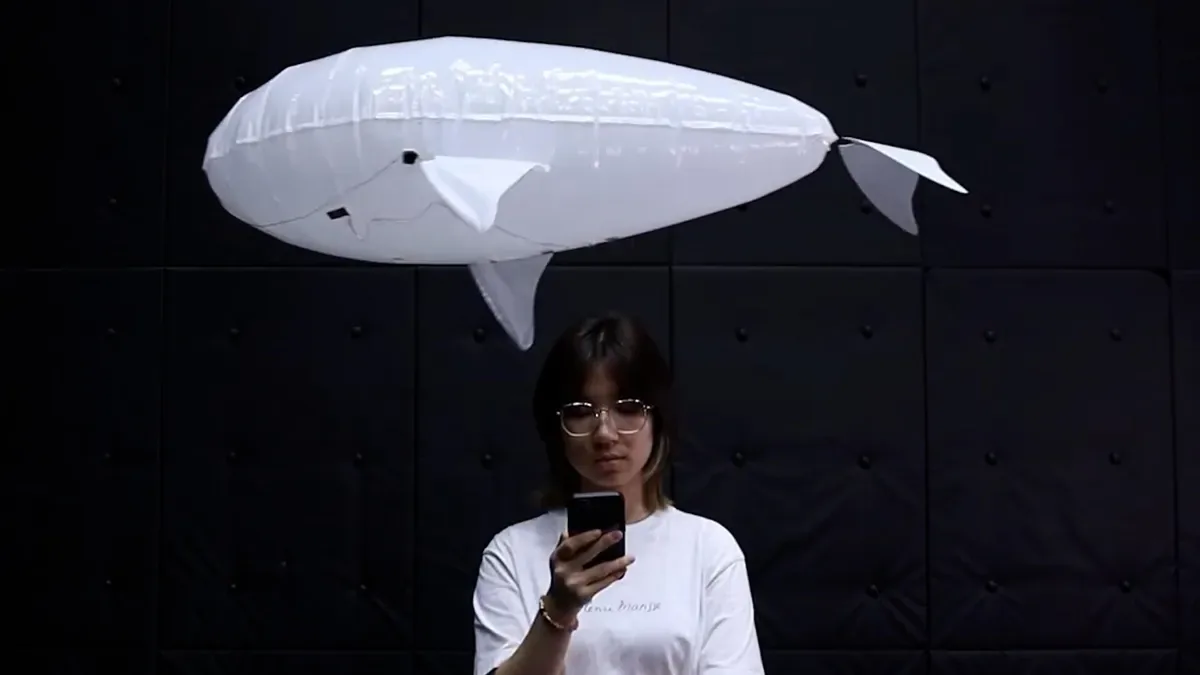
A team of researchers, including Mingyang Xu from Keio University and participants from the MIT Media Lab, has unveiled a novel lighter-than-air robotic companion. This innovative robot, inspired by whimsical animated characters, is designed to float through the air with a gentle motion, aiming to foster safe and friendly interactions with humans. The project seeks to overcome common challenges in robotics, such as the uncanny valley effect, by prioritizing a soft, pliable form and non-verbal communication through full-body movements rather than rigid mechanical actions.
The robot's design features a soft, lightweight body with fins, allowing it to glide through its environment without the disruptive noise typically associated with drones. This unique construction, devoid of hard edges or pinch points, significantly minimizes the risk of injury during close human contact. This emphasis on safety and approachability is a key differentiator from many existing robotic designs, which can sometimes evoke unease due to their mechanical or overly anthropomorphic appearances.
A New Approach to Human-Robot Connection
Robotics developers often face the difficult task of creating machines that are not only functional but also emotionally resonant and safe to be around. Traditional designs, with their hard materials and sharp angles, can inadvertently trigger the "uncanny valley" phenomenon—a sense of discomfort or creepiness that arises when a robot appears almost human but not quite. The floating robot concept aims to bypass this by replacing complex facial expressions with the subtle language of full-body movements. Its inherently soft and yielding nature allows for more natural and less intimidating physical interactions.
The team recently released a demonstration video showcasing the robot's capabilities. The footage illustrates the floating robot serving a variety of roles, acting as a dance partner, a study assistant, a gentle alarm clock, a reminder system, and even a source of simple entertainment. These applications highlight the potential for such a companion to integrate seamlessly into daily life, providing support and engagement without the inherent risks or unsettling aspects of more conventional robots. The researchers hope this new paradigm will pave the way for more intuitive and accepted forms of robot companions.
This development represents a significant step forward in human-robot interaction, moving beyond purely functional applications towards creating robots that can genuinely enhance well-being and offer companionship. The unique blend of advanced robotics and an approachable, soft design could redefine how humans perceive and interact with artificial entities. The focus on safety and emotional connection, rather than just task completion, suggests a future where robots are more integrated into the social fabric of our lives. The research highlights how soft robotics principles can be applied to create more universally accepted and beneficial robotic systems.