
New Enamel Protein Study Links Chinese Homo Erectus Specimens
Researchers analyzed enamel proteins from six Homo erectus fossils found across China. The findings reveal a distinct genetic marker, suggesting these ancient human relatives form a unique lineage.

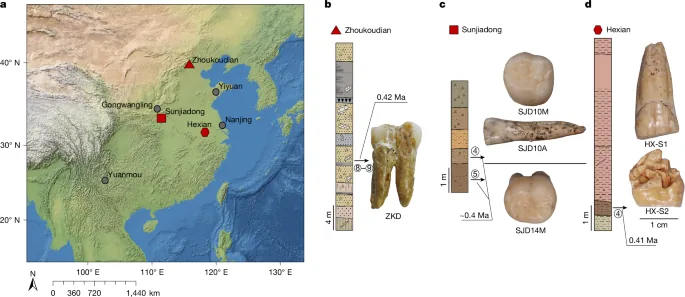
A groundbreaking analysis of enamel proteins from six Homo erectus specimens unearthed in China has revealed a unique genetic signature, shedding new light on the evolutionary relationships of ancient human relatives. The study, published in Nature, examined proteins extracted from fossil teeth discovered at multiple sites, including Zhoukoudian, Hexian, and Sunjiadong, dating back to the Middle Pleistocene epoch. This research provides compelling evidence that these Chinese H. erectus individuals represent a distinct lineage within the human family tree.
The international research team focused on specific amino acid substitutions, known as specific allergenic proteins (SAPs), within the enamel proteome. These substitutions act like unique molecular markers, allowing scientists to compare ancient hominins with modern humans, Neanderthals, Denisovans, and other primates. By analyzing the peptide counts and amino acid sequences, the scientists identified a novel SAP in the ameloblastin protein (AMBN), designated as A253>G, present in all six Chinese H. erectus samples. This specific variant was absent in all other primate species studied, strongly suggesting it is a marker unique to this group of Middle Pleistocene H. erectus.
"This mutation causes these six Middle Pleistocene H. erectus samples from Zhoukoudian, Hexian and Sunjiadong to cluster together in the phylogenetic tree," the study authors reported. The high confidence in this finding is supported by extensive data, with thousands of peptide counts confirming the presence of the A253>G variant in each sample. This clustering helps solidify the classification of the Hexian teeth as belonging to H. erectus, countering previous suggestions that they might be Denisovan based on morphological traits.
Ancient Protein Analysis Reveals Evolutionary Insights
Beyond the A253>G variant, the study also identified another SAP, AMBN(M273V), in all six Chinese H. erectus specimens. This variant is also found in Denisovans and has been traced in modern human populations, particularly in Southeast Asia, with frequencies reaching up to 21% in the Philippines. This finding links the Chinese H. erectus to broader hominin gene flow events. Genomic studies indicate that Denisovans received gene flow from an ancestral hominin lineage that diverged significantly from the ancestors of Neanderthals and modern humans over a million years ago. Approximately 15% of these ancient DNA regions are found in Asian and Oceanian populations today.
The presence of AMBN(M273V) in these H. erectus individuals suggests that this variant may have been introduced into Denisovans from a population linked to these Middle Pleistocene hominins. The research highlights the complex interbreeding and gene exchange that occurred among different hominin groups during this period. While AMBN(M273V) is homozygous in later Denisovans, its heterozygous state in earlier Denisovan samples suggests a lower frequency of this specific allele in their more ancient ancestors. This protein analysis provides a molecular timeline, distinguishing these Chinese specimens from earlier Denisovan finds and reinforcing their unique evolutionary path.
The methodology involved meticulous protein extraction from fossilized dentin using acid decalcification and enzymatic digestion. The extracted peptides were then analyzed using advanced mass spectrometry techniques, including MALDI-TOF and LC–MS/MS. Rigorous validation steps, including manual inspection of mass spectra and confirmation of fragmentation patterns, ensured the accuracy and reliability of the identified SAPs. These detailed laboratory procedures, conducted in specialized clean rooms, underscore the scientific rigor applied to this significant paleontological discovery.
This research provides crucial molecular evidence to complement existing fossil and genetic data, painting a more detailed picture of hominin diversity and migration patterns during the Middle Pleistocene. The identification of these specific enamel proteins and their unique variants offers a powerful new tool for tracing the evolutionary history and relationships of ancient human relatives across Asia and beyond.