
Francis Halzen Wins 2026 Nobel Physics Prize for Antarctic Neutrino Research
Professor Francis Halzen of the University of Wisconsin-Madison has been awarded the 2026 Nobel Prize in Physics for his pioneering work in detecting high-energy neutrinos, or 'ghost particles,' from the Antarctic ice.

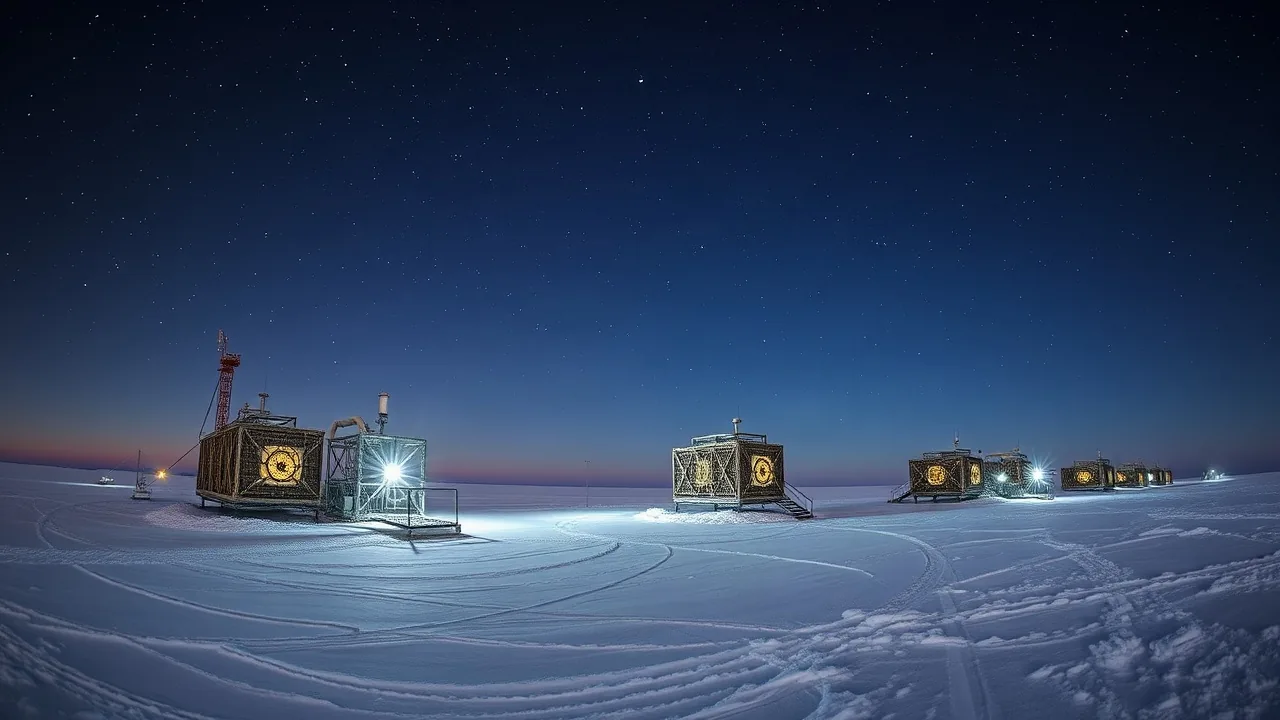
University of Wisconsin–Madison professor Francis Halzen has been awarded the 2026 Nobel Prize in Physics for his groundbreaking work in detecting high-energy neutrinos, often called 'ghost particles,' using the Antarctic ice sheet as a massive detector. The announcement was made on October 6, 2026, recognizing decades of research that opened a new window into the cosmos.
Halzen, a theoretical physicist, spearheaded the development of the IceCube Neutrino Observatory, a facility buried deep within the South Pole's ice. This unique observatory, consisting of thousands of optical sensors spread over a cubic kilometer of ice, is designed to detect the faint blue light emitted when neutrinos collide with ice molecules. These elusive particles, which interact very weakly with matter, travel vast cosmic distances unimpeded, carrying information from the universe's most energetic events.
The significance of Halzen's work lies in its ability to capture these "ghost particles." Neutrinos are notoriously difficult to detect, passing through ordinary matter, including our planet, without leaving a trace. IceCube, however, leverages the immense volume and purity of Antarctic ice to capture the rare interactions that do occur. "We've been looking for this for so long, and to finally see it come to fruition is extraordinary," Halzen stated following the announcement, reflecting on the immense effort involved.
A New Era in Astronomy
The IceCube observatory, a collaboration involving hundreds of scientists from institutions worldwide, has successfully detected neutrinos originating from sources like active galactic nuclei and supernova remnants. These detections provide invaluable data about extreme astrophysical phenomena that were previously inaccessible to conventional telescopes. This new method of observing the universe, known as multi-messenger astronomy, combines information from neutrinos, gravitational waves, and electromagnetic radiation to offer a more complete picture of cosmic events.
Halzen's theoretical work laid the foundation for the experimental design of IceCube, predicting the types of neutrinos that could be detected and the energies they would possess. His persistence through years of challenging conditions in Antarctica, including extreme cold and logistical hurdles, was crucial for the project's success. The observatory first began taking data in 2008 and has since made groundbreaking discoveries, including the first detection of an extraterrestrial high-energy neutrino source in 2013.
The Antarctic ice sheet provides an unparalleled natural laboratory for this research. Its depth and transparency are ideal for detecting the Cherenkov radiation produced by neutrino interactions. This vast, subterranean telescope has enabled scientists to probe the origins of cosmic rays and study the fundamental properties of neutrinos. The findings from IceCube have not only advanced astrophysics but also contributed to particle physics by providing insights into subatomic particles and their interactions.
The Nobel Prize in Physics is the latest in a series of accolades for Halzen, acknowledging his visionary leadership and the profound impact of his research on our understanding of the universe. The award celebrates a career dedicated to unraveling the mysteries of the cosmos through the most elusive particles known to science.