
Purdue Engineers Advance Quantum Computing Using Light and Silicon Nitride
Purdue University researchers have developed potential solutions to major hurdles in building large-scale quantum photonic integrated circuits using light.

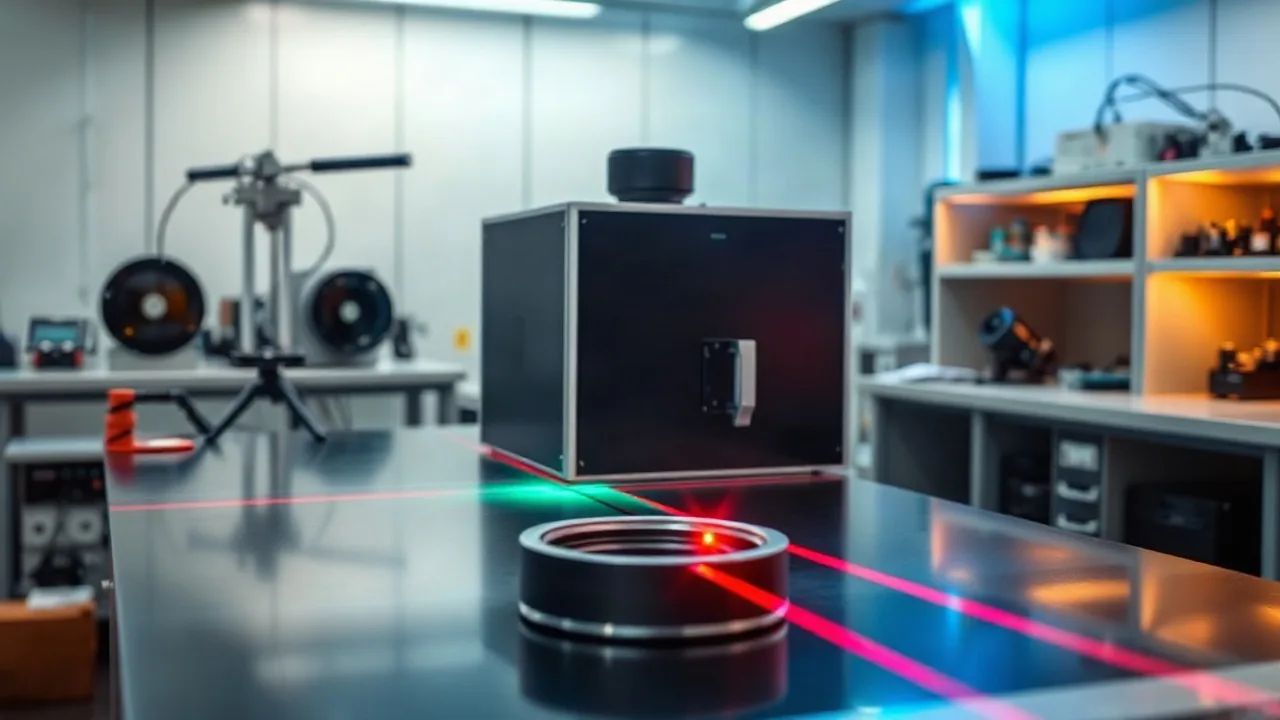
Engineers at Purdue University have advanced the development of quantum computing by addressing several major design hurdles involved in harnessing the speed of light. Quantum computers hold the potential to execute calculations faster than traditional supercomputers, and they could operate with greater energy efficiency by utilizing photons as their foundational units, known as qubits. However, significant fabrication challenges have persisted in creating the chips that allow photons to function reliably as qubits within a circuit.
A qubit functions as the quantum equivalent of a conventional computer's bit. While standard bits process information as either zero or one individually, a qubit can represent both states simultaneously via superposition. Photons offer distinct advantages over other quantum particles, enabling qubits to move through circuit gates at the speed of light to accelerate data transfer and minimize algorithm delays. Furthermore, because photons resist easy disturbance from ambient heat, they can maintain stability at room temperature, whereas other qubit types require energy-intensive supercooling.
Overcoming Photon Generation and Switching Hurdles
“Single photons are the building blocks of quantum photonics. The biggest challenges in scaling up a quantum photonic integrated circuit have to do with creating good single-photon sources,” said Vladimir Shalaev, the Bob and Anne Burnett Distinguished Professor in Electrical and Computer Engineering. Shalaev and Alexandra Boltasseva lead research efforts at Purdue's Elmore Family School of Electrical and Computer Engineering, the Birck Nanotechnology Center, and the Purdue Quantum Science and Engineering Institute.
To tackle the problem of generating consistent single photons, the researchers utilized silicon nitride, an industry-standard material for quantum photonic platforms. Traditional methods like spontaneous parametric down-conversion produce single photons inconsistently and with low efficiency. In contrast, the Purdue team's method emits exactly one photon at room temperature from multiple locations on a silicon nitride platform whenever a laser beam passes through. They achieved this by creating atomic defects within the platform, and later demonstrated they could control these defects by embedding them in nanosized pillars.
Another major obstacle involves getting single photons to interact with one another so they can be controlled via switches, much like transistors toggle bits in conventional systems. The research team reported building a switch operating at the single-photon level by adapting optical nonlinearity. In this setup, a control photon strikes silicon to generate an electron that triggers an avalanche of electrons, altering the material's refractive index and allowing a probe beam to pass through.
Additionally, the team addressed decoherence—a disturbance that causes qubits to fall out of superposition and creates computational errors. Led by Alexander Kildishev and graduate student Pranshu Maan, researchers utilized statistical-physics analysis and machine learning to recognize patterns in decoherence over time, establishing a framework to anticipate and reduce issues like spectral diffusion.