
AI Reshaping Urban Mobility Across America's Border Cities
Artificial intelligence is transforming transportation systems in major US cities, with autonomous vehicle technology and intelligent traffic management reshaping how millions commute daily.

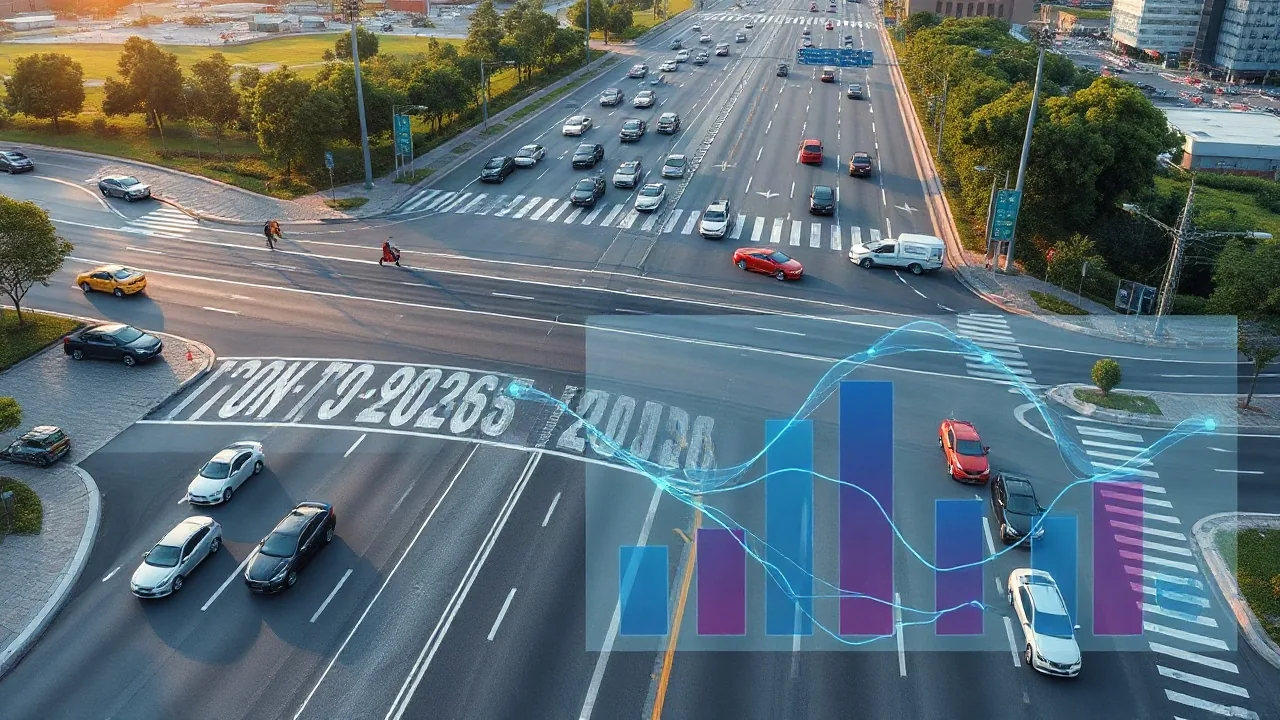
San Diego and Tijuana's cross-border region has become a testing ground for AI-driven transportation systems that are reshaping America's future mobility landscape. In October 2026, the San Ysidro Port of Entry, one of the world's busiest land borders, deployed an AI-powered traffic management system that reduced vehicle wait times by 23 percent in its first six weeks of operation. This success marks a broader shift toward intelligent transport solutions across major US metropolitan areas.
The system uses real-time data collection, predictive algorithms, and adaptive signal control to optimize vehicle flow. Dr. Maria Chen, director of transportation innovation at the Urban Mobility Institute, observed: "What we're seeing in border regions is a natural laboratory for AI. The complexity of managing high-volume, multi-directional traffic with strict safety requirements has accelerated adoption of autonomous traffic management systems."
Autonomous vehicles are now operating in controlled pilot programs across twelve major US corridors, including routes between Los Angeles and San Diego. These vehicles use AI to predict road conditions, adjust speed, and communicate with infrastructure in real time. Unlike earlier prototypes, 2026 models employ multi-sensor fusion combining LiDAR, radar, and camera feeds with edge computing to process data locally, reducing latency to under 50 milliseconds.
Smart Cities and Intelligent Transport Networks
The integration of smart cities technology with AI in automotive systems is reshaping urban planning decisions. Denver, Phoenix, and Houston have implemented city-wide traffic optimization platforms that adjust signal timing, recommend routes to drivers through mobile apps, and predict congestion patterns 15 to 30 minutes before bottlenecks form.
These platforms collect anonymized movement data from vehicles, pedestrians, and transit systems. They then apply machine learning models trained on five years of historical traffic data to forecast demand and allocate road capacity dynamically. The results speak for themselves: Phoenix reported a 19 percent reduction in average commute times and a 12 percent decrease in traffic-related emissions over the past eight months.
Transportation agencies now use AI to manage the entire ecosystem:
- Adaptive traffic signals that respond to real-time vehicle counts and predicted patterns
- Parking management systems that guide drivers to available spaces, cutting search time by 30 percent
- Public transit optimization that adjusts bus and rail schedules based on demand forecasts
- Emergency response coordination that prioritizes routes for ambulances and fire trucks
- Air quality monitoring tied to vehicle routing to reduce pollution in sensitive neighborhoods
Cities are also deploying AI-enabled pedestrian detection and protection systems. These identify people crossing streets or standing near traffic and alert autonomous vehicles or human drivers through in-vehicle alerts and street-level notifications.
Challenges and Infrastructure Requirements
Urban planning departments face significant hurdles in scaling these systems. The largest challenge is interoperability: vehicles from different manufacturers must communicate with city infrastructure and with each other using standardized protocols. The Society of Automotive Engineers and the US Department of Transportation finalized V2X (vehicle-to-everything) standards in March 2026, but adoption remains uneven.
Funding constraints also limit rollout speed. A comprehensive AI traffic management system for a city of one million requires $80 million to $150 million in infrastructure upgrades, including sensor networks, communication hardware, and computing facilities. Federal grants under the Infrastructure Investment and Jobs Act have partially covered costs, but many mid-sized cities remain underfunded.
Privacy and cybersecurity pose persistent risks. The same data streams that optimize traffic can reveal personal movement patterns. In September 2026, a security researcher identified a vulnerability in an older traffic management system that could allow unauthorized access to vehicle location data. Most cities have since upgraded to current versions, but older systems in smaller communities remain exposed. Encryption and data anonymization standards are still evolving.
Public acceptance varies by region. Surveys from the American Automobile Association in September 2026 showed 62 percent of American drivers support autonomous vehicles on highways, but only 48 percent trust them in dense urban environments. Trust increases with exposure: drivers in cities with active autonomous vehicle pilots report 71 percent confidence, compared to 42 percent in areas without visible deployments.
What's Next for American Mobility
The next phase focuses on rural and suburban integration. While major cities have invested heavily, rural areas account for 30 percent of highway fatalities but receive less than 15 percent of autonomous vehicle testing resources. The Department of Transportation announced in July 2026 a new $3.2 billion Rural Mobility Initiative to deploy AI systems in 150 smaller towns and counties.
By 2027, expect to see AI systems handling full traffic management cycles in 25 major US cities. Autonomous shuttle services are expanding in San Francisco, Austin, and Miami. Long-haul trucking is the next frontier: AI-driven fleet management and autonomous highway driving could reshape freight logistics within 18 months. However, regulatory frameworks for cross-state autonomous operations remain fragmented, requiring federal coordination that is still underway.
The convergence of autonomous vehicles, intelligent traffic systems, and urban planning powered by AI represents a fundamental shift in how Americans experience daily mobility. What began as isolated experiments at the US-Mexico border and in Silicon Valley tech hubs is now transforming transportation networks from coast to coast.