
Doomsday Glacier's Sea-Level Rise Threat Doubles by 2100, Study Warns
New research suggests the Thwaites Glacier, nicknamed the 'Doomsday Glacier,' could significantly increase its contribution to global sea-level rise by the end of the century. Scientists warn of potentially catastrophic impacts.

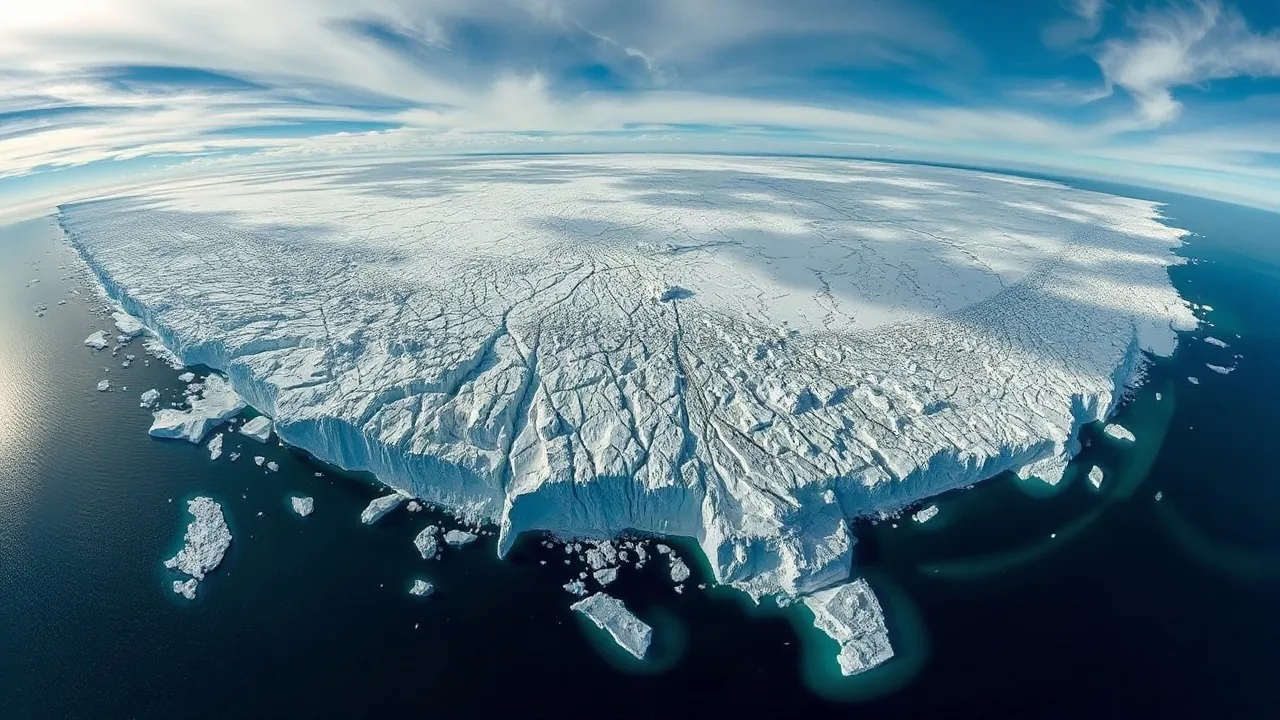
New scientific projections indicate that the massive Thwaites Glacier in Antarctica, often referred to as the "Doomsday Glacier," could contribute double the amount of sea-level rise by 2100 than previously estimated. A recent study, published in the journal Nature, utilized an advanced ice-sheet model to analyze the glacier's behavior under various warming scenarios, revealing a potentially more aggressive melting rate and subsequent impact on global coastlines.
Researchers from the British Antarctic Survey and other leading institutions employed an observation-constrained ice-sheet model to simulate the glacier's response to ongoing climate change. The model incorporated recent data on ocean temperatures and ice flow dynamics beneath the glacier's ice shelf. The findings suggest that warmer ocean waters are infiltrating cavities beneath the ice, accelerating melting from below and destabilizing the glacier's structure.
"We knew the glacier was melting, but the scale and speed of the potential sea-level contribution were underestimated," stated Dr. Anya Sharma, lead author of the study. "Our model shows that if current warming trends continue, the Thwaites Glacier could destabilize much faster than we've previously modeled, leading to significant global impacts." The glacier, which is roughly the size of Florida, already accounts for about 4% of annual global sea-level rise.
Accelerated Melting and Global Implications
The primary concern stems from the potential for a more rapid retreat of the glacier's grounding line – the point where the ice transitions from resting on bedrock to floating on the ocean. As this line recedes, more ice is exposed to warmer ocean currents, creating a feedback loop that hastens melting and ice discharge into the ocean. If the Thwaites Glacier were to collapse entirely, it could raise global sea levels by more than two feet (0.6 meters) over centuries, though this new research suggests its contribution to that rise could be amplified significantly by 2100.
The implications of such a sea-level rise are far-reaching, threatening coastal communities, infrastructure, and ecosystems worldwide. Low-lying areas, including major cities in the United States such as Miami, New Orleans, and New York, are particularly vulnerable. The increased frequency of coastal flooding, erosion, and saltwater intrusion into freshwater sources could displace millions of people and cause trillions of dollars in economic damage.
This research underscores the urgent need for global action to mitigate climate change. Limiting greenhouse gas emissions and transitioning to cleaner energy sources are critical to slowing the rate of ocean warming and preserving the stability of major ice sheets like the Thwaites Glacier. The findings provide crucial data for policymakers and climate scientists working to understand and prepare for the multifaceted challenges of a warming planet.