
Green Hydrogen Production Surges With Steel Industry Innovation
Major steel producers are deploying hydrogen-based reduction technologies in 2026, cutting emissions while advancing the clean energy transition. Industry leaders report 40% faster deployment than initially projected.

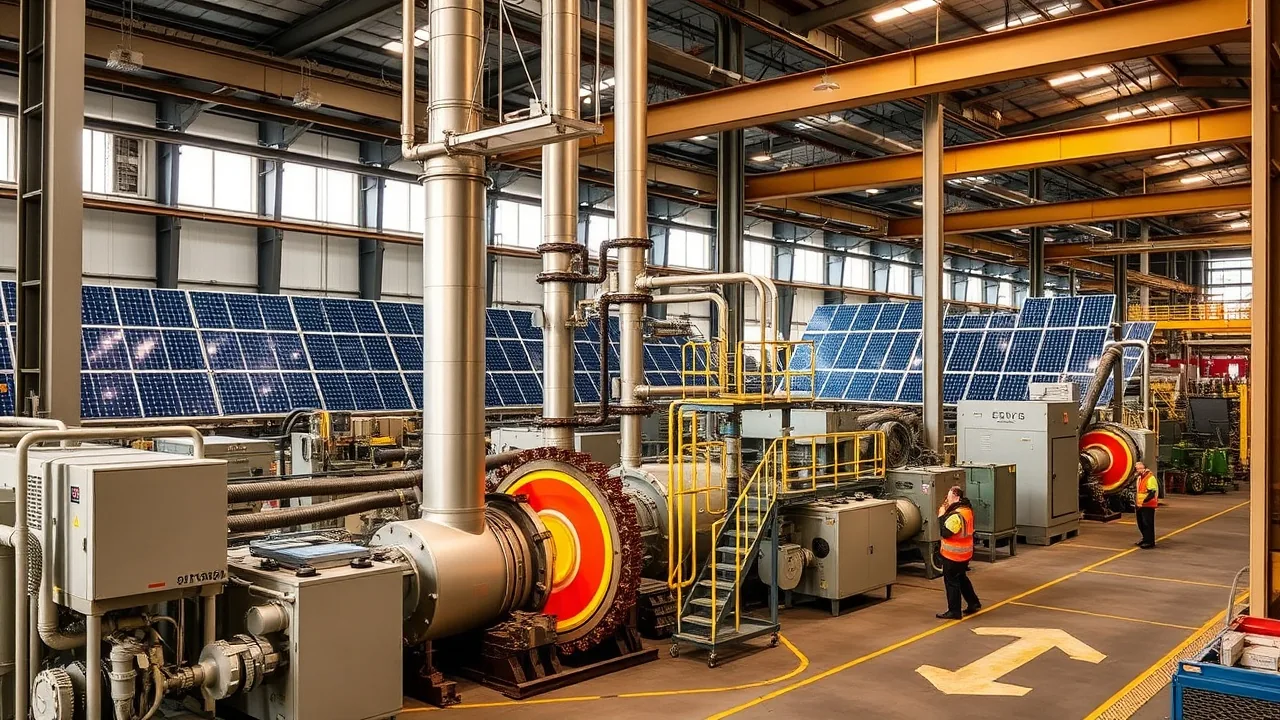
ArcelorMittal announced in June 2026 that its hydrogen direct reduction plant in Hamburg will reach full operational capacity by September, marking the first commercial-scale deployment of green hydrogen production in European steelmaking. The facility will consume 120 megawatts of renewable power annually, eliminating approximately 800,000 metric tons of CO2 emissions per year compared to traditional blast furnace methods.
This milestone represents a watershed moment for industrial decarbonization. Steel manufacturing accounts for roughly 8 percent of global CO2 emissions, and the sector has long been considered one of the hardest to decarbonize. Hydrogen-based reduction replaces carbon with hydrogen as the reducing agent, fundamentally shifting how iron ore transforms into usable steel.
"We are seeing the economics of hydrogen-based steelmaking reach parity with conventional methods by 2027 in favorable markets," said Dr. Sarah Chen, senior analyst at the Global Institute for Clean Energy Transition, in a July 2026 interview. "What seemed like a 15-year roadmap in 2023 is now compressing into three to five years."
Steel Innovation Driving Market Acceleration
Three major developments are converging to accelerate steel innovation around hydrogen. First, electrolyzer costs have fallen 35 percent since 2024, reducing the primary operational expense. Second, renewable electricity prices in regions like Denmark and Germany have stabilized below 40 euros per megawatt-hour, making hydrogen production economically viable. Third, automotive and construction companies are now contractually committing to hydrogen-reduced steel, creating guaranteed offtake agreements.
Thyssenkrupp, the German industrial conglomerate, began producing hydrogen-reduced steel billets at its pilot facility in Duisburg in April 2026. The company reported that material properties match or exceed conventional steel, eliminating a key technical uncertainty that had delayed wider adoption.
- Direct reduction furnaces using hydrogen gas require 30 percent less energy input than blast furnaces
- Production cycle times are 20 percent shorter, improving throughput per facility
- Water consumption drops by 85 percent compared to traditional steelmaking
- Existing mills can be retrofitted within 18 to 24 months, avoiding complete facility replacement
South Korea's POSCO announced in May 2026 that it will operate six hydrogen-based furnaces across its Pohang and Gwangyang mills by the end of 2027, positioning the company to capture growing Asian demand for clean energy-certified steel.
Supply Chain and ESG Momentum
The steel industry's pivot toward hydrogen is inseparable from broader ESG and regulatory pressure. The European Union's Carbon Border Adjustment Mechanism, which took effect in 2026, imposes tariffs on carbon-intensive imports. This framework has driven European steelmakers to decarbonize faster than competitors elsewhere. At the same time, major asset managers are divesting from coal-intensive steel producers, redirecting capital to hydrogen-focused facilities.
Supply chain alignment is underway. Automotive suppliers like Salzgitter AG and energy firms including Orsted are structuring joint ventures to build hydrogen electrolyzer capacity tied directly to steel mills. These integrated projects reduce transportation costs and create closed-loop efficiency gains.
India's Tata Steel announced a 200-million-dollar investment in July 2026 to develop hydrogen capacity across its Jamshedpur and Kalinganagar facilities. The company projects that 25 percent of its output will be hydrogen-reduced by 2030, positioning it to meet global sustainability standards and capture premium pricing.
Financial institutions are responding. The World Bank and multilateral development banks have allocated 3.2 billion dollars specifically for hydrogen infrastructure in developing economies in 2026. Private equity firms focused on climate tech have deployed 8.5 billion dollars into hydrogen-adjacent companies since January 2026, more than double the 2025 total.
Challenges and Next Frontier
Hydrogen production at scale still faces logistics constraints. Renewable energy capacity must expand significantly to supply hydrogen demand. Most current electrolyzer installations in steel regions are powered by a mix of renewables and grid electricity, not 100 percent clean sources. Scaling to true green hydrogen requires parallel investment in wind and solar farms.
Financing remains uneven across geographies. European steelmakers benefit from generous government subsidies and EU emissions trading revenue. Producers in North America and Asia face steeper financing hurdles, though tax incentives under the US Inflation Reduction Act are beginning to level the field.
Technology standardization is still emerging. Different electrolyzer designs, furnace configurations, and hydrogen handling protocols mean that best practices vary by location. Industry consortiums like the Hydrogen Steelmakers Alliance are now drafting shared technical standards expected to finalize in Q4 2026.
Despite these headwinds, market momentum is unmistakable. Investment in hydrogen steelmaking reached 12 billion dollars in 2026, up 180 percent from 2024. Industry analysts project that hydrogen-based methods will represent 8 to 12 percent of global steel output by 2030, compared to less than 0.5 percent today. This shift redefines not only steelmaking but the entire industrial approach to hard-to-decarbonize sectors.