
Brain-Controlled Hearing Device Isolates Voices in Crowds
Researchers have developed a "neural extension" system that uses real-time brain signals to help users focus on a single voice in noisy environments. This technology marks a significant step beyond traditional hearing aids.

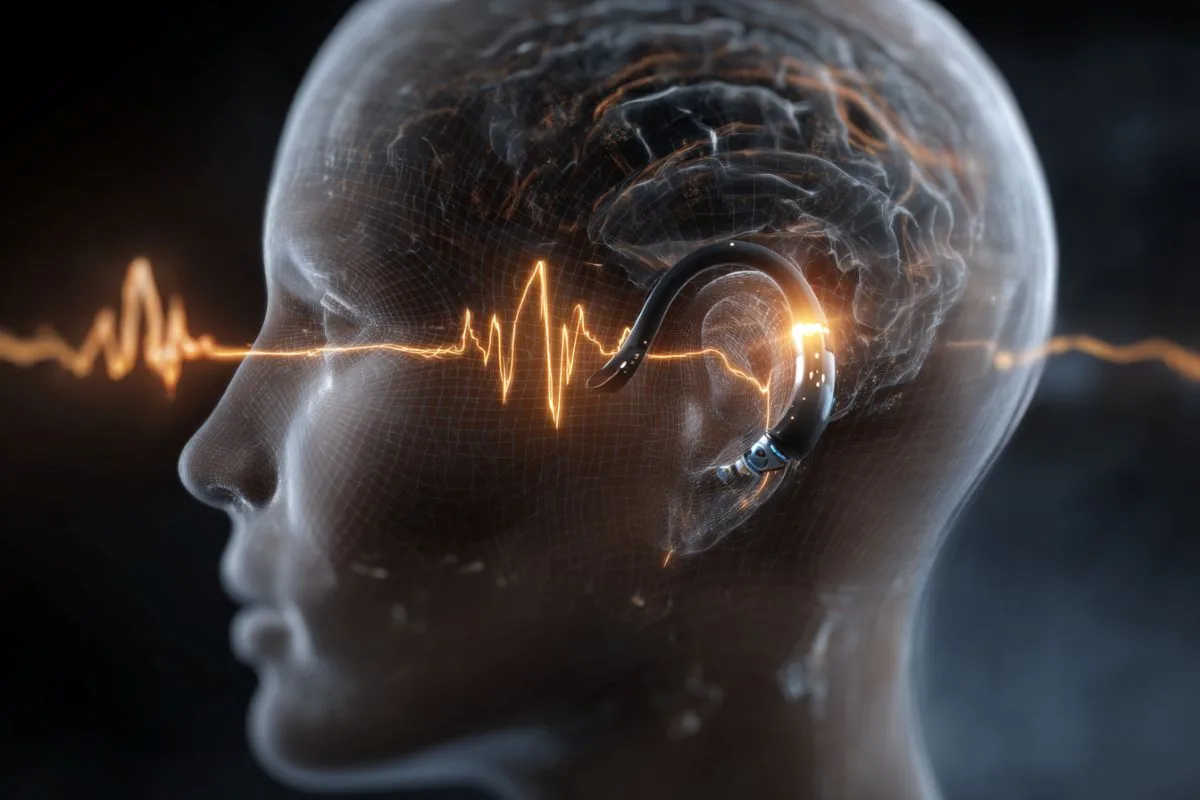
In a significant breakthrough for assistive listening technology, scientists have provided the first direct human evidence that a brain-controlled device can help users isolate a specific voice within a noisy, crowded environment. Developed by researchers at Columbia University’s Zuckerman Institute, the system acts as a "neural extension," utilizing a user's real-time brain signals to automatically amplify the voice they are focusing on, effectively overcoming the limitations of conventional hearing aids in challenging auditory settings.
The study, published in Nature Neuroscience, addresses the long-standing challenge known as the "cocktail party effect." This phenomenon describes the difficulty people, especially those with hearing impairments, face in distinguishing and following a single conversation when multiple sounds and voices are present. Traditional hearing aids often amplify all sounds indiscriminately, making it harder, not easier, to focus on a specific speaker in busy surroundings.
“We have developed a system that acts as a neural extension of the user, leveraging the brain’s natural ability to filter through all the sounds in a complex environment to dynamically isolate the specific conversation they wish to hear,” said senior author Nima Mesgarani, PhD, a principal investigator at Columbia’s Zuckerman Institute and an associate professor of electrical engineering. He added, “This science empowers us to think beyond traditional hearing aids, which simply amplify sound, toward a future where technology can restore the sophisticated, selective hearing of the human brain.”
Advancing Hearing Assistance Through Neural Signals
The innovative system was tested on epilepsy patients who had electrodes implanted in their brains as part of their medical treatment. These volunteers played a crucial role, allowing researchers to measure their brain activity as they listened to two overlapping conversations. Using advanced machine-learning algorithms, the system analyzed the brainwave patterns to detect which conversation the participant was actively attending to. Once identified, the system would then adjust the audio output in real-time, enhancing the target voice while reducing the volume of the other.
The results were compelling. The system accurately identified the user's focus and significantly improved speech intelligibility. Participants reported reduced listening effort and consistently preferred the audio output from the brain-controlled system over unassisted conversations. One volunteer expressed astonishment, initially accusing researchers of secretly manipulating the volumes, highlighting how seamlessly the technology mimicked natural hearing. This brain-controlled hearing technology represents a departure from incremental improvements, offering a tangible prototype that provides immediate benefits.
Vishal Choudhari, the paper's first author, who led the development and evaluation of the system, stated, “For the first time, we have shown that such a system that reads brain signals to selectively enhance conversations can provide a clear real-time benefit. This moves brain-controlled hearing from theory toward practical application.” The research team collaborated with medical professionals and patient volunteers from institutions including Hofstra Northwell School of Medicine, the Feinstein Institutes for Medical Research, New York University School of Medicine, and the University of California San Francisco’s Department of Neurological Surgery.
The system's ability to function dynamically was also a key finding. It proved effective whether participants were subtly guided toward a specific speaker or allowed to freely choose their conversational focus, mirroring the fluid nature of real-world social interactions. This adaptability is crucial for a practical assistive device, ensuring it can accommodate diverse and unpredictable listening scenarios.
Globally, over 430 million people live with disabling hearing loss, according to the World Health Organization. Many struggle most in social settings with background noise. Beyond the direct impact on communication, untreated hearing loss is recognized as a significant modifiable risk factor for dementia, as well as a contributor to depression and social isolation. This new hearing device research lays essential groundwork for future wearable technologies that could integrate brain sensing with sophisticated audio processing. Such advancements hold the promise of not only assisting individuals with hearing loss but potentially augmenting hearing capabilities and reducing listening fatigue for a wider population.
The implications of this assistive technology are profound. By directly tapping into the brain's natural filtering mechanisms, this technology offers a path toward restoring a level of auditory selectivity previously thought impossible outside of normal hearing. Future iterations could lead to more discreet and effective hearing aids that genuinely understand and respond to the user's intent, making noisy environments less daunting and social interactions more accessible for millions worldwide. The research signifies a major leap from understanding the neural basis of selective listening to creating a functional system that mimics and enhances it.