
DJI Osmo Pocket 4P: Lab Tests Reveal Staggering Dynamic Range
New lab tests for the DJI Osmo Pocket 4P gimbal camera show it achieving an unprecedented 17 stops of dynamic range, outperforming even high-end cinema cameras.

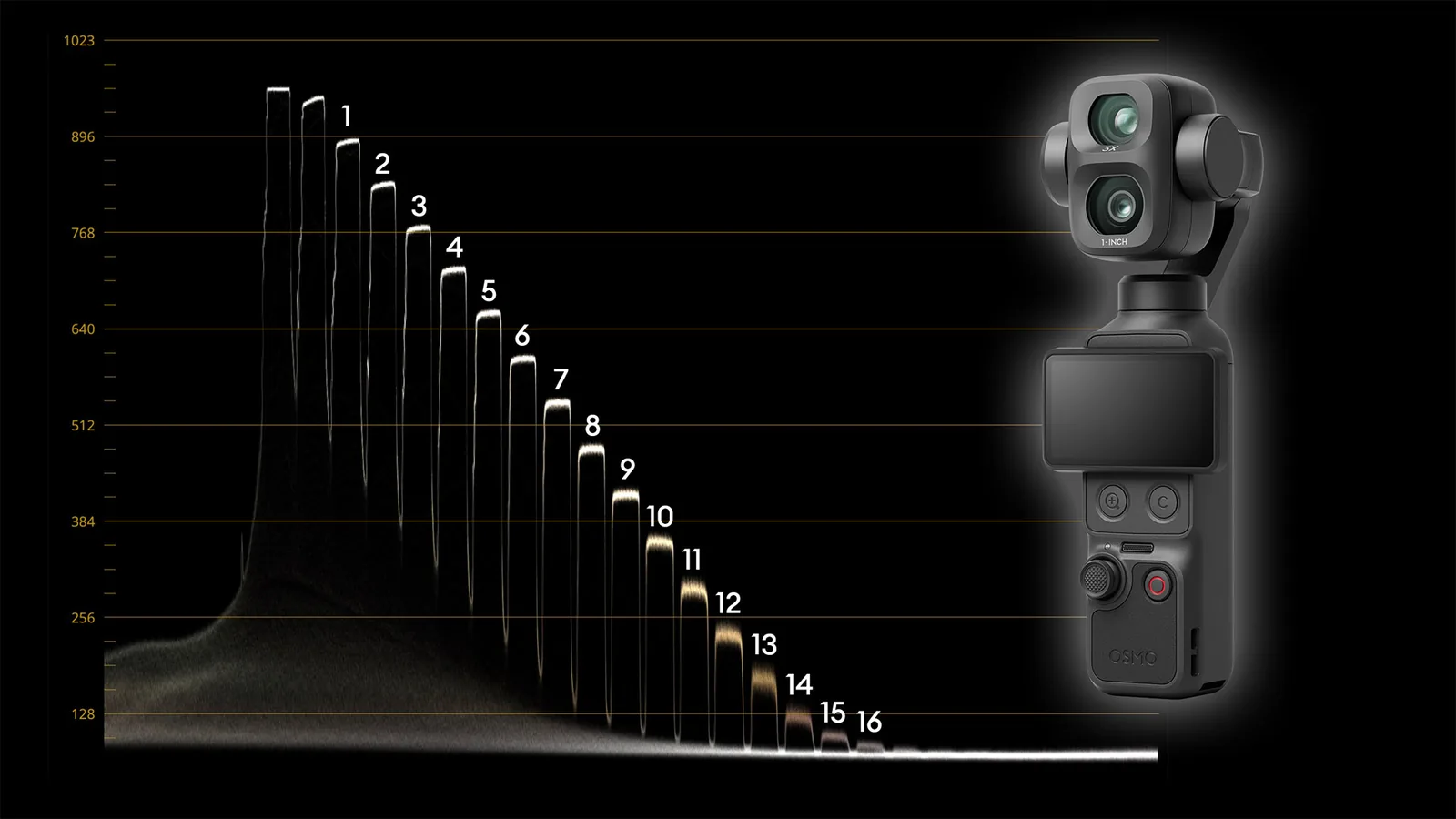
The recently released DJI Osmo Pocket 4P gimbal camera has entered the spotlight with claims of an extraordinary 17 stops of dynamic range from its wide lens. Independent laboratory tests conducted by CineD have now verified these impressive assertions, revealing performance that rivals and even surpasses professional cinema equipment.
Traditional lab tests for new cameras often yield dynamic range figures between 11.5 to 12.5 stops at a standard signal-to-noise ratio (SNR) of two, with exposure latitude typically falling between 7 to 9 stops. However, the Osmo Pocket 4P, utilizing a new sensor technology called LOFIC (lateral overflow integration capacitor) in its wide camera, has rewritten these expectations. This technology significantly enhances highlight retention, a feature previously seen in professional cinema cameras like the ARRI Alexa lineup.
Dual gain technology, which combines high and low ISO information within a single exposure, has been instrumental in narrowing the gap between professional and consumer cameras in recent years. This technology is now present in various consumer models, including the Canon C70, LUMIX S1II, GH6/7, and the Sony A7R IV. The Osmo Pocket 4P's LOFIC technology represents another leap forward, particularly for a compact gimbal camera.
Testing Challenges and Results
Conducting precise lab tests on the Osmo Pocket 4P presented unique challenges. The 20mm wide camera required extremely close proximity to the testing chart for dynamic range measurements, leading to potential reflections that could skew results. Testers had to implement modifications, including repositioning the camera and using DIY flags, to mitigate these issues. The close proximity also caused image distortion, necessitating careful analysis. Fortunately, the Osmo Pocket 4P's manual mode proved to be truly manual, without computational scene-dependent adaptations that could interfere with objective testing, unlike some smartphone cameras.
The tests yielded separate results for the camera's two lenses: a 1-inch sensor 20mm equivalent wide camera with an f/2.0 aperture, featuring the LOFIC technology and a 10-bit D-Log2 profile at a native ISO of 1600; and a 1.28-inch sensor 60mm equivalent mid-telephoto camera with an f/1.8 aperture, using a standard D-Log profile at a native ISO of 400.
For the 20mm wide camera, the lab tests confirmed an astonishing 16 stops of dynamic range above the noise floor, with a faint 17th stop present. Using IMATEST analysis, the camera achieved 16 stops at an SNR of 2 and an impressive 17.2 stops at SNR = 1. This performance exceeds that of the ARRI Alexa 35, a camera that costs exponentially more. The "noise spectrum" graph indicated a very detailed 4K image with minimal internal noise reduction, underscoring the sensor's capability.
In contrast, the 60mm mid-telephoto camera delivered a more typical but still strong result of 12 stops above the noise floor, with IMATEST showing 11.6 stops at SNR = 2 and 12.9 stops at SNR = 1. This is considered excellent performance for its sensor size.
Regarding rolling shutter, the wide camera clocked in at 11ms in D-Log2, and the mid-tele camera was slightly faster at 9.4ms, both in standard modes. Higher frame rates, such as 4K at 200fps, are achieved through sensor subsampling, requiring significantly lower rolling shutter times.
Exposure Latitude Prowess
The exposure latitude test evaluates a camera's ability to retain detail and color when images are over- or underexposed and then brought back to a base exposure. For the 20mm wide camera, even after pushing an image that was 4 stops overexposed back to base, there was still headroom in the red channel, indicating over 5 stops of highlight recovery. More remarkably, when underexposing by 4 stops and bringing it back, the image showed very little noise and required no noise reduction, achieving 9 plus stops of exposure latitude. This puts it on par with high-end cameras from 2026.
Pushing further, the Osmo Pocket 4P maintained usable results up to 10 stops of underexposure, though a brownish cast and significant vignetting became apparent in the shadows. At 11 stops of underexposure, the image showed pronounced vignetting and chroma noise, pushing the limits of its 10-bit recording, although artifacts like harsh lines were avoided. The test confirmed that while the 20mm wide camera excels in dynamic range, its extreme underexposure capabilities are challenged by shadow noise and internal processing limits.