
Flipper One: Linux PC Gadget for Hackers Unveiled
Flipper Devices announced Flipper One, a new Linux-powered gadget designed for hackers and tinkerers. It boasts advanced networking capabilities and can function as a portable Linux PC.

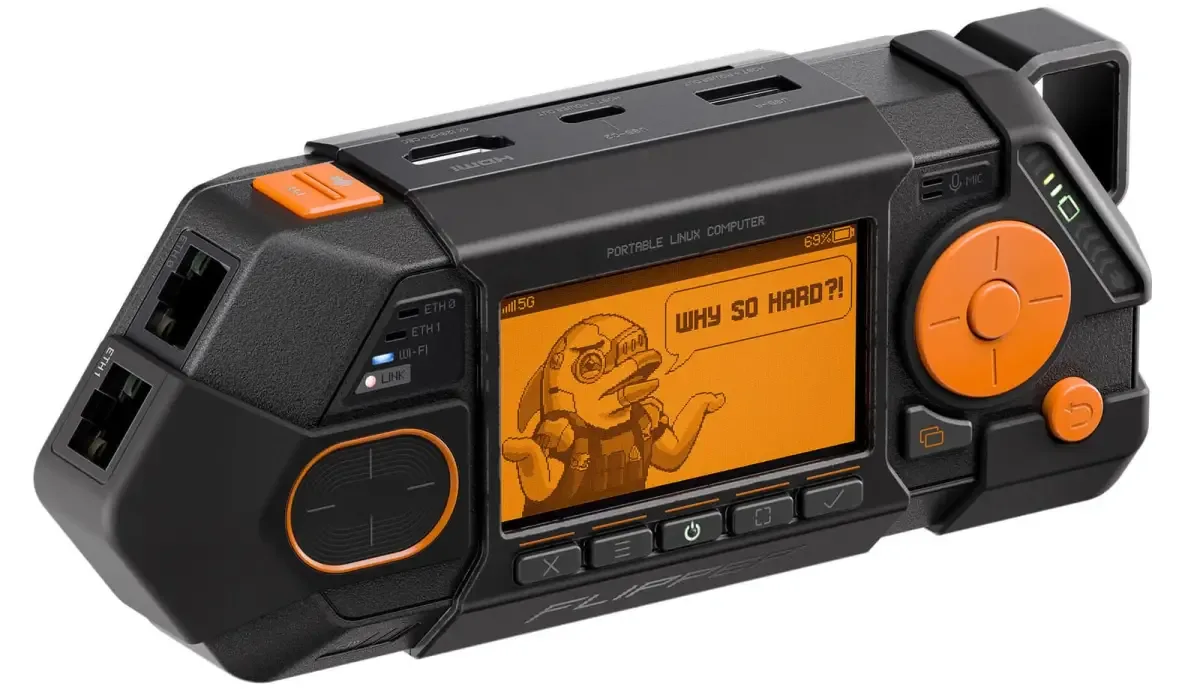
Flipper Devices, the company behind the popular Flipper Zero hacking tool, has unveiled a new gadget named Flipper One. This device is engineered with extensive networking capabilities and is designed to function as a portable Linux computer, according to an announcement made Thursday. The Flipper One is not a direct successor to the Flipper Zero but operates on a different technological plane, the company clarified. Flipper Zero has achieved significant success, selling over one million units and generating more than $150 million in revenue, becoming a favorite within the hacker community for its ability to interact with various radio frequencies like Bluetooth, RFID, and NFC, as well as infrared signals.
In contrast, the new Flipper One prioritizes robust network connectivity. It features dual Gigabit Ethernet ports, a USB Ethernet connection supporting 5 Gbps, and Wi-Fi 6E across the 2.4 GHz, 5 GHz, and 6 GHz bands. A notable addition is an M.2 port, which offers significant expandability. This port can accommodate a 5G modem for cellular connectivity or be used with adapters for devices such as Software Defined Radio (SDR) modules, AI accelerators, Solid State Drives (NVMe or SATA), and additional Wi-Fi cards.
Open Linux Integration and Custom OS
The Flipper One is still in its early development stages, with the company currently sharing its project roadmap. The device is powered by two distinct processors. The primary processing unit is an eight-core RK3576 chip, which runs an open-source Linux distribution alongside a Mali-G52 GPU and a dedicated Neural Processing Unit (NPU) for local AI model execution. Flipper Devices collaborated with the open-source software consulting firm Collabora to ensure robust support for this chip within the mainline Linux Kernel, making the core software accessible from Kernel.org for experimentation.
Complementing the main processor is a two-core Raspberry Pi RP2350 microcontroller. This secondary chip manages the device's display, buttons, touchpad, LEDs, and power systems, allowing basic operation even when the main Linux system is powered down. Flipper Devices CEO Pavel Zhovner indicated that the company is developing its own custom Linux-based operating system, tentatively called Flipper OS. He explained in a company blog post that while existing options like Raspberry Pi OS are functional, performing a clean factory reset after extensive package installations typically requires re-flashing the SD card. The envisioned Flipper OS aims to simplify this by enabling users to switch between preconfigured profiles with different software packages and settings, allowing for easy experimentation without the need to re-flash storage media.
The development effort also includes the creation of a FlipCTL interface. This proprietary system is designed to facilitate control of small LCD screens on devices like the Flipper One through a D-pad and touch inputs. With the integration of network connection drivers, the Flipper One is poised to serve multiple roles. Users could configure it as a network router, a VPN gateway, or a network bridge. Furthermore, by connecting a monitor, keyboard, and mouse via a USB hub, the device can transform into a full-fledged Linux desktop environment. Its HDMI 2.1 port supports 4K streaming at 120 Hz, making it suitable as a portable media center. The onboard NPU also opens possibilities for running local AI models to assist with device configuration, generate settings, and provide troubleshooting tips without requiring an internet connection.
Despite the ambitious announcement and roadmap, Flipper Devices acknowledges that significant software development is still required to realize all the planned features. For instance, the NPU for AI processing and hardware video decoding currently lack mainline kernel support. Both Flipper OS and FlipCTL are conceptual at this stage, and the team has yet to train the offline Large Language Models (LLMs) intended to help users with configurations. The company anticipates that by leveraging the capabilities of the RK3576 chip, Flipper One will become an indispensable tool for advanced users in the rapidly evolving field of network gadgets.