
Nvidia Unveils AI Superchip for Laptops, Aiming to Reshape PCs
Nvidia announced new "AI personal computers" powered by its RTX Spark superchip, combining CPU and GPU capabilities. These Windows laptops and desktops from brands like Dell and Microsoft are set to debut this fall.

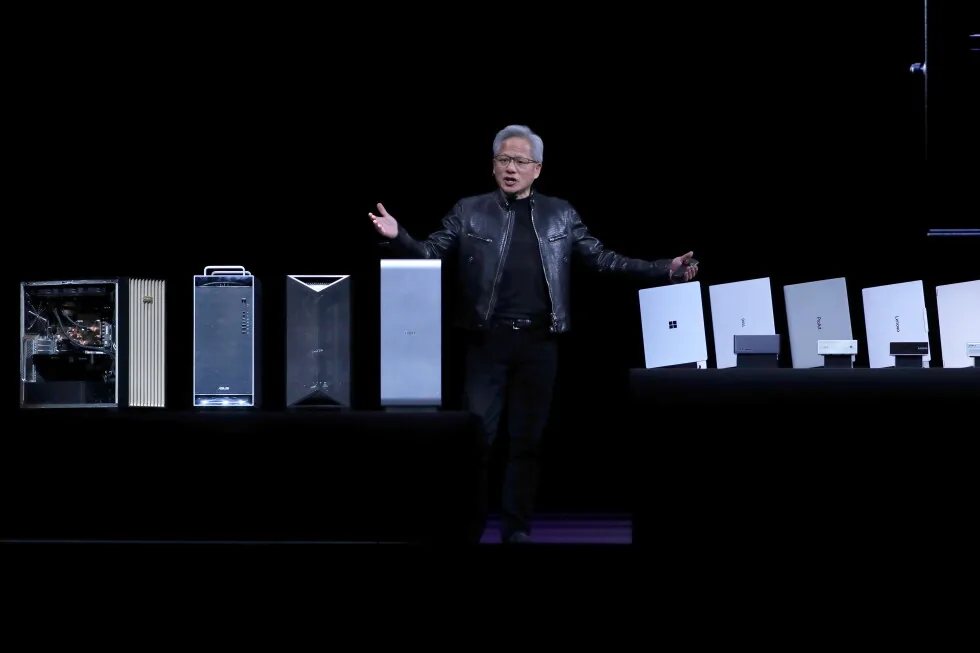
Nvidia CEO Jensen Huang announced Monday in Taipei that the company is bringing advanced artificial intelligence capabilities directly to personal computers with its new RTX Spark superchip. This new silicon, set to power Windows laptops and desktops from manufacturers including Microsoft and Dell, is slated for release in the fall of 2026. The move signals a significant expansion for Nvidia beyond its dominance in data center chips amidst a global surge in AI demand.
Huang, speaking at the annual Nvidia GTC event, declared that Microsoft and Nvidia are poised to "reinvent the PC." The RTX Spark superchip integrates both central processing unit (CPU) and graphics processing unit (GPU) functionalities, enabling what Nvidia is calling "AI personal computers." These new machines are designed to run sophisticated AI tasks locally, rather than relying solely on cloud processing.
The announcement comes as Nvidia solidifies its position as the world's most valuable company. Its expansion into the PC market directly challenges established chipmakers like Intel and AMD. Nvidia's shares saw a nearly 4% increase in early U.S. trading following the announcement, while Intel and AMD experienced declines of over 3%.
AI Agents and the Future of Computing
Nvidia's vision for the AI PC centers on enabling personal AI agents that can assist users in a more intuitive way. "When it has an autonomous (AI) agent, an agent that’s helping you, that understands you, you could talk to it. It could look at you. You could ask it to read files, go help you do some research. It could do a lot more," Huang explained. Microsoft corroborated this, stating that PCs equipped with the new Nvidia chips will support "highly capable AI models" and handle complex workloads efficiently.
This initiative is seen as a pivotal moment for personal computing. Analysts suggest that this move is the first major reinvention of the personal computer in four decades. The focus on enabling AI agents locally is expected to drive new applications and user experiences. "For consumers, it means more choices, which is always a good thing," commented Lian Jye Su, chief analyst at Omdia. Neil Shah, analyst and co-founder of Counterpoint Research, described the announcement as revolutionary, predicting that these new devices will "drive agentic AI applications in every home," ultimately aiming for an "AI supercomputer" in each household.
Beyond personal computers, Nvidia also provided updates on its data center offerings. Huang confirmed that its new Vera CPUs for data centers are in full production and are anticipated to be a major growth driver, with early adopters including Anthropic, OpenAI, and SpaceXAI. Furthermore, Nvidia unveiled a humanoid robot reference design, dubbed "Isaac GR00T." Standing nearly six feet tall and featuring a chassis from Chinese robot maker Unitree, the robot is equipped with advanced dexterous hands from Singapore-based startup Sharpa, capable of fine motor control. This development is particularly aimed at advancing research within the higher education sector.