
Rutgers Professor Eva Andrei Wins $1M Kavli Prize for Graphene Breakthrough
Rutgers University physicist Eva Andrei was awarded a $1 million Kavli Prize for her groundbreaking research on twisted graphene, a discovery that could revolutionize quantum computing and electronics.

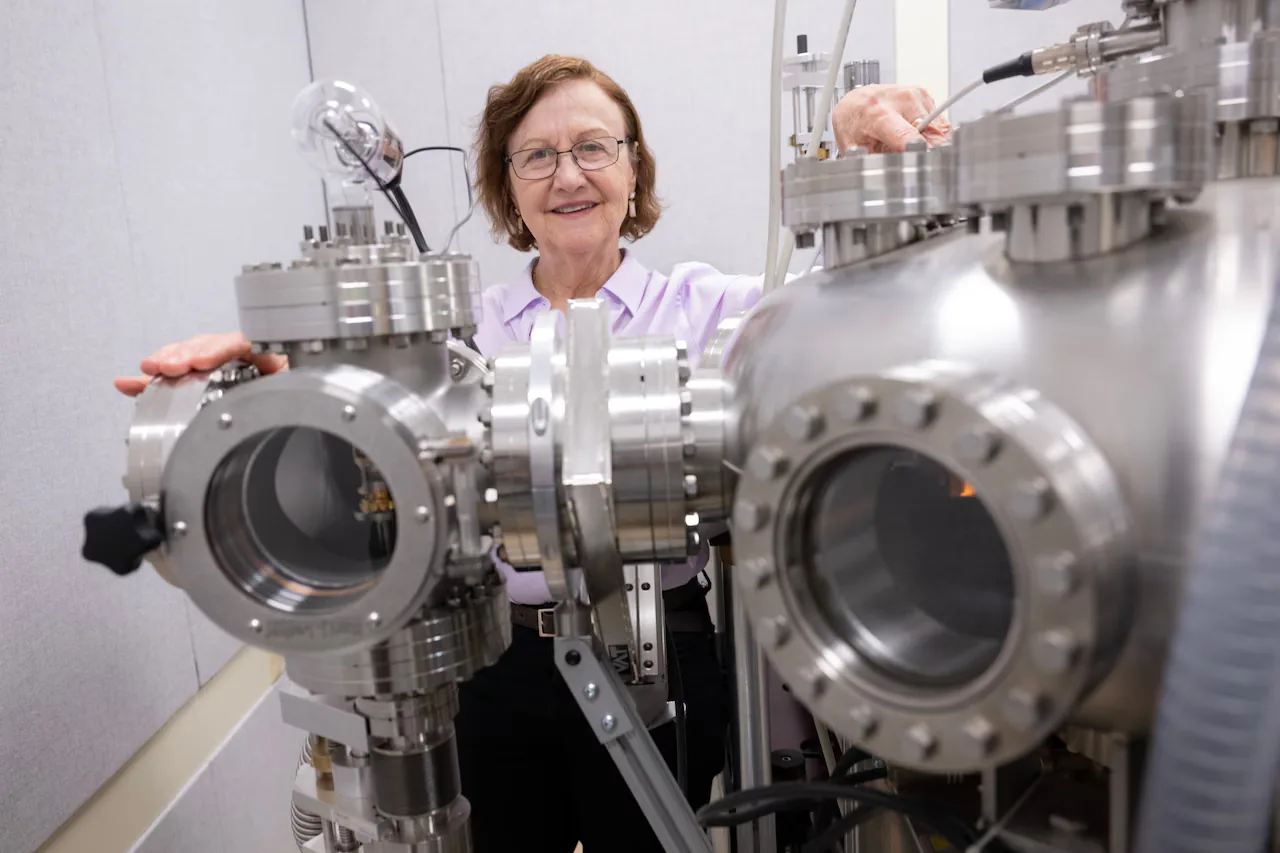
Rutgers University physicist Dr. Eva Andrei has been honored with a $1 million Kavli Prize, one of science's most prestigious awards, for her pioneering work in manipulating the electronic properties of graphene. Announced on Wednesday, the award marks a historic achievement as Andrei becomes the first professor in Rutgers' history to receive a Kavli Prize. She will share the prize with two other leading physicists: Dr. Pablo Jarillo-Herrero of the Massachusetts Institute of Technology and Dr. Allan H. MacDonald of the University of Texas at Austin.
The trio is recognized for their discovery of how precisely twisting ultrathin sheets of carbon, known as graphene, can fundamentally alter their electronic behavior. This manipulation opens new pathways for advanced computing and electronic devices. “This recognition reflects the work of every student and postdoc who has passed through our group,” Dr. Andrei stated, acknowledging the collaborative nature of scientific progress. She also highlighted her Rutgers colleague, Dr. Guohong Li, as a crucial “scientific partner since the earliest days of our discoveries.”
The Kavli Prize, awarded biennially, celebrates researchers whose discoveries have made significant impacts in fields such as astrophysics, nanoscience, and neuroscience. The 2026 laureates are scheduled to be honored at a ceremony in Oslo, Norway, in September, attended by members of the Norwegian royal family. Notably, 10 Kavli laureates have gone on to win Nobel Prizes, underscoring the significance of this award.
Dr. Andrei, a distinguished professor and Board of Governors professor in the Department of Physics and Astronomy at Rutgers, is among only 10 scientists globally named as a 2026 Kavli laureate and is the sole recipient from a New Jersey institution this year. Her journey into science began in her childhood in Romania, where early exposure to complex puzzles fostered a love for problem-solving that eventually led her to physics. “When I was 10, he told me, ‘You’re going to be a physicist,’ before I knew what that word meant,” she recalled, referencing her older brother.
Transforming Graphene's Potential
The breakthrough discovery partially stemmed from an accidental observation. Dr. Andrei’s team was studying graphene, typically grown on copper, when a sample grown on nickel by a student at MIT revealed numerous twisted bilayers at varying angles. Using a scanning tunneling microscope, her team observed in 2009 that at a specific angle – approximately 1.07 degrees, later dubbed the ‘magic angle’ by co-laureate MacDonald – the electrons within the graphene slowed significantly and began interacting in novel ways.
“We were tantalizingly close to seeing superconductivity, but our equipment ran just a little too warm,” Dr. Andrei explained. In 2018, Dr. Jarillo-Herrero's group at MIT managed to cool the system further, unlocking even greater potential within the material. Subsequent research revealed that the behavior of electrons in twisted graphene varied dramatically based on the angle of the twist and applied voltage. This tunability offers unprecedented control over material properties.
“Imagine a single material that you could reprogram with a battery,” Dr. Andrei mused. “Turn the voltage up a little and it becomes a superconductor. Turn it differently and it becomes an insulator or a magnet.” This ability to switch between different electronic states—such as becoming a superconductor, insulator, or magnet—within the same material could lead to a new generation of adaptive electronic components and significantly advance the field of quantum computing.
Dr. Andrei is the fourth woman to win a Kavli Prize in nanoscience, a field that has recognized approximately 30 laureates since the award’s inception. While the potential applications in quantum technology are vast, Dr. Andrei emphasized that the research is still in its foundational stages. “But we’re still in the discovery phase,” she said. “Right now, the most important thing we’re doing is understanding why these materials behave the way they do. The technology will follow from that understanding.” This fundamental research into the exotic electronic states of matter, like those observed in twisted graphene, is crucial for future technological advancements in areas ranging from energy to computation and advanced materials.