
Benin Coral Reef Rediscovered: Once Lost, Now Thriving Marine Ecosystem
A coral reef off the coast of Benin, believed to be dead for over 50 years, has been rediscovered by scientists. Modern sonar and camera technology revealed a vibrant ecosystem teeming with diverse marine life.

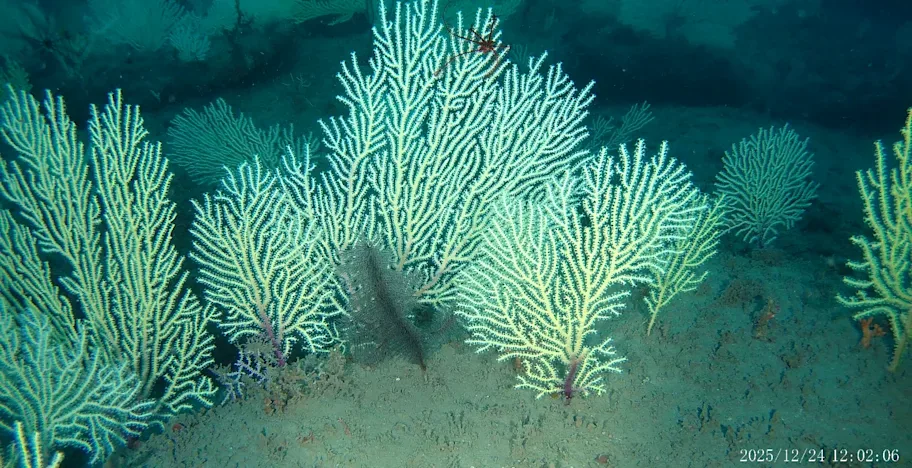
A deep-water coral reef off the coast of Benin, previously thought to be extinct for over half a century, has been rediscovered and is thriving, according to a new study. Initial surveys in the 1960s had indicated the presence of a reef structure but concluded it was lifeless. However, recent expeditions utilizing advanced sonar and a specialized Deep Sea Camera System have confirmed that the ecosystem not only survived but is flourishing.
"It was a mix of excitement and disbelief, because after all this time thinking about this reef, suddenly there was something real in front of us," said Gérard Zinzindohoué of the Institut de Recherches Halieutiques et Océanologiques du Bénin, lead author of the study published in Frontiers in Marine Science. The challenging field campaign involved long days at sea and overcoming technical issues, but promising sonar signals offered hope.
The original 1960s surveys had suggested a reef existed more than 50 meters (164 feet) below the surface. Scientists now believe this may be a mesophotic coral ecosystem, a type of deep-water reef that differs significantly from its shallow-water counterparts. "A mesophotic coral ecosystem lives deeper than the usual shallow coral reefs, in zones where light is much more limited," Zinzindohoué explained. "Instead, it can appear as patchy or scattered coral communities spread across the seafloor." This characteristic may have contributed to its prior misclassification as dead.
New Survey Reveals Biodiversity
Using the historical data as a guide, the research team meticulously mapped 11.5 kilometers (7.1 miles) of the seabed. This revealed two distinct signals consistent with reef structures. Subsequent investigation using an underwater drone equipped with the Deep Sea Camera System provided unprecedented visual confirmation of the seafloor.
The findings presented a picture of a healthy and active reef. Researchers identified eight distinct coral types and eight fish species utilizing the structure for food and shelter. Notable species observed include golden African snappers, blackbar soldierfish, Guinean angelfish, West African goatfish, the Monrovia doctorfish, three-banded butterflyfish, and two types of damselfish. While species identifications are provisional due to the lack of direct coral sampling, the visual evidence strongly suggests a vibrant marine environment.
The exact history of the reef remains a subject for further investigation. It is unclear whether the corals were genuinely dead in the 1960s and have since recovered, or if the initial surveys simply failed to accurately assess the site. Answering these questions will require more extensive research, both at this location and in surrounding areas.
Zinzindohoué emphasized the preliminary nature of the current findings. "This is still an initial exploration," he stated. "Historical reports suggest that this could be a continuous coral reef barrier extending roughly 40 kilometers (25 miles) parallel to the coast. We only surveyed a small section of this area, and we had a limited number of visual transects." He expressed a desire for a comprehensive scientific diving and sampling program, noting the limited knowledge of such ecosystems in the region. "These are ecosystems that are still poorly known in this part of the world, and every additional piece of information matters," he added.
The rediscovery offers a unique opportunity to study the history of marine environments off the coast of Benin and understand how they have evolved over time. "For me, the most exciting part is understanding the reef’s history and what it can tell us about how the ocean in this region has changed over time," Zinzindohoué concluded. "It feels like we have only just started to read an archive that has been there for a very long time." Further research could shed light on coral resilience and adaptation in deep-sea environments, potentially offering insights into conservation strategies for vulnerable marine habitats globally.