
Sea Worm Jaws Inspire New 'Bio-Metal' Materials Class
Ancient sea worms' jaws, composed of proteins and metal ions, exhibit properties akin to metals, prompting scientists to propose a new 'bio-metal' material classification.

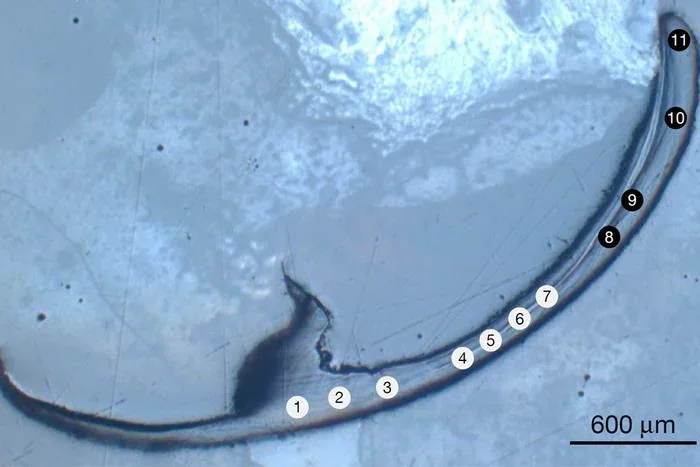
Researchers have identified a distinct category of natural materials, dubbed 'bio-metals,' by studying the remarkable jaws of the ancient sea worm Perinereis cultrifera. These biological structures, a unique combination of proteins and metal ions, exhibit hardness and deformation characteristics typically associated with conventional metals like copper and silver, blurring the lines between biology and materials science. The findings, detailed in Biophysics Reviews by scientists from TU Wien and the University of Vienna, suggest that these natural composites warrant their own classification beyond broader terms like 'metallike biomaterials.'
The proposed 'bio-metal' classification hinges on three key features: exceptional hardness, specific strain behavior under stress, and an underlying ion-protein structure. The bristle worm, Perinereis cultrifera, which uses its hardened jaws for biting and crushing prey, serves as a prime example. Scientists analyzed a single jaw, examining its central and tip regions using nanoindentation, a technique that involves pressing a tiny probe into the material at various depths to measure its resistance to deformation. Chemical analysis and imaging revealed a higher concentration of metal ions near the jaw tips, contributing to their increased hardness compared to the central parts.
Interestingly, the jaw material did not exhibit uniform hardness across all scales. Shallower indentations encountered greater resistance than deeper ones, a phenomenon known as the nanoindentation size effect. This effect, typically observed in crystalline metals like copper and silver and linked to dislocations within their atomic lattices, was present in the worm's jaw despite its lack of a conventional metallic crystal lattice. Instead, its structure relies on metal ions coordinated with proteins.
Strain Behavior Mirrors Metallic Properties
The discovery of the Nix-Gao nanoindentation size effect in the worm's protein-based jaw strengthens evidence that strain-gradient plasticity—how deformation varies across space—also operates within this biological material. At microscopic indentation depths, sharp changes in strain over short distances can enhance resistance to deformation, making the material appear harder. This finding is significant because the Nix-Gao effect is traditionally considered a hallmark of crystalline metals, demonstrating that similar mechanical behaviors can arise from vastly different microscopic structures. The research team also observed size-dependent elasticity in the bristle worm jaws, a characteristic that further distinguishes bio-metals from standard crystalline metals. While copper and silver show hardness size effects, they do not exhibit the same elastic response patterns observed in the worm's jaw, where the deformation and recovery behavior shifts with the size of the tested region.
To explain these complex mechanical properties, the researchers employed mathematical modeling based on manifold micromechanics. This framework links microscopic forces, such as Peach-Koehler forces associated with dislocation-like folds within the ion-coordinated protein matrix, to the material's overall mechanical response. The model suggests that these folds create strain gradients substantial enough to influence the material's behavior at the experimental scale, providing a theoretical basis for the observed size-dependent elasticity. This work successfully integrates all three criteria for the proposed bio-metal definition: hardness, size-dependent mechanical behavior, and an ion-protein structure.
This research provides a more robust framework for understanding natural materials that leverage ions to strengthen protein structures, potentially guiding further studies into how hardness and elasticity emerge in the absence of traditional metallic lattices. The team plans to expand their research by examining additional species of bristle worms to determine if these properties are widespread and to refine their theoretical models of deformation and ion-protein organization. Future work may even explore how genetic modifications could influence these material properties, offering insights into how living organisms engineer hard tissues at the microscopic level.