
Quebec's 15-Mile Meteor Crater Confirmed After Arduous Expedition
Scientists have confirmed a 15-mile-wide pit in Quebec, initially spotted on Google Maps, as a 390-million-year-old meteor impact crater. The discovery followed a challenging field expedition.

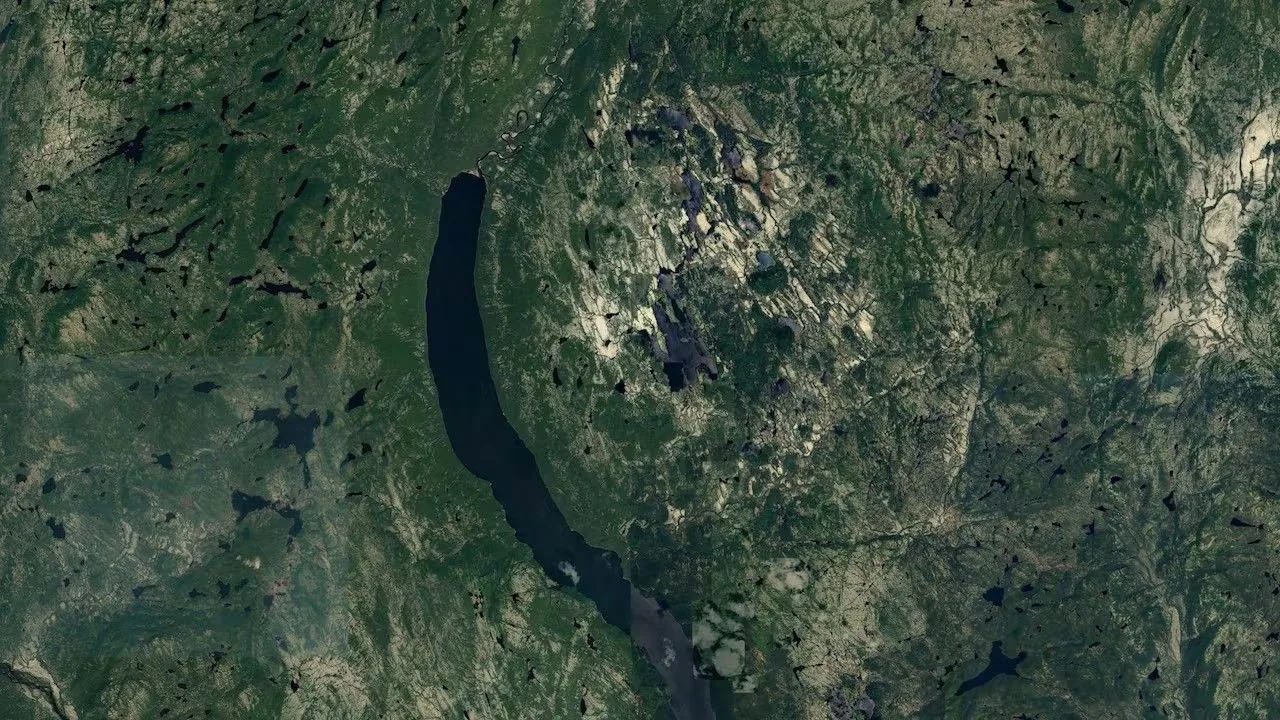
Scientists have confirmed that a massive, 15-mile-wide pit in Quebec's Côte-Nord region, first noticed on Google Maps, is actually an ancient meteor impact crater dating back 390 million years. The discovery was the culmination of an arduous expedition led by geologists who sought definitive proof of the site's extraterrestrial origins.
The feature, centered around Lake Marsal, was initially flagged in 2024 by amateur astronomer Joël Lapointe, who observed its near-perfect circular shape and significant diameter. Lapointe contacted geophysicist Pierre Rochette, who noted that the surrounding topography strongly suggested an impact event. Initial geological samples contained zircon, a mineral often associated with meteor impacts, but further validation was required.
A team of scientists, including Professor Gordon Osinski of Western University, a specialist in planetary geology, visited the remote site in October 2025. Their objective was to find evidence of shock metamorphism, an effect of the extreme pressures generated by impacts. "One of the key things we look for is evidence for shock metamorphism, which can only occur due to the immense pressures created by asteroid or cometary impacts — or nuclear explosions," Osinski explained. "Most of these features are microscopic, so you can only confirm in the lab with samples."
However, one telltale sign visible to the naked eye, known as shatter cones, was present. These grooved rock formations are created by the passage of shockwaves through the ground. Osinski described the expedition as one of the most challenging he has undertaken, citing the rugged terrain and abundant insect life. "This was one of the most arduous expeditions I’ve ever done — and I’ve done 25 expeditions to the Arctic and 6 continents," he stated.
Geological Evidence and Naming
Despite the difficulties, the team successfully identified shatter cones and discovered large cliffs of impact melt rock. This melt rock is formed from the intense heat and pressure generated when a large celestial body strikes Earth's crust, capable of melting vast quantities of rock. "You can melt literally tens of cubic kilometres of the Earth's crust when you get a big enough asteroid hitting," Osinski told CBC.
Analysis of collected rock samples allowed the researchers to date the crater to approximately 390 million years ago. Osinski, who operates the Impact Earth website to verify impact sites, noted that public discoveries of potential craters are common but rarely confirmed. "I get lots of messages from the public thinking they have found a crater and 99/100 turn out not to be the case," he told Live Science. "This is one of those rare examples that shows this is possible."
Globally, about 200 impact craters are known, with 31 located in Canada. The discovery of this large crater is significant, as typically only one or two smaller craters are found each year. The last confirmed meteor crater in Canada was identified in 2010. Following confirmation, the crater has been officially named Uhaachatik Crater after consultations with the Ekuanitshit Innu council, representing the indigenous community of the region.
The findings will be presented next month at the Annual Meeting of the Meteorological Society in Germany. Lapointe expressed his satisfaction with the confirmation, noting, "It's not every day that an ordinary citizen finds a 390-million-year-old crater." He encouraged others to trust their observations, even outside their professional expertise. The research team plans to continue studying the samples to gain further insights into the impact event and its effects on Earth's geology, biology, and climate.