
Quantum Gates Built by Braiding Anyons on New Hardware
Scientists have demonstrated a new method for creating universal quantum gates by manipulating 'anyons' on a specialized quantum computing platform. This breakthrough could accelerate the development of fault-tolerant quantum computers.

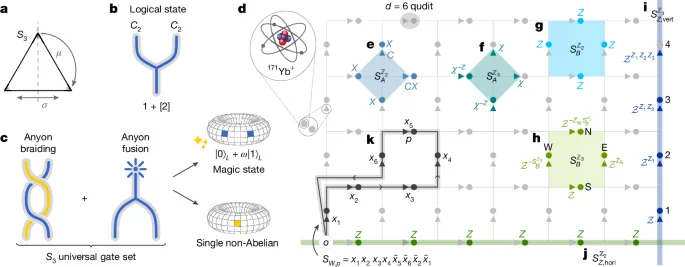
Researchers have successfully engineered universal quantum gates by utilizing the unique properties of anyons, exotic particles that behave according to different quantum rules. This significant achievement was realized on a novel quantum hardware platform, paving the way for more robust and scalable quantum computation. The experiment involved braiding and fusing these anyons, a process analogous to weaving threads, to perform complex logical operations essential for quantum computing.
The work, detailed in a recent publication, showcases a method for creating logical qubits that are inherently protected against errors. Unlike conventional qubits, which are fragile and prone to decoherence, the topological nature of these anyons offers a form of built-in error correction. This is crucial for building fault-tolerant quantum computers capable of tackling problems currently intractable for even the most powerful supercomputers.
Universal quantum gates are the fundamental building blocks of any quantum algorithm. The ability to reliably construct these gates using topological quantum computation principles has been a long-standing goal in the field. The experimental setup involved preparing specific quantum states, such as the $\mathbb{Z}_3$ toric-code ground state, and then performing intricate operations using mid-circuit measurements and adaptive circuits.
Advancing Topological Quantum Computing
The core of the breakthrough lies in the controlled manipulation of anyons, which are quasiparticles exhibiting fractional statistics. In this experiment, scientists utilized a system where these anyons could be braided around each other and subsequently fused. The outcomes of these braiding and fusion operations directly translated into the execution of specific quantum gates. This technique is central to topological quantum computing, a paradigm that promises inherent resilience against environmental noise and manufacturing imperfections.
The researchers verified the successful implementation of these gates by measuring various expectation values of local and non-local quantum projectors. For instance, they measured values for $\mathbb{Z}_2$ and $\mathbb{Z}_3$ projectors, noting that specific configurations, such as the nonlocal W-flux correlators $\Pi_{Wp1Wp2}^{\mathbb{Z}_3}$, remained close to unity. These measurements confirm that the prepared quantum states closely approximate the ideal, noiseless theoretical predictions, indicating high-fidelity operations.
One key aspect of the experimental verification involved using control qutrits that were moved around target qutrits. The worldlines of these qutrits and the plaquettes where their endpoints interacted provided visual representations of the quantum processes. The measured expectation values for these local and nonlocal projectors, with average standard errors often below 0.03, demonstrated the precision of the implemented quantum logic. This precision is vital for complex quantum computations where even small errors can cascade and invalidate results.
The development of this hardware and technique addresses a significant bottleneck in quantum computing: achieving fault tolerance. Current quantum computers struggle with errors that accumulate rapidly, limiting the depth and complexity of calculations they can perform. By leveraging the topological properties of anyons, this new approach offers a potential pathway to overcoming these limitations. The ability to perform operations through the braiding of anyons means that the information is encoded in the global properties of the system, making it less susceptible to local disturbances.
Furthermore, the experiments confirmed strong intra-pair and inter-pair Z correlations through measurements of W-flux correlators. These correlations are essential for maintaining the integrity of quantum information across multiple qubits and for implementing more advanced quantum algorithms. The team also successfully prepared 'magic states' using projection via measurement, a technique that further enhances the capabilities of the quantum hardware for universal quantum computation.
This work represents a significant step towards building practical, large-scale quantum computers. The successful demonstration of universal quantum gates using anyon braiding on this new hardware provides a concrete pathway for developing fault-tolerant quantum systems. The future implications include accelerating drug discovery, materials science, financial modeling, and artificial intelligence, areas where the computational power of quantum computers is expected to yield transformative results.