
NASA Curiosity Rover Finds Puzzling Honeycomb Pattern on Mars
NASA's Curiosity rover has discovered a mysterious honeycomb-like geological formation in Mars' Gale Crater. Scientists are analyzing the patterns and accompanying dark rocks to understand their origin and what they reveal about the planet's past.

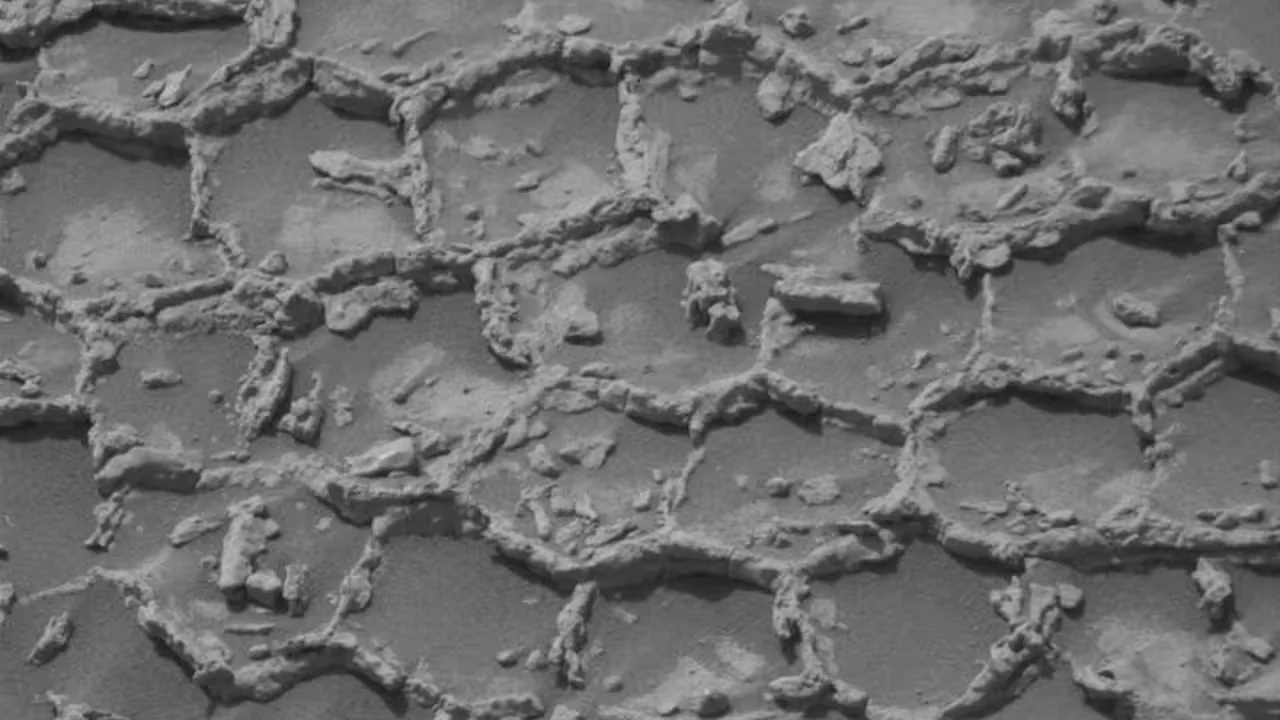
NASA's veteran Curiosity rover has captured striking images of a peculiar honeycomb-like texture on the surface of Mars, adding another geological enigma to the Red Planet's catalog of wonders. The discovery, made within Gale Crater, has left mission scientists intrigued about the formation's origins.
The rover team was surprised to observe the Martian terrain adorned with polygonal structures that closely resembled a giant, natural honeycomb. As the rover ventured further into the area, the polygonal ridges appeared more eroded. Scattered across this unit are rocks ranging in size from pebbles to cobbles, notable for their dark coloration.
Investigating the Martian Geology
Scientists are exploring several hypotheses for the formation of these unique patterns. One possibility is that these are fragments of Martian rock that detached from higher geological strata and subsequently rolled downhill. Another theory suggests they could be ejecta from distant impact events that occurred outside Gale Crater. A third consideration is that these could be meteorites that originated from beyond Mars altogether. The presence of the dark-toned rocks has introduced an additional layer of mystery, as researchers plan to conduct compositional analysis, comparing them to meteorites previously found on Mars which often contain minerals like nickel, a substance relatively rare in native Martian rocks.
Similar geometric patterns on Earth can arise from a variety of geological processes, including the drying and cracking of mud, the crystallization of minerals, or the cyclical freezing and thawing of the ground. Researchers are keen to determine if the Martian feature was sculpted by comparable terrestrial processes or if an entirely distinct geological mechanism is at play. Understanding the formation of this structure could provide crucial insights into the past environmental conditions of Mars.
The Curiosity rover has been meticulously exploring Gale Crater since its landing in 2012. Its mission objectives include studying rock layers, ancient riverbeds, and mineral deposits to search for evidence that Mars may have once harbored conditions suitable for supporting microbial life. This latest discovery underscores the ongoing surprises Mars offers, even after years of dedicated exploration.
The current findings present a compelling puzzle for geologists. Whether the unusual polygons and the nearby dark rocks are interconnected features or the result of separate geological events remains an open question. Continued analysis of the images and geological data transmitted by Curiosity is essential for unraveling the secrets held within this remarkable Martian landscape.