
Werewolf USB-C Dongle Lets Old Gadgets Use Modern Power
A new dongle from Werewolf enables older electronic devices to be powered by USB-C chargers and batteries, bypassing the need for proprietary adapters and offering a flexible power solution.

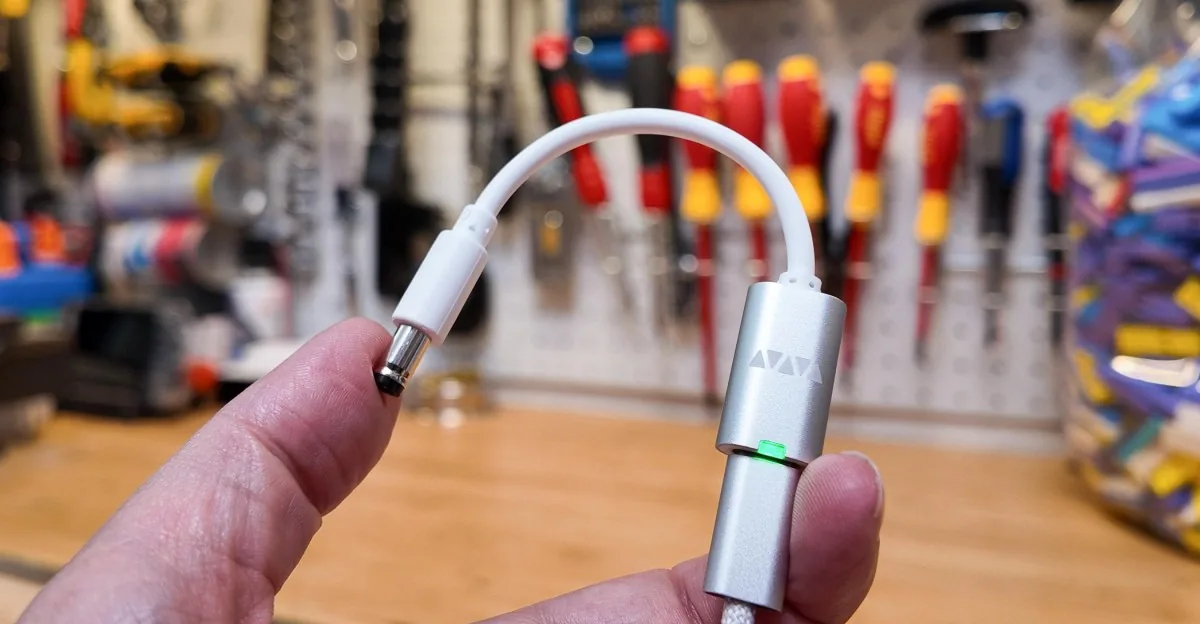
A new programmable dongle from a company called Werewolf is transforming older electronic devices, allowing them to be powered by ubiquitous USB-C chargers and portable batteries. This innovation bypasses the need for original, often cumbersome, power adapters and offers a modular approach to powering everything from vintage gaming consoles to desktop monitors.
The system involves a small Werewolf VFLEX dongle, which is programmed via a smartphone app. Users then connect the dongle to a USB-C power source and attach a specific barrel jack tip to the device needing power. This setup effectively converts the USB-C power delivery into the voltage required by older electronics, many of which predate the USB-C standard by decades. For instance, the author demonstrated powering a 27-inch desktop monitor, a Super Famicom (Japanese Super Nintendo), and an RCA-to-HDMI adapter using a single portable battery and two VFLEX adapters.
The practicality of this solution is highlighted by its ability to extend the life and utility of legacy hardware. A Game Boy, measured at a mere 0.33 watts during gameplay, could theoretically be powered by a pocket-sized USB-C battery for over 90 hours using the VFLEX. During a recent gaming party, the Super Famicom was successfully powered for a five-player Bomberman session. Similarly, a recording device that suffered from quickly draining batteries was kept operational by plugging it into a USB-C source via the VFLEX.
Navigating Voltage and Polarity
While the concept is straightforward, the Werewolf system requires some forethought regarding voltage and polarity. Before connecting the dongle to a gadget, users must program it with the correct voltage, typically done by plugging the USB-C end into a phone. The dongle stores these settings in non-volatile memory, but accidental misconfiguration could potentially damage vintage electronics. The system itself doesn't convert voltage but rather negotiates power delivery using USB-C Power Delivery (PD) protocols, allowing the user to specify the desired output.
Challenges arise when specific voltages are not standard. For example, a desktop monitor might require 19 volts, a figure not always supported by every USB-C charger. While 100W USB-C PD chargers typically offer standard voltages like 5V, 9V, 15V, or 20V, and Extended Power Range (EPR) chargers can go higher, achieving less common voltages might necessitate a programmable power supply (PPS). The Werewolf app helps by saving profiles for each gadget and charger, indicating compatibility. However, determining the required voltage for a device often still requires checking the device itself or its original power brick.
An additional complication is center pin polarity. Some devices, including certain gaming consoles, use a negative center pin instead of the more common positive one. This requires a reverse-polarity connector, which the current Werewolf app does not explicitly support programming, although a non-working toggle exists. Users must ensure they use the correct connector, such as an orange-tipped plug for reverse-polarity needs, to avoid feeding power backward. Werewolf acknowledges these complexities, with former employee Kevin Spangler noting the system may not resonate with the average consumer. The company is reportedly working on specific adapter cables for retro gaming consoles and other devices, and founder Luke Beno plans to phase out separate reverse-polarity connectors in favor of a VFLEX version that can handle it internally.
Looking ahead, Werewolf envisions further enhancements. The dongles are firmware updatable, a public API and web app are available, and the company might even develop its own power supplies to unlock a wider range of voltages. This modular and adaptable approach positions the Werewolf system as a significant tool for enthusiasts seeking to integrate their cherished legacy electronics into a modern, USB-C-centric power ecosystem.