
NASA's Swift Telescope Poised for Earth Re-entry After 20 Years
NASA's Swift space telescope, after two decades of cosmic observation, is set to re-enter Earth's atmosphere due to a failed stabilization attempt. Its trajectory suggests a high probability of burning up.

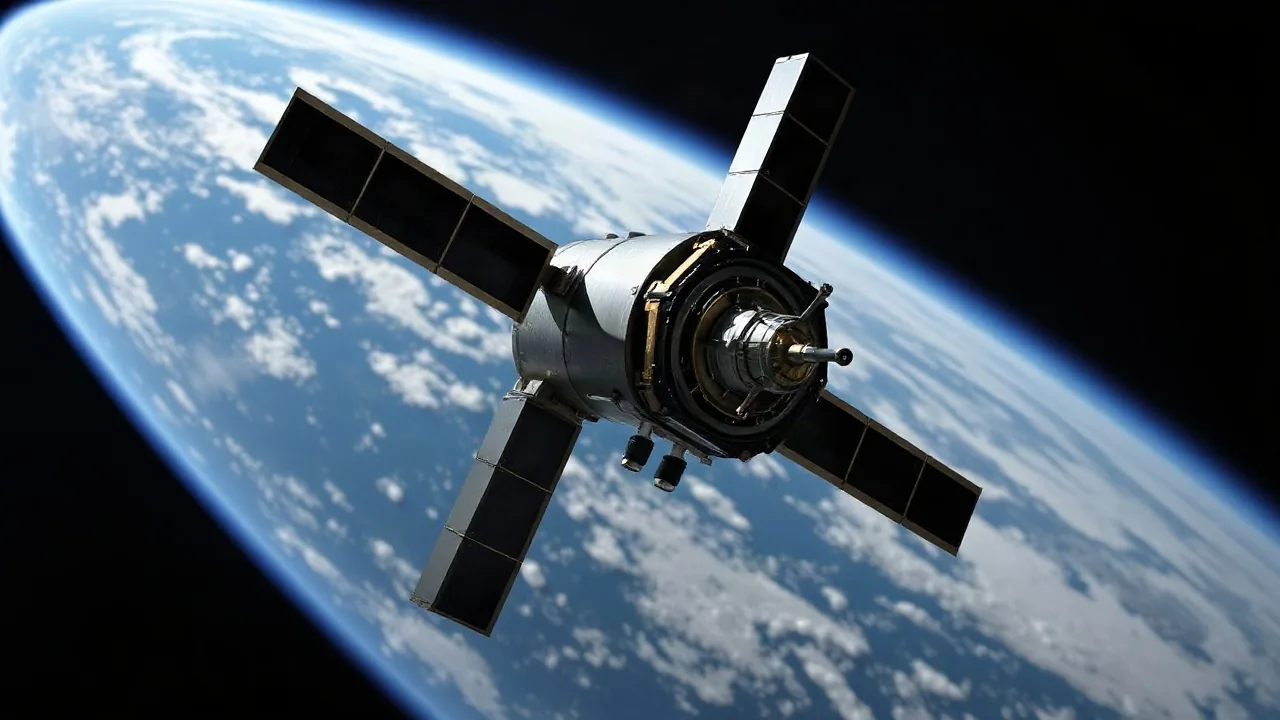
NASA's Swift space telescope, a vital instrument for observing the universe's most energetic phenomena, is nearing the end of its remarkable 20-year mission. The observatory is expected to re-enter Earth's atmosphere in the coming days, following a mission extension that ultimately failed to stabilize its orbit. Designed to detect gamma-ray bursts, Swift has provided invaluable data on supernovae, black holes, and other cosmic events since its launch in 2004.
The impending re-entry comes after NASA attempted to extend the mission beyond its planned operational life. However, a stabilization issue prevented the successful execution of this extension, leading to the inevitable descent. While a precise impact zone cannot be determined, mission planners anticipate that the majority of the telescope's components will burn up harmlessly upon entering the atmosphere. NASA engineers have stated that the probability of any debris reaching the ground is very low.
End of an Era for a Cosmic Watcher
Swift's journey began on November 20, 2004, when it was launched from Cape Canaveral Air Force Station in Florida aboard a Delta II rocket. Its primary mission was to detect and observe transient astronomical events, particularly gamma-ray bursts (GRBs), which are the most luminous explosions in the universe. The telescope's sophisticated suite of instruments, including the Burst Alert Telescope (BAT), the X-ray Telescope (XRT), and the Ultraviolet/Optical Telescope (UVOT), allowed scientists to pinpoint the locations of these events and study their afterglow across different wavelengths.
Over its two decades of service, the NASA spacecraft has been instrumental in numerous scientific discoveries. It played a crucial role in the study of supernovae, helping astronomers understand the expansion of the universe. Swift's observations have also shed light on the behavior of active galactic nuclei and the formation of heavy elements. The telescope's ability to quickly slew to new targets made it an indispensable tool for rapid-response astrophysics.
The decision for Swift to re-enter Earth's atmosphere is a common end-of-life scenario for many satellites. While efforts are often made to extend their operational lives, orbital decay and component failures eventually necessitate controlled or uncontrolled re-entries. NASA typically aims for controlled re-entries over unpopulated ocean areas for larger spacecraft, but for smaller satellites like Swift, atmospheric burn-up is the most likely outcome. Mission control will continue to monitor Swift's descent, but direct intervention to alter its path is not feasible at this stage.
The scientific community is already preparing for Swift's departure, with researchers eager to analyze its final data streams. The knowledge gained from Swift's observations will continue to inform astrophysics for years to come. Its legacy lies in the vast archive of data it has collected, enabling deeper understanding of the cosmos and inspiring future generations of space telescopes. NASA has also launched successor missions and is developing new technologies to continue the groundbreaking work initiated by Swift.