
Google Gemini Spark AI Agent Promises Automated Tasks for Users
Google unveiled Gemini Spark, an AI agent designed to perform tasks autonomously for users. Integrated with Google's ecosystem, it aims to shift AI from chat to action, but privacy concerns remain.

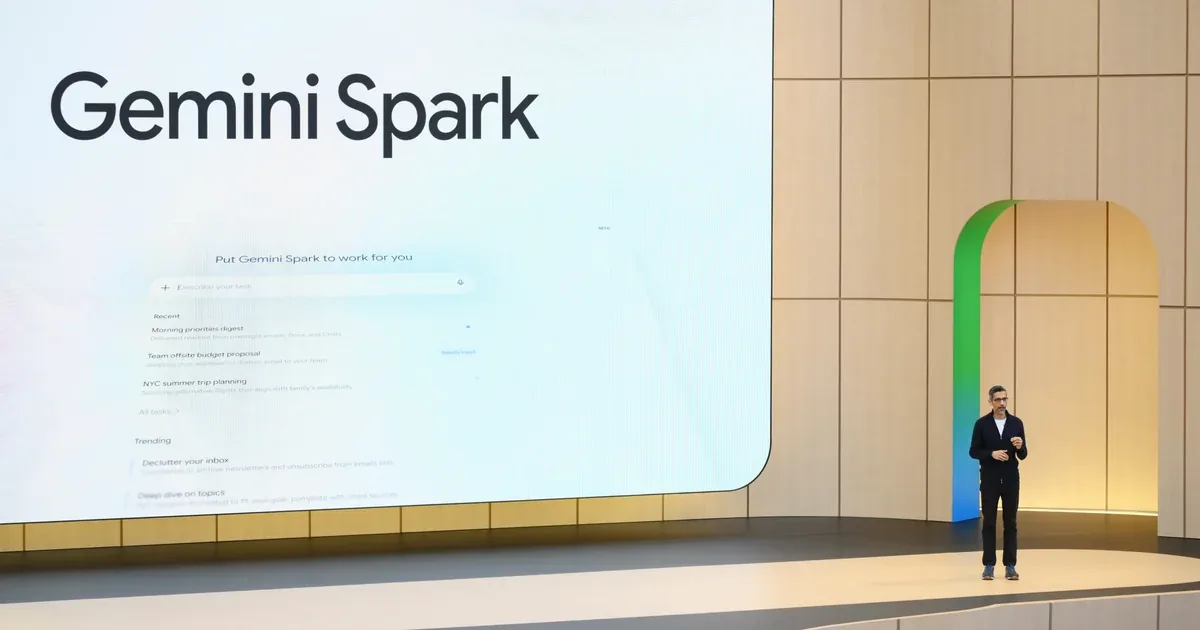
Google announced Gemini Spark, a new AI agent designed to proactively complete tasks for users, potentially marking a significant shift in how consumers interact with artificial intelligence. Unveiled this week amidst a broader rollout of AI features, the tool is Google's direct response to burgeoning autonomous AI agents like OpenClaw, which are gaining traction among developers and tech enthusiasts.
"There is a paradigm shift happening right now where AI is going from a chat interface to actually being able to do things for you," Clarence Lee, a tech entrepreneur and visiting lecturer at the Cornell SC Johnson College of Business, told CBS News. Lee likened the capabilities of an AI agent like Gemini Spark to that of a personal assistant, capable of handling assignments ranging from composing emails and making restaurant reservations to booking accommodations.
"It's like having a team that you can delegate things to," he added. For such AI agents to perform optimally, a deep understanding of their human users is paramount, according to Karan Girotra, professor of operations, technology and innovation at Cornell University. "You give it an objective, and it takes actions to accomplish that on your behalf," Girotra explained. "For it to be good, it needs intelligence, context and information relevant to those actions."
Contextual Integration and Future Potential
Google appears poised to leverage its extensive digital ecosystem as a key differentiator for Gemini Spark. The AI agent's integration with widely used Google applications, including Gmail and Google Calendar, grants it access to crucial contextual information about user activities and preferences. This deep integration allows Gemini Spark to possess more pertinent user data than many competing agents.
"It knows more about you than many others because it connects to Gmail and other apps, so personal intelligence will come through in the agent," Girotra said. Google stated that Gemini Spark is currently undergoing testing and is slated for a wider rollout to Google AI Ultra subscribers starting next week. This tier of access costs $100 per month.
In a blog post, Google described the transition: "Spark represents a big shift for Gemini, transforming it from an assistant that can answer your questions into an active partner that does real work on your behalf and under your direction." The agent can analyze emails within a user's inbox to flag important updates, such as school notifications for children, or to remind users of impending deadlines. It can also process meeting notes, synthesizing key takeaways into a polished document.
Beyond its native Google apps, Gemini Spark can connect with external services like Instacart and OpenTable, enabling users to delegate tasks such as arranging dinner reservations or purchasing groceries. This expansion into third-party services amplifies the agent's utility, moving it closer to a comprehensive digital assistant.
However, the increasing capabilities of AI agents also raise significant privacy and security considerations. As these tools gain access to more personal information to complete tasks, they become potential targets for hackers and could also be exploited for advertising purposes. Linking an agent with services like Instacart inherently means the AI learns about dietary preferences, while access to email communication could expose sensitive personal or professional data.
Google has indicated that Gemini Spark will require explicit user permission before executing what it terms "high-stakes actions," such as financial transactions or sending communications on behalf of the user. Despite these safeguards, experts advise a cautious approach to adopting AI agents. "The first time you onboard an assistant, you don't know how good they are, so you try them out a little bit before you hand over your credit card," advised Cornell's Lee. "You might have them draft emails or create a grocery list, so I recommend that users start that way." This measured adoption strategy allows users to gauge the reliability and safety of AI agents before entrusting them with more critical functions.