
Google Health Replaces Fitbit App Amid User Frustration
Google has replaced the Fitbit app with Google Health, leading to widespread user confusion and complaints about the new interface and AI integration.

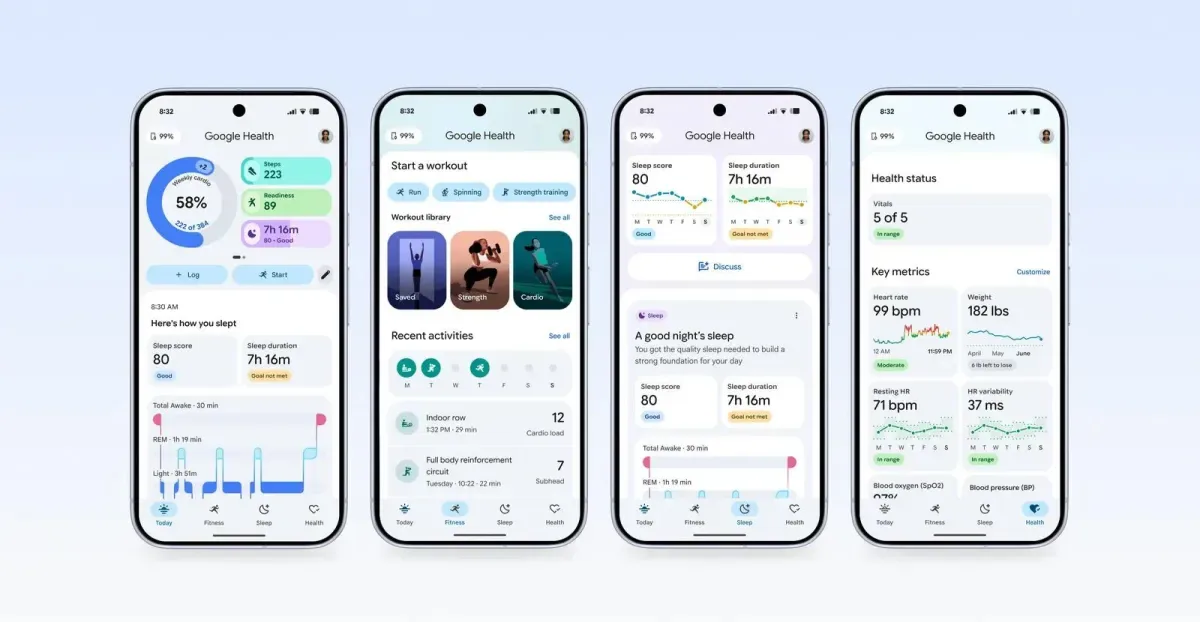
The familiar Fitbit app has officially been retired, replaced by the newly launched Google Health. This transition, announced earlier, has sparked significant user dissatisfaction, with many expressing confusion and a desire to revert to the previous version. Online forums and social media are abuzz with complaints about the redesigned interface, with users highlighting issues such as limited screen real estate for key data and the prominent placement of AI-generated content.
One common critique points to the new app's layout. On platforms like Reddit, users lament that the home screen offers only a couple of large tiles, preventing access to other essential information without scrolling. The main page now dedicates prime space to recent activity updates and conversational notes from Google's AI health coach, pushing core fitness statistics further down or requiring extra steps to view. While the AI coach has been met with mixed reactions – some finding it helpful for generating workouts or updating sleep logs, others find its proactive conversational approach intrusive or unnecessary.
The user experience with the AI component varies. Some users appreciate its capabilities, such as designing tailored workouts or assisting with data entry, describing it as a “quite a helpful feature.” However, many find the AI's presence unwelcome, particularly when it precedes access to their own data. Comments indicate frustration with scrolling through “paragraphs of AI slop” before reaching activity logs. The AI's conversational style is criticized for offering unsolicited platitudes, like commenting on a short walk, when users simply want to view their performance metrics.
Interface and Navigation Challenges
Beyond the AI integration, the visual design and navigation of Google Health are also points of contention. One user described the graphical user interface as resembling that of a child's creation, while others complained about the time it takes to access minimal results. The app is perceived by some as no longer being a “genuine fitness app,” but rather a “huge disappointment and a total time drain.” The transition has left many users disoriented, struggling to locate previously accessible data, such as rowing workout logs, which are now buried under multiple menu layers in the “Health” and “Focus areas” sections, a stark contrast to their simple accessibility in the old Fitbit app.
Google's official blog posts showcase sample images of a “Today” screen that appears to present information more comprehensively, including an AI chat feature that was not consistently visible to all users in testing. A significant concern is the apparent inability to remove or minimize the “Ask Coach / activity” window that occupies a substantial portion of the screen. While Google has stated that the AI bot can be disabled via the new app's Feature Privacy Controls, the persistent UI element remains a source of irritation for many.
For users relying on third-party wearables, the experience may be further complicated. While Google has indicated that Google Health will eventually support a wider range of devices, current compatibility is limited. For instance, a user's Nothing Watch Pro 3 was insufficient to unlock additional dedicated tabs for Fitness and Sleep, features that are presented as enhancements to the user experience but require specific wearable integrations to become fully accessible. These added tabs, if available, are designed to streamline access to fitness and sleep data, but their conditional availability highlights potential fragmentation in the user experience and dependence on specific hardware.
The shift from the established and user-friendly Fitbit interface to Google Health represents a significant overhaul. Many users who have relied on the Fitbit app for years found its functionality superior for tracking their health and fitness goals. The integration of Google's AI features, while potentially offering advanced capabilities, has seemingly come at the cost of a streamlined and intuitive user experience, leading to widespread calls for a return to the previous app's design and functionality.