
Trump Phone's 'Made in USA' Claims Face Scrutiny
The recently launched Trump Phone faces questions about its 'Made in USA' claims, with evidence suggesting components are sourced internationally and final assembly in Miami.

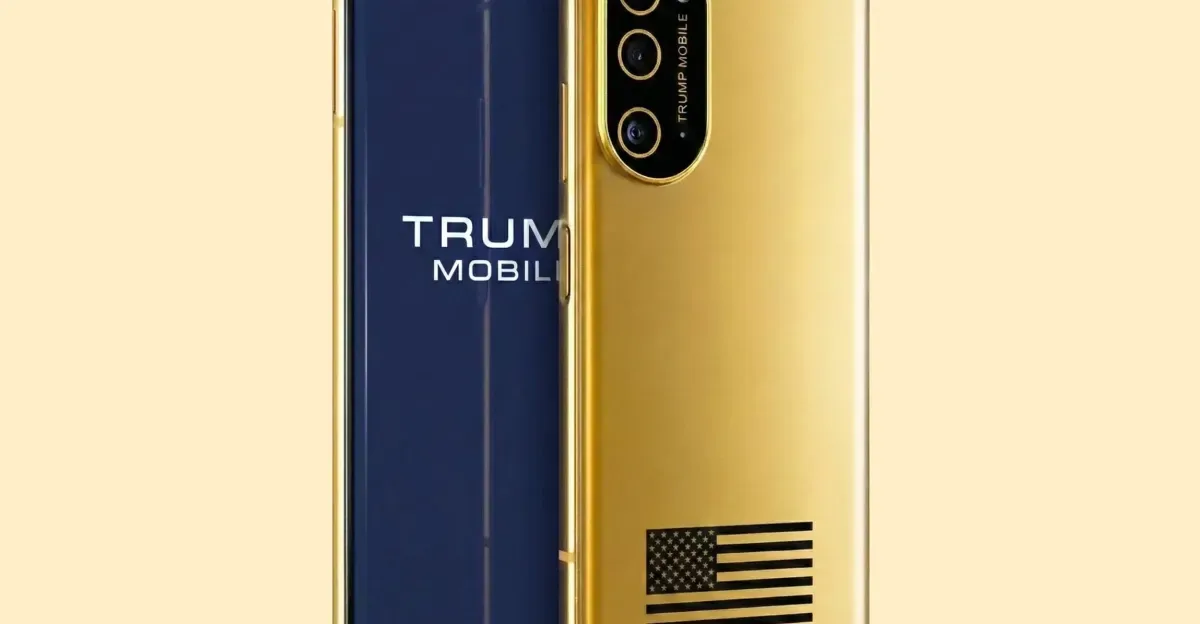
The highly anticipated Trump Phone, officially known as the T1 Phone 8002, has recently begun to reach select journalists and YouTubers, nearly a year after its initial announcement in June 2025. However, scrutiny is mounting over the device's 'Made in USA' marketing, with an investigation revealing that components are predominantly sourced from overseas, and assembly is conducted in Miami, raising questions about the accuracy of its patriotic branding.
When Trump Mobile first unveiled the phone, the company made explicit claims that it was "designed and built in the United States." These assertions were quickly met with skepticism due to an opaque spec sheet featuring oddities like a "5,000mAh long life camera," and multiple missed release dates. The original 'made in the USA' statements were notably absent from the Trump Mobile website less than two weeks after the announcement, replaced with more ambiguous phrasing such as 'proudly American' and 'American hands behind every device.'
The Federal Trade Commission (FTC) has stringent guidelines for 'Made in USA' claims, requiring "all significant processing" and "all or virtually all" components to be sourced domestically. Given that the vast majority of smartphone components are manufactured in countries like China, India, and Southeast Asia, meeting these standards is a significant challenge for any phone manufacturer, including Trump Mobile.
Executives from Trump Mobile have acknowledged the complexities. Don Hendrickson stated in February that the company had only ever claimed it was a "goal" to be made in America. Fellow executive Eric Thomas admitted that "there might have been something put on the website" regarding explicit 'Made in USA' claims, while suggesting that producing entirely in the US "is going to cost more money." Since then, the company has largely adhered to less definitive language, with CEO Pat O’Brien stating last month that the T1 is "proudly assembled in the US."
The Reality of US Smartphone Manufacturing Infrastructure
Thomas and Hendrickson confirmed that the phone undergoes "final assembly" in Miami, though the exact nature of this process remains undisclosed. Thomas offered that it is "definitely more than slapping a cover on the phone," estimating that components arrive in Miami in "let's say 10 parts." The FTC also regulates 'assembled in the US' claims, demanding "principal assembly" in the US that is "substantial," though the definition is not precisely defined and excludes "simple screwdriver assembly."
The underlying issue, according to industry insiders, is the current lack of comprehensive infrastructure in the United States for building smartphones at scale. Keith Cochran, who previously worked on iPhone manufacturing at Apple supplier Jabil, explained that the sheer volume of labor and specialized equipment required is immense. "The US simply doesn’t have the infrastructure to build phones, in terms of equipment, engineering expertise, and the affordable labor required for manufacturing at scale," Cochran stated. He further elaborated on the tight profit margins in the low-margin smartphone business, making it difficult for US manufacturers to absorb higher labor costs associated with domestic employees. Cochran described the challenge: "You’re being asked to build some of the hardest things in the world to build, with the most precision that you can imagine, at peanuts."
Even Hendrickson conceded that specific manufacturing equipment needed for phone production is not readily available in the US. "Some of the manufacturing equipment that’s required for the phone doesn’t exist in the US," he said. While some US companies produce components like touchscreens and batteries, these are often for larger equipment and not at the miniaturized scale and quality required for smartphones. The production of flagship-quality chipsets, OLED displays, advanced batteries, modems, camera sensors, and other intricate components domestically remains a distant prospect.
The high cost of producing phones in the US is exemplified by companies like Purism. Their Liberty Phone, which costs $1,999, offers specifications comparable to mid-range devices, highlighting the significant price premium for domestically manufactured electronics. Trump Mobile's decision to source internationally and assemble locally appears to be a strategic choice to offer a $499 device, rather than a patriotic manufacturing endeavor.
Trump Mobile has not disclosed the exact origin of its phone, with executives only indicating that components are sourced from "favored" or "friendly" nations, with the stated aim of reducing reliance on China. However, the T1 Phone bears a strong resemblance to the 2024 HTC U24 Pro. While HTC has stated they do not manufacture phones for third parties, records from Taiwan's National Communications Commission database list Guangdong Yuanchang Electronics Co., Ltd., based in China, as the manufacturer of the U24 Pro. This suggests that if the Trump Phone is indeed a modified version of the HTC U24 Pro, it likely originates from China.
Despite these revelations, Trump Mobile maintains an optimistic outlook. CEO Pat O’Brien recently reiterated the company's goal to "become the first to release a phone with the majority of parts being built here in America." Executives like Hendrickson and Thomas have hinted at future iterations, potentially a T1 Ultra, being wholly US-made. They also position Trump Mobile as a catalyst, aiming to push other manufacturers to establish production lines in the US. They claim to have identified US manufacturing partners ready to produce components, including potentially Qualcomm for chip runs in Phoenix, within a year. However, industry experts like Cochran caution that such a comprehensive shift in manufacturing is a long-term endeavor, potentially taking a decade to achieve a fully US-designed and built smartphone.