
Alien Debris on Moon? Scientists Propose New Lunar Soil Search
A team of scientists is exploring the provocative idea that microscopic debris from advanced alien civilizations could be present in lunar soil. Their research suggests searching the moon's surface might help answer whether humanity is alone in the universe.

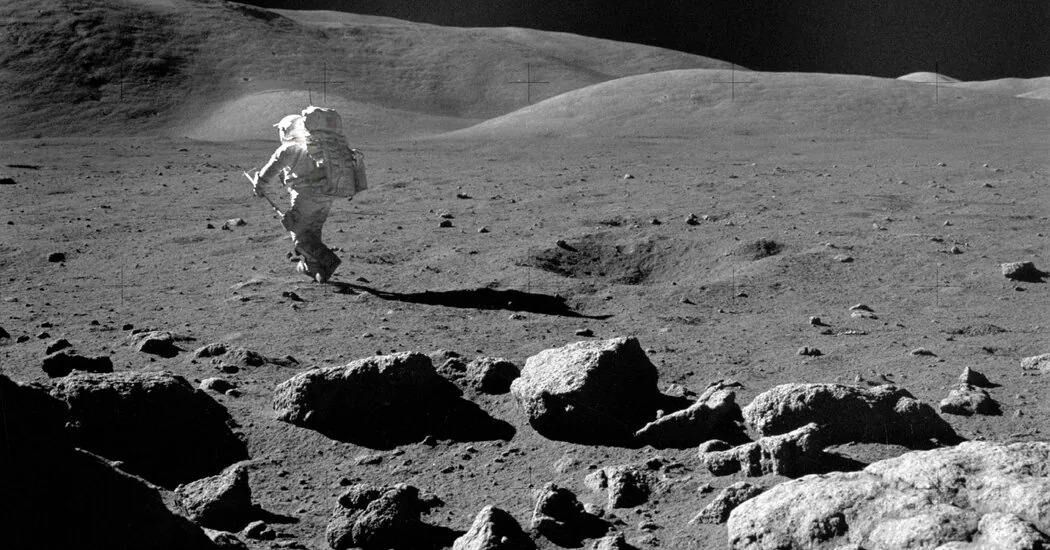
A team of scientists is proposing a novel approach to the search for extraterrestrial intelligence (SETI): examining lunar soil for microscopic remnants of alien technology. The provocative study, currently undergoing peer review for the International Journal of Astrobiology, suggests that if advanced alien civilizations have ever existed in our galaxy, particles from their infrastructure could have settled on the Moon.
"If any other technological civilization has ever existed in our galaxy, it’s not an unreasonable hypothesis to think that particles of them are on the moon in some quantity," said Lewis Pinault, an affiliate scientist at the SETI Institute in Mountain View, California, and a researcher at Birkbeck College, University of London, who led the research. The team's work models how alien infrastructure might erode and disperse through space, drawing parallels to how satellites shed microscopic material into Earth's orbit.
Searching for Extraterrestrial Micro-Particles
The concept hinges on the idea that the harsh conditions of space and the natural processes of erosion and decay could break down advanced alien technologies into tiny fragments. These particles, akin to microscopic plastic pollution in Earth's oceans, could then travel across the cosmos. The Moon, with its stable, ancient surface and lack of significant atmospheric or geological activity to erase evidence, presents an ideal location for such hypothetical detritus to accumulate over vast timescales.
Sofia Sheikh, a scientist at the SETI Institute specializing in hypothetical alien technologies known as “technosignatures,” described the team’s idea as “a creative and worthwhile avenue.” She emphasized that this research gains particular relevance with NASA's renewed focus on lunar exploration through the Artemis program, which aims to return astronauts to the Moon's surface in the coming years. Upcoming lunar missions could potentially collect the samples necessary to test this intriguing hypothesis.
This scientific endeavor represents a significant departure from traditional SETI methods, which primarily focus on detecting radio signals or optical transmissions from alien civilizations. While those approaches search for active signs of life, the lunar soil investigation seeks evidence of past existence, even from civilizations long extinct. The sheer age of the Moon’s surface, estimated to be billions of years old, means it could potentially preserve the faintest traces of ancient extraterrestrial activity.
The research acknowledges the immense challenges involved. Detecting and distinguishing such microscopic alien particles from the Moon’s native regolith would require highly advanced analytical techniques. Scientists would need to develop new methods to identify artifacts with non-terrestrial isotopic compositions or unique material structures that could only originate from artificial, technologically advanced sources. The possibility of contamination from Earth-based sources during sample collection and analysis also presents a significant hurdle.
Despite these obstacles, the potential payoff is enormous. Confirming the presence of even microscopic alien debris on the Moon would provide undeniable evidence that humanity is not alone in the universe. It would revolutionize our understanding of life's prevalence and the history of technological development beyond Earth, fundamentally altering our place in the cosmos. This lunar debris hypothesis, while speculative, opens a new frontier in the ongoing quest to understand our cosmic neighborhood.