
Asteroid 2026 JH2 Safely Passes Earth Closer Than Moon Monday
A newly discovered asteroid, 2026 JH2, will pass Earth on Monday at a distance closer than the moon. The 62-foot-wide space rock poses no threat and may be visible to amateur astronomers.

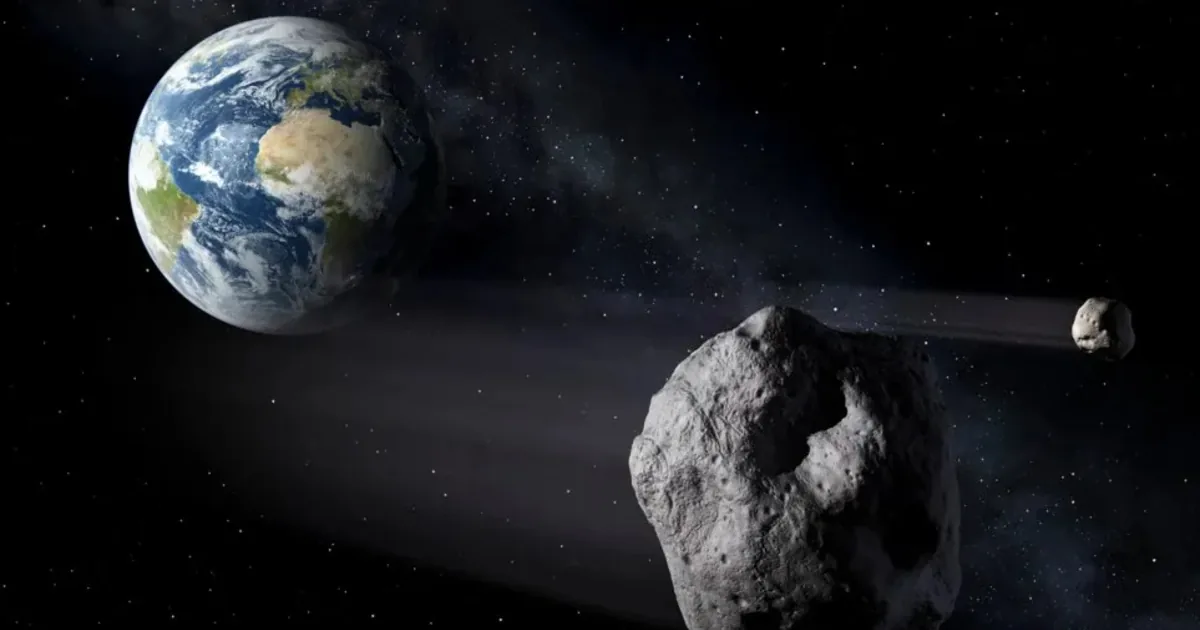
A newly discovered asteroid, designated 2026 JH2, will make a close pass by Earth on Monday, May 19, 2026, coming within approximately 57,000 miles of the planet. This distance is significantly closer than the average distance of the moon, which orbits Earth at about 238,855 miles away. Scientists have confirmed that the asteroid, estimated to be about 62 feet wide, does not present any threat to Earth. The close approach is set to occur around 6 p.m. ET, according to NASA's Jet Propulsion Laboratory.
The asteroid 2026 JH2 was first detected on May 10 by astronomers participating in the Mount Lemmon Survey, an ongoing astronomical project situated in Arizona's Santa Catalina Mountains. While close flybys by objects of this size are rare, they are not unheard of. During its closest approach, 2026 JH2 is expected to reach its peak brightness, potentially making it visible to amateur astronomers equipped with small telescopes.
Space Rock Encounters and Planetary Defense
The European Space Agency (ESA) provided the data on the asteroid's trajectory and proximity. While this particular object is not a concern, its close passage highlights the ongoing efforts in planetary defense. NASA's Near-Earth Object Observations program is dedicated to identifying and tracking celestial bodies that could potentially pose a risk to our planet. By studying their orbits and characteristics, scientists aim to predict and mitigate any future impact threats.
In contrast to the harmless passage of 2026 JH2, history offers stark reminders of asteroid impacts. The Chelyabinsk meteor, which exploded over Russia in 2013, serves as a notable example. Measuring approximately 59 feet across before atmospheric entry, it released an energy equivalent to 30 times the Hiroshima atomic bomb. The Chelyabinsk event caused widespread damage and injured over 1,500 people, primarily from shattered glass.
The tracking of asteroids like 2026 JH2 is crucial for understanding our solar system and ensuring the safety of Earth. Astronomers continuously monitor the skies using a global network of ground-based and space-based telescopes. This vigilance allows for early detection and characterization of potentially hazardous objects, providing valuable time for observation and, if necessary, developing mitigation strategies.
Looking ahead, astronomers are closely monitoring other space rocks that are projected to pass even nearer to Earth. One such object is Apophis, a much larger asteroid, approximately 1,200 feet in diameter. Apophis is anticipated to pass within 20,000 miles of Earth on April 13, 2029. In preparation for this significant event, NASA's OSIRIS-APEX probe is scheduled to rendezvous with Apophis in June 2029. The mission aims to study how the close gravitational interaction with Earth will alter Apophis's orbit and physical properties.
The OSIRIS-APEX mission builds upon the success of its predecessor, OSIRIS-REx, which successfully collected samples from an asteroid and returned them to Earth in 2023. This ongoing exploration of near-Earth objects is vital for scientific understanding and long-term planetary safety. Proposed budget cuts by the Trump administration for NASA's fiscal year 2027, however, could impact future missions like OSIRIS-APEX, potentially canceling over 50 planned projects if enacted.