
BepiColombo Mission Nears Mercury Orbit After 8-Year Space Journey
After an eight-year voyage, the European Space Agency and Japan Aerospace Exploration Agency's BepiColombo mission is set to arrive at Mercury. The dual-orbiter mission aims to unravel the planet's mysteries.

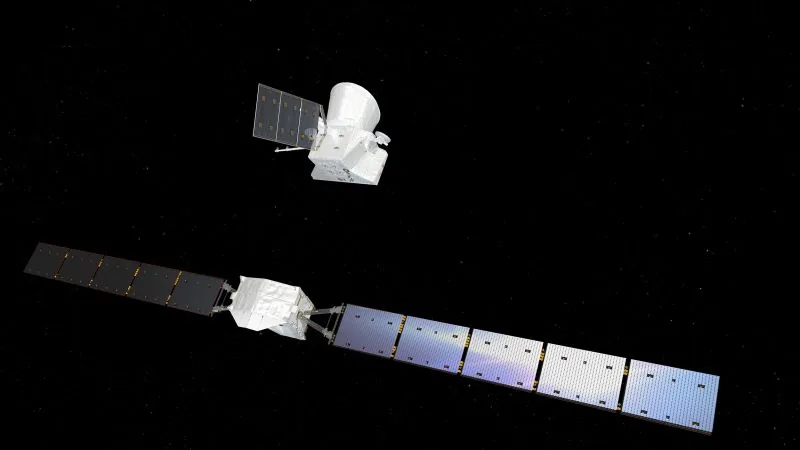
The BepiColombo mission, a collaborative endeavor between the European Space Agency (ESA) and the Japan Aerospace Exploration Agency (JAXA), is on the cusp of arriving at Mercury after an extensive eight-year journey. Launched in October 2018, the ambitious mission is poised to deploy two specialized orbiters to investigate the formation and evolution of the planet closest to our sun. The spacecraft has traversed over 6 billion miles (10 billion kilometers) to reach its destination.
Named after Italian engineer Giuseppe “Bepi” Colombo, who pioneered studies of Mercury’s unique rotation, the mission faced a lengthy and complex transfer. Unlike direct trajectories to planets like Jupiter, reaching Mercury requires significant deceleration to match the planet’s orbital velocity, a process that consumes considerable energy. Mission engineers utilized a combination of electric propulsion and nine gravitational assists from Earth, Venus, and Mercury to achieve the necessary speed reduction.
A critical phase of the mission is scheduled for Thursday: the separation of the Mercury Transfer Module, which powered the spacecraft’s journey, from the two science orbiters. The ESA will broadcast key milestones of this operation, followed by a crucial safety check of the BepiColombo stack. "The separation of the transfer module will take place in conditions which are exceedingly challenging, and we will have to face a considerable risk that things don’t go as planned," stated Ignacio Tanco, head of Inner Solar System Mission Operations at the ESA. He likened the event to launching a new spacecraft, albeit one already in orbit around another planet, with systems that have not been fully tested in situ.
Unraveling Mercury's Extreme Environment
The challenges are far from over, as establishing a stable orbit around Mercury presents its own set of difficulties. On November 21, the ESA’s Mercury Planetary Orbiter (MPO) and JAXA’s Mercury Magnetospheric Orbiter (MIO) will be captured by Mercury’s gravity. The two orbiters will then separate from each other between December 9 and 10. The MPO is slated to reach its operational orbit on December 16, with the MIO following suit by March 10. Full science operations for both spacecraft are expected to commence in April 2027.
This deployment marks the first time a mission will place two fully independent operational spacecraft into orbit around a planet. The MPO will focus on studying the planet's surface and internal structure, while the MIO will analyze the space environment surrounding Mercury. "It will be the first time that a mission releases two fully independent, fully operational separate spacecrafts around a different planet," Tanco added.
Mercury, averaging 36 million miles (58 million kilometers) from the sun, experiences extreme temperature fluctuations, with daytime surface temperatures soaring to approximately 800 degrees Fahrenheit (430 degrees Celsius). This proximity to the sun demands highly resilient spacecraft design. Both orbiters are equipped with solar arrays designed to withstand intense solar radiation and overheating. The MIO will spin rapidly to manage heat, while the MPO will angle its arrays to receive sufficient power without succumbing to the sun’s harsh rays.
Only two previous missions, NASA's Mariner 10 in 1974 and MESSENGER from 2011 to 2015, have successfully studied Mercury. Like BepiColombo, MESSENGER endured a seven-year journey to reach the planet. The extreme conditions necessitate spacecraft capable of operating within what engineers describe as "extremely punishing" environments, akin to being constantly exposed to a "very hot pizza oven."
The BepiColombo mission aims to answer long-standing questions about Mercury, including the origin of enigmatic surface features known as hollows. These peculiar depressions, found nowhere else in the solar system and not attributable to wind or water erosion, are a primary focus for scientists. "There are depressions in the surface that look like the surface is being eaten away," explained Geraint Jones, lead project scientist for BepiColombo at the ESA. "It might be possible that we can see changes in these regions over time."
Another significant mystery concerns Mercury's unusually high density for its small size. Current theories suggest that early in the solar system's history, a colossal impact stripped away much of Mercury's outer layers, leaving behind a denser core. The data gathered by BepiColombo's instruments, which include high-resolution mapping capabilities and spectrometers, will provide crucial insights into Mercury’s composition and geological history, potentially confirming or refining this impact hypothesis. Understanding solar system formation and planetary evolution remains a key objective.