
Black Hole Discovery: Astronomers Find Stellar Remnant in Omega Centauri
University of Utah astronomers have identified the first stellar-mass black hole in the Omega Centauri star cluster using NASA's Hubble and Webb telescopes. The discovery challenges existing models of black hole formation in dense stellar environments.

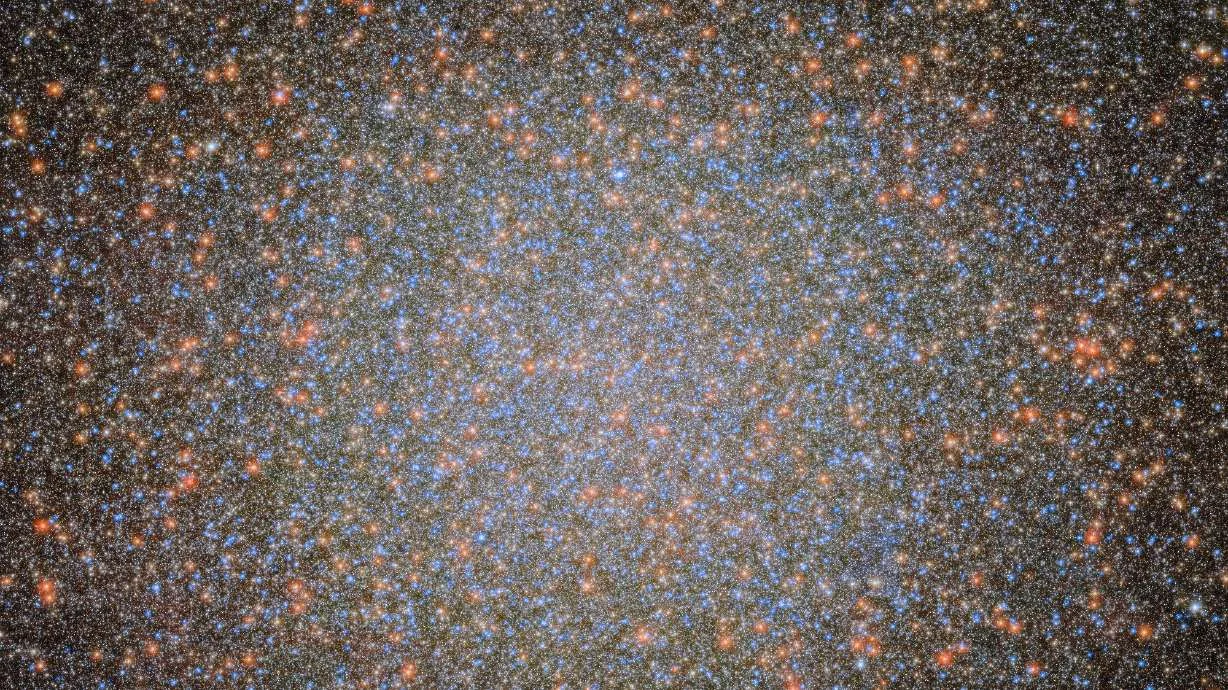
SALT LAKE CITY — In a significant breakthrough for astrophysics, University of Utah astronomers have pinpointed the first stellar-mass black hole within the vast Omega Centauri globular star cluster. This monumental discovery, detailed in the latest issue of The Astrophysical Journal Letters, was made possible by leveraging archival data from NASA's Hubble Space Telescope and new observations from the James Webb Space Telescope. The findings offer a surprising challenge to established theories regarding the formation of black holes in such densely populated stellar environments.
Omega Centauri, a colossal cluster comprising an estimated 10 million stars, was theorized to host approximately 10,000 stellar-mass black holes. However, detecting these elusive objects had proven exceptionally difficult until this research team employed a sophisticated astrometry technique. Astrometry involves meticulously measuring the minute movements of stars over extended periods. By scrutinizing over two decades of Hubble data and supplementing it with recent Webb observations, the astronomers refined their astrometric measurements to an unprecedented degree.
This rigorous analysis allowed the team to identify a star locked in orbit around an unseen, yet massive, celestial body. The object's substantial gravitational influence strongly indicated its identity as a black hole. Designated oMEGACat BH-2, this marks the first stellar-mass black hole ever detected within Omega Centauri. Furthermore, it exhibits unexpected characteristics, including a mass that is lower than predicted for its environment. Coupled with its visible star companion, this black hole-star binary system boasts the longest orbital period ever recorded for such a configuration.
"With Hubble and Webb data, we were able to see the motion of the visible main-sequence star that is part of this binary, which is about 18,000 light-years away in the dense environment of Omega Centauri," stated Matthew Whitaker, an undergraduate research assistant at the University of Utah and lead author of the paper. "The precision of these measurements is incredible, down to a fraction of a pixel on Hubble and Webb's detectors. It would not have been possible to find this black hole without these two space telescopes."
Challenging Formation Theories
The U. team's findings build upon prior research that suggested this specific binary system might contain a neutron star. However, the combined power of the Hubble and Webb data streams enabled the U.-led team to more accurately determine the mass of the visible star's dark companion, definitively ruling out the possibility of a neutron star. Anil Seth, a professor of physics and astronomy at the University of Utah and coauthor of the study, elaborated on the implications: "While we already knew that the star was 0.78 solar masses, we can now calculate the black hole's mass, which is 4.46 solar masses and therefore too heavy to be a neutron star. However, its mass is much lower than would be expected in a metal-poor environment like Omega Centauri. This is surprising and exciting."
Seth further explained the significance of this anomaly: "We now know that a metal-poor star is able to form a black hole like this, and we need to figure out how that happens. This detection is providing some data to those who do that kind of modeling." This discovery provides crucial empirical evidence for astrophysicists working to refine theoretical models of black hole genesis, particularly in low-metallicity environments.
Leveraging the highly precise data from Hubble and Webb, researchers were able to map the visible star's trajectory over more than 20 years. They observed its path during its closest approach to the black hole companion, when its apparent movement across the sky was at its peak velocity. The team calculated that the visible star completes one orbit around oMEGACat BH-2 approximately every 94 years. This extended orbital period establishes it as the longest-period black hole binary system known to date.
The determination of this extended orbital period also provided insights into the likely origin of this particular binary system. The researchers propose that it was dynamically formed, meaning the star and its black hole companion did not originate as a pair but rather encountered each other within the crowded stellar cluster. Calculations indicate that a system like oMEGACat BH-2 has a survival expectancy of less than a billion years before tidal forces from interactions with neighboring stars tear it apart. This lifespan is considerably shorter than the estimated 12 billion-year age of the cluster itself.
The discovery of oMEGACat BH-2 is anticipated to be the first of many such findings, paving the way for the identification of more elusive black hole populations within globular star clusters. "With Hubble and Webb, we can continue to look at Omega Centauri and expand our search for similar systems within other clusters," Whitaker remarked. The team also expressed enthusiasm for future observatories, such as NASA's Nancy Grace Roman Space Telescope, which is expected to provide even more comprehensive data from crowded regions of the galaxy, potentially leading to the discovery of numerous other black hole binary systems like this one.