
China's Chang'e-7 Mission Targets Lunar Water Ice Discovery
China's Chang'e-7 mission is set to launch this month, employing a unique rover and hopper to explore permanently shadowed lunar craters for water ice. This mission differs significantly from NASA's resource-gathering approach.

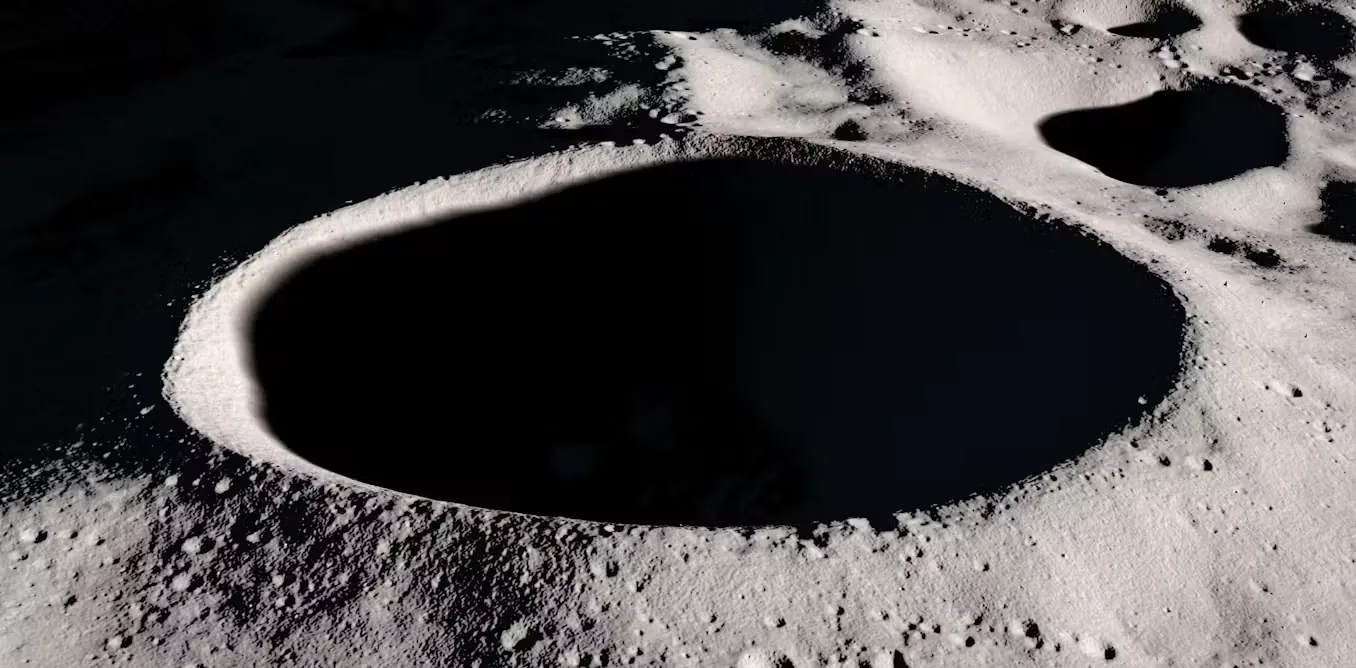
China's space program is poised to launch an innovative lunar exploration mission, Chang'e-7, this month, aiming to locate and characterize water ice within the Moon's permanently shadowed craters. This ambitious undertaking, named after the ancient Chinese goddess of the Moon, represents a significant step in understanding and potentially utilizing lunar resources. The mission is expected to utilize an orbiter, a lander, a rover, and a novel hopping vehicle designed to navigate the extreme conditions of the lunar poles.
While evidence of water on the Moon has been known for nearly two decades, the precise location, form, accessibility, and quantity of water ice in the deepest, coldest, and darkest regions remain largely unknown. These permanently shadowed areas, where temperatures plummet below -200°C, are considered highly valuable for future space exploration but pose immense challenges for conventional exploration methods. The Chang'e-7 mission's design, particularly the inclusion of a "hopper," is intended to overcome these obstacles, allowing for exploration of terrain that wheeled rovers cannot traverse. A relay satellite, Queqiao-2, already in orbit, will facilitate crucial communication links between the mission elements and Earth.
Navigating the Lunar South Pole's Extremes
A prime landing site candidate for Chang'e-7 is a ridge near the Shackleton crater within the Lunar South Pole's Aitken region. This area, like other potential locations, features steep crater walls, broken terrain, and areas of perpetual darkness. The mission's core objective is not merely to confirm the presence of water but to precisely map its distribution and form, transitioning from general exploration to assessing resource viability. This focus on resource utilization marks a new phase in lunar science. The mission is part of China's extensive, two-decade-long lunar exploration program, which has seen progressively ambitious missions.
In contrast to China's coordinated, objective-specific approach, NASA is pursuing a different strategy. The U.S. space agency is fostering a lunar marketplace through its Commercial Lunar Payload Services (CLPS) program. NASA contracts with private companies to deliver payloads and services, encouraging diverse technological development. While CLPS aims for sustained lunar operations and supports the broader Artemis program, an earlier CLPS mission, Intuitive Machines' IM-2, faced setbacks. It carried instruments and a hopping vehicle similar in concept to Chang'e-7's but its lander toppled shortly after arrival. These differing approaches highlight the global interest in unlocking the Moon's potential, with varied methods being tested to overcome the same fundamental challenges.
The scientific community believes that understanding and accessing lunar water ice is critical for enabling long-term human presence on the Moon. The potential uses range from drinking water and oxygen production to rocket fuel. China's subsequent mission, Chang'e-8, slated for around 2028, is intended to demonstrate practical resource utilization techniques. These efforts, alongside the proposed International Lunar Research Station led by China and Russia, indicate a growing focus on establishing a sustained presence beyond Earth. Ultimately, the harsh environment of the lunar poles presents universal challenges, regardless of the nation or agency undertaking the exploration. Successfully navigating these conditions and utilizing lunar resources could indeed be one of the defining scientific and engineering feats of the 21st century.