
China's New Moon Map Advances Space Ambitions
China has unveiled a new, highly detailed map of the moon, recalibrating its geologic eras and showcasing advanced cartographic standards. This initiative signals Beijing's growing influence and ambition in global space exploration.

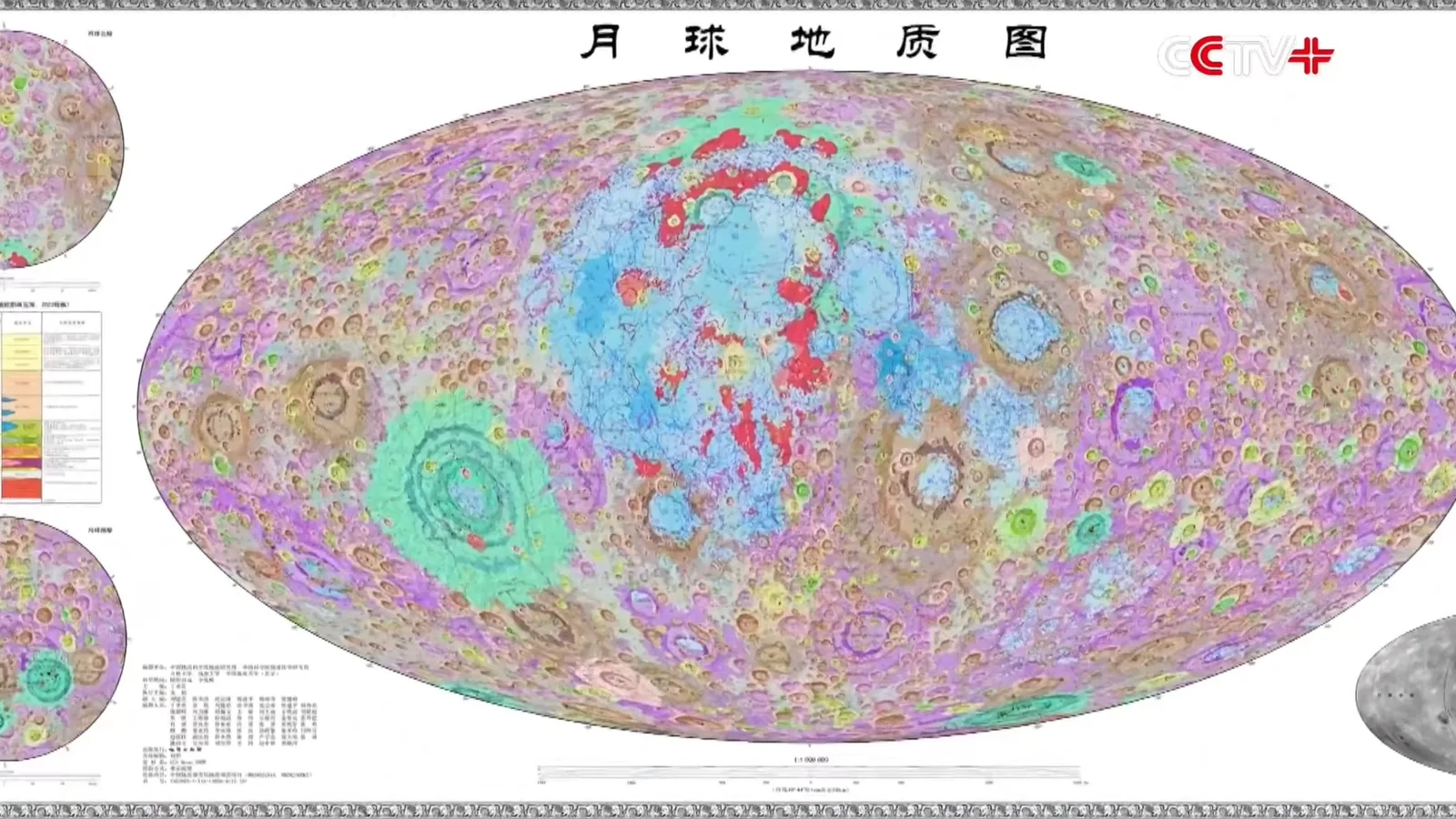
Researchers in China have released an updated and comprehensive map of the moon, featuring a scale of 1:5 million. The map, unveiled on August 6 by the Institute of Geology, Chinese Academy of Geological Sciences (IGCAGS), refines the boundaries of ancient lunar geologic periods, including the Aitkenian, Nectarian, and Imbrian eras. This latest version supersedes a 2024 edition, incorporating new scientific findings and recalibrated data.
The map also provides an updated understanding of KREEP terrane, a lunar crustal region rich in potassium, rare-earth elements, and phosphorus. Reprocessed spectral data suggests this material is more continuous and abundant than previously believed. Yang Zhiming, director of the IGCAGS, stated that the lunar geologic history has been "refined and systematized," according to the state-run outlet Xinhua.
China's advancements in lunar mapping build upon decades of international lunar research, including samples returned by U.S. Apollo missions and Soviet Luna probes. More recently, China's own robotic sample-return missions, Chang'e 5 (launched in 2020) and Chang'e 6 (launched in 2024), have provided crucial new materials. Notably, the Chang'e 6 mission was the first to successfully return samples from the lunar far side, offering unique insights into that hemisphere.
China Establishes New Cartographic Standards
Beyond the scientific recalibrations, the new map introduces a proprietary cartographic standard, according to Xinhua. This initiative aligns with a broader government strategy to influence international standards in space exploration. Elements such as the map's color scheme, geological logic, and aesthetic principles—described as "lighter for younger, darker for older"—are intended for broader application in future planetary geologic mapping.
Yang Zhiming further emphasized that this endeavor extends beyond demonstrating technological prowess. "This goes beyond showcasing technological soft power," he said. "This standard will be extended to future planetary geologic mapping, establishing an independent intellectual property framework for China's deep space exploration." This move suggests a deliberate effort by China to develop its own frameworks and assert leadership in the global space domain, including potential future missions to the outer solar system.
The development of this new lunar map underscores China's escalating commitment to space exploration. With ongoing and future missions, the nation aims to deepen its scientific understanding of celestial bodies and solidify its position as a major player in international space endeavors. The detailed cartographic work and the establishment of new standards are critical steps in this long-term strategy, potentially shaping the future of planetary science and exploration for years to come.