
China Shares First Image of 'Quasi-Moon' Kamo'oalewa
China's Tianwen-2 mission has captured the first photo of Kamo'oalewa, an asteroid orbiting Earth. The probe launched in 2025 and will study the object before attempting a sample return.

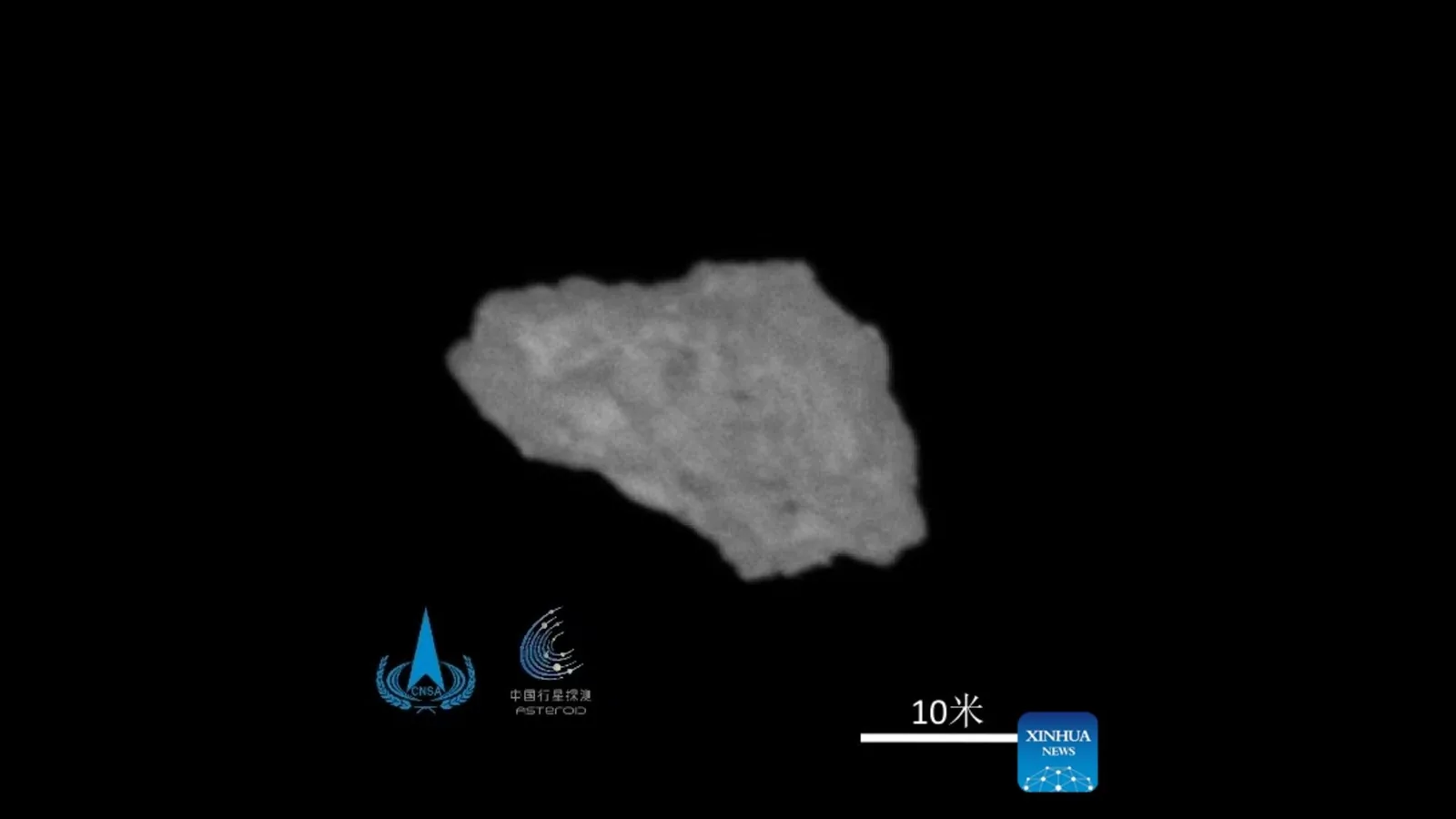
China's ambitious Tianwen-2 mission has unveiled its first breathtaking image of Kamo'oalewa, a celestial body officially designated asteroid 2016HO3, often referred to as Earth's "quasi-moon." The spacecraft, which embarked on its journey in 2025, successfully reached a vantage point approximately 12 miles (20 kilometers) from the asteroid after traveling an astounding 620 million miles (1 billion kilometers). This marks a significant milestone for China's space exploration program, positioning it among nations capable of complex asteroid missions.
The Tianwen-2 probe is scheduled to dedicate nearly a year to meticulously studying Kamo'oalewa, employing an array of 11 sophisticated scientific instruments. Following this extensive observation period, the mission aims to collect a sample from the asteroid's surface, with the ultimate goal of returning it to Earth for in-depth analysis. The newly released photograph, transmitted on July 2, was shared by China's Xinhua news agency. It offers a detailed look at Kamo'oalewa, revealing it to be a small, irregularly shaped rocky object measuring between 50 and 65 feet (16 to 20 meters) in diameter.
The precise origins of Kamo'oalewa remain a subject of scientific inquiry. However, one prevailing hypothesis suggests that this peculiar quasi-moon might be a fragment of Earth's own moon, ejected into space between one million and ten million years ago during a colossal impact event. Quasi-moons, or quasi-satellites, are a class of smaller celestial bodies that, while orbiting the sun, maintain close proximity to Earth due to its gravitational influence. At least seven such objects are currently known to be associated with our planet, though Earth's gravity can temporarily capture others before they are nudged back into solar orbits. Unlike the majority of near-Earth asteroids, which are typically believed to originate from the main asteroid belt located between Mars and Jupiter, Kamo'oalewa's potential lunar connection suggests a closer genesis.
Unraveling Asteroid Origins
A 2024 study published in the esteemed journal Nature Astronomy put forth the compelling theory that Kamo'oalewa could consist of material that was forcefully ejected from Earth's moon by the impact event responsible for forming the Giordano Bruno crater. If the Tianwen-2 mission successfully retrieves a sample, it could provide crucial evidence to either support or refute this fascinating hypothesis. This potential link to lunar material makes Kamo'oalewa a particularly valuable target for scientific study, offering insights into the early history of the Earth-moon system.
The journey for Tianwen-2 commenced on May 28, 2025, launching atop a Long March 3B rocket from the Xichang spaceport in southwestern China. The spacecraft's visual appearance was first revealed to the public shortly after its launch, when China's National Space Administration released an image captured by Tianwen-2 from a distance of 1.8 million miles (3 million kilometers) from Earth. This early image offered the public a glimpse of the mission hardware less than two weeks after its departure.
While Tianwen-2 represents China's inaugural attempt at asteroid sample collection, it follows in the footsteps of successful missions conducted by both Japan and the United States. Japan's Hayabusa spacecraft achieved the world's first asteroid sample return in 2010, bringing material back from asteroid 25143 Itokawa. More recently, the United States' OSIRIS-REx mission accomplished a similar feat in 2023, successfully retrieving samples from asteroid Bennu. The scientific bounty from these missions has already yielded significant discoveries, including the presence of amino acids—the fundamental building blocks of life as we know it—within the collected asteroid materials. These findings underscore the profound scientific value of asteroid exploration and sample return missions, promising new revelations with each endeavor.
Tianwen-2 is not only China's first asteroid mission but also its second planetary exploration undertaking. The nation's first interplanetary venture, Tianwen-1, successfully delivered an orbiter and a rover to Mars in 2020, further solidifying China's growing capabilities in deep space exploration.