
Copper's Heat Resilience Shatters Fusion Reactor Material Models
New research using SLAC's ultrafast electron camera reveals copper melts gradually, defying previous computer models that predicted sudden collapse under extreme heat. This finding impacts future fusion reactor designs.

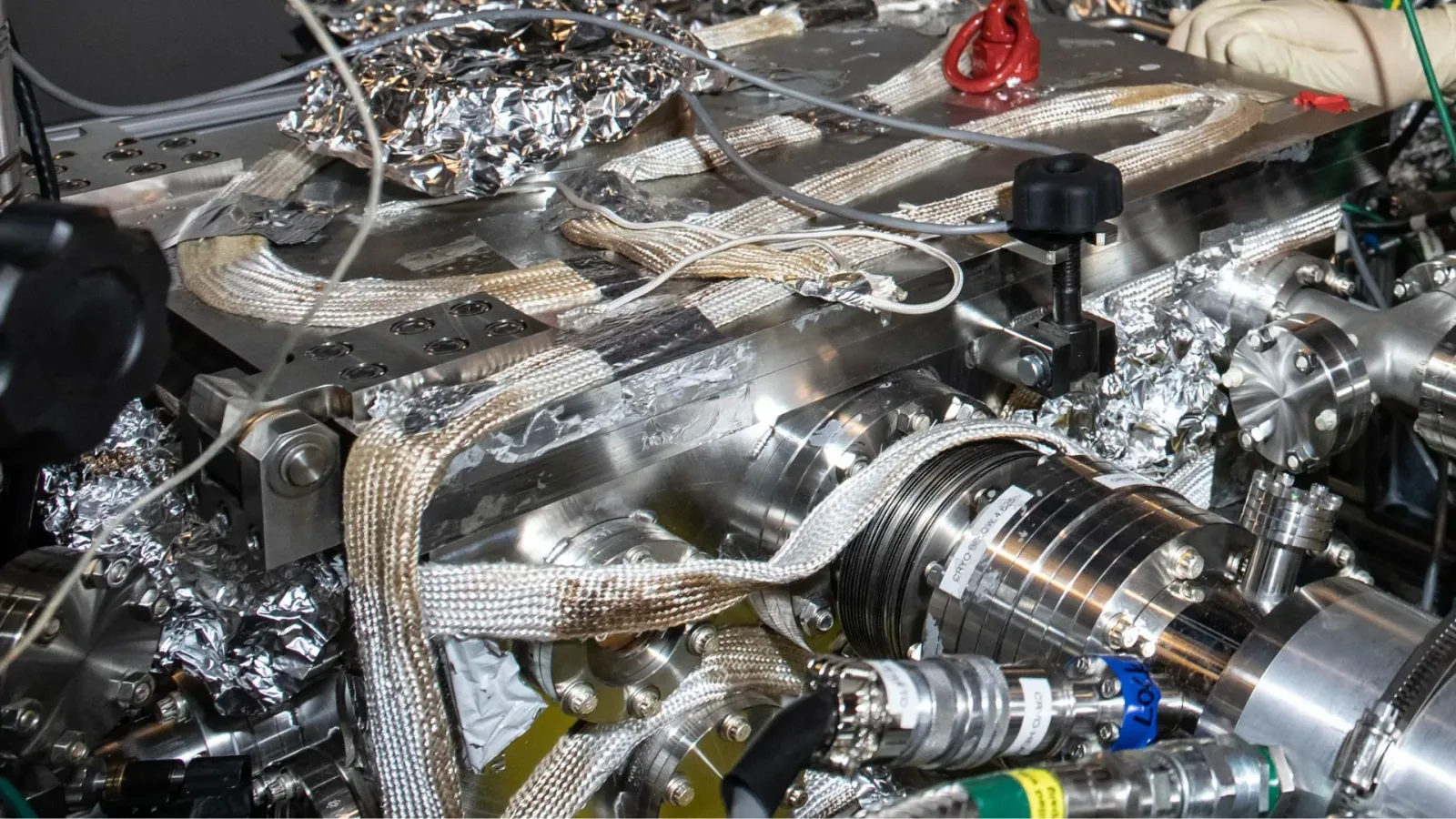
Scientists have observed that copper, a critical material in extreme environments, melts in a nuanced, gradual process rather than collapsing instantaneously under immense heat, a discovery that challenges long-held assumptions in nuclear fusion reactor development. The groundbreaking study, published in Nature Communications, was spearheaded by researchers at the Department of Energy’s SLAC National Accelerator Laboratory in collaboration with several European universities. Traditionally, assessing materials under extreme heat relied on a destructive "cook and look" method, which analyzed samples only after they had been subjected to intense temperatures and subsequently cooled, leaving behind only a melted residue and obscuring the transient physical changes.
To overcome this limitation, the team employed SLAC’s MeV-UED instrument, an advanced electron camera capable of tracking atomic-level movements with femtosecond precision—one quadrillionth of a second. By rapidly heating a thin copper film with a laser, researchers induced swift temperature increases and observed the material’s response in real-time. "They blasted a thin copper film with laser heat, then sent an electron beam to image the sample as it heated," stated a SLAC press release. "What they saw surprised them." The results contradicted previous computer simulations, which predicted that copper would begin melting at its surfaces around 1,085°C (1,985°F). These models posited that while the edges melted, the central, higher-pressure region would maintain its crystalline structure longer, undergoing a sudden breakdown into a liquid state only when reaching approximately 1,424°C (2595.2°F), known as the superheating limit.
Dynamic Pressures Reshape Material Behavior
Contrary to these predictions, the real-time imaging demonstrated that the copper sample retained order within its crystal lattice and continued melting steadily well beyond its theoretical superheating limit. The experiments also identified a pre-melting phenomenon, where atomic disorder initiated along nanoscale grain boundaries before the metal even reached its standard melting point. The researchers identified the flaw in the older computer simulations: an assumption of static conditions. "In this case, existing simulations had assumed the melting copper would face static conditions, with uniform pressure on all sides keeping the atoms fixed in place," the researchers noted. The experiment, however, involved dynamic pressure conditions that allowed copper atoms to shift and relax, thereby preserving structural integrity past the superheating limit.
When the team integrated these dynamic pressure conditions into their computer calculations, the simulation outcomes aligned precisely with the experimental data. Siegfried Glenzer, High Energy Density Science division director, remarked, "This is a major improvement to modeling capabilities and their predictive power going forward." He added, "The precision and resolution with which we are able to see these things demonstrates how remarkable this technique is at unveiling these ultrafast, ultrasmall dynamics."
These findings hold significant implications for the design and construction of future fusion power plants. These facilities aim to replicate the energy generation processes of stars. Although the plasma core operates at hundreds of millions of degrees, the surrounding structural components must withstand intense, transient heat fluxes, comparable to those experienced by spacecraft during atmospheric re-entry. Engineers currently rely on computer models and artificial intelligence to identify suitable materials for these demanding environments. With a more accurate understanding of copper’s thermal behavior, engineers can better select and engineer materials capable of enduring the extreme conditions within a fusion reactor. The SLAC-led team now intends to further investigate copper under balanced pressure conditions and apply their advanced electron imaging technique to study more complex copper alloys, aiming to enhance the longevity and safety of fusion energy technologies. The study also paves the way for refined material science in other high-temperature applications, potentially impacting fields from aerospace to advanced manufacturing. The improved modeling capabilities will accelerate the development of next-generation fusion reactors by reducing the guesswork in material selection and performance prediction. This advancement is crucial as the global pursuit of clean, virtually limitless energy from fusion continues to gain momentum.