
Cosmic Web's Hidden Highways Directly Imaged for First Time
Scientists have captured the first direct image of a cosmic web filament, revealing the universe's hidden structure. This breakthrough offers new insights into galaxy formation and the flow of gas across vast cosmic distances.

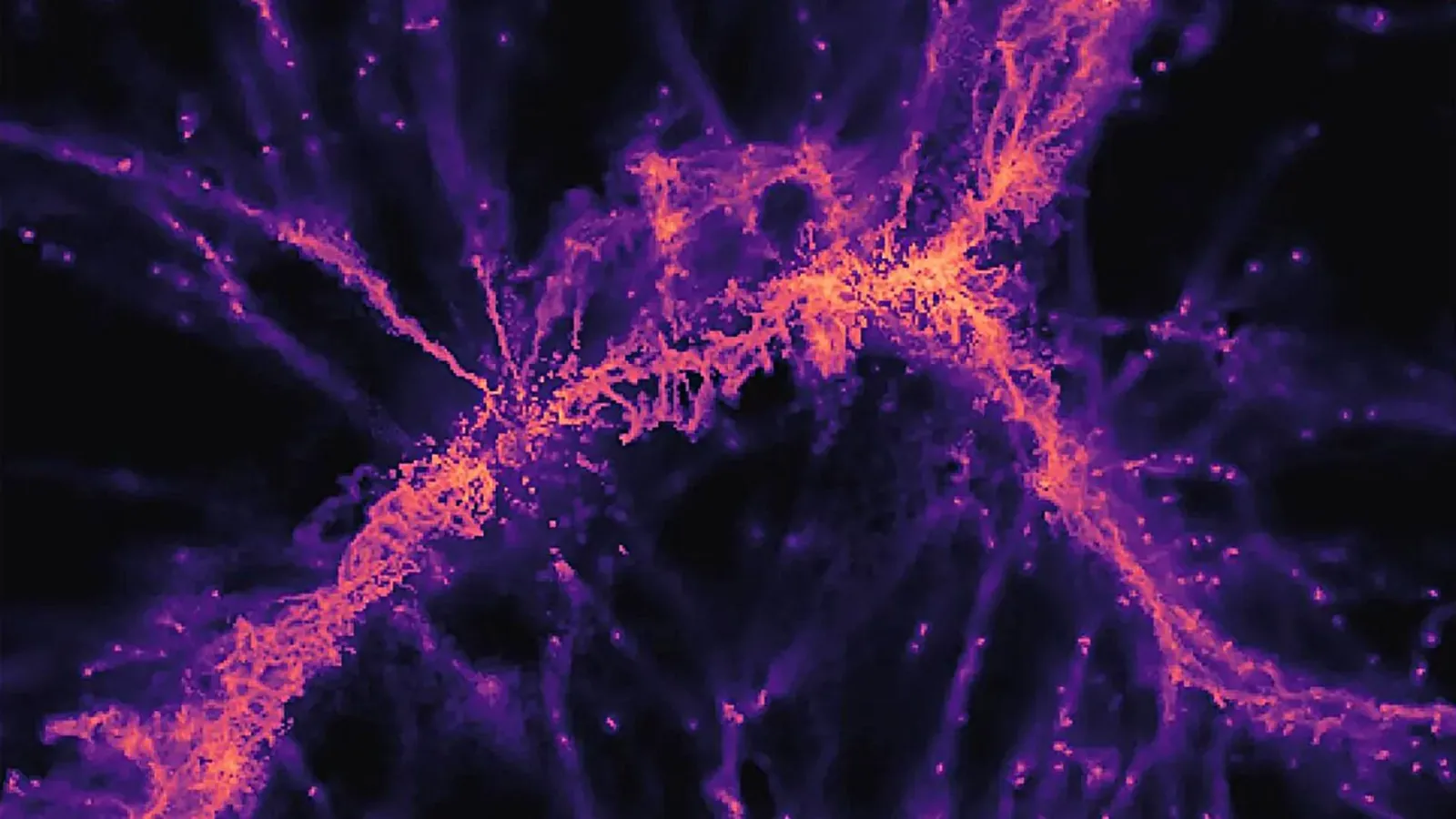
For the first time, astronomers have directly captured an image of the cosmic web, a vast network of gas and dark matter filaments that forms the largest structure in the universe. This groundbreaking observation, published in Nature Astronomy, offers an unprecedented direct look at one of the universe's most extensive structures and promises to deepen our understanding of how galaxies form and evolve over billions of years.
Modern cosmology posits that dark matter comprises about 85% of all matter. While invisible, it's believed to form a gigantic, web-like framework. Galaxies are thought to emerge at the intersections of these filaments, acting like cosmic construction sites. Scientists theorize these filaments also serve as intergalactic highways, funneling gas into galaxies to fuel the birth of new stars. Understanding this gas flow is crucial for grasping galaxy development, but directly observing it has been exceedingly difficult. Most intergalactic gas has been detected indirectly by measuring how it absorbs light from distant sources. Hydrogen, the most abundant element, emits only a faint glow, rendering direct observation challenging for previous instruments.
The new observations were led by researchers from the University of Milano-Bicocca in collaboration with scientists from the Max Planck Institute for Astrophysics (MPA). They utilized the MUSE (Multi-Unit Spectroscopic Explorer) instrument on the European Southern Observatory's Very Large Telescope in Chile. This ambitious project involved hundreds of hours of observation time dedicated to a single region of the sky, aimed at detecting the faint cosmic filament with enough clarity for detailed analysis.
Unveiling a 12-Billion-Year-Old Structure
The study, headed by PhD student Davide Tornotti, yielded the sharpest image ever obtained of a cosmic filament, stretching approximately 3 million light-years. This structure connects two galaxies, each hosting an active supermassive black hole. The findings enable a novel method for studying the physical properties of gas within these intergalactic filaments. "By capturing the faint light emitted by this filament, which traveled for just under 12 billion years to reach Earth, we were able to precisely characterize its shape," explained Tornotti. "For the first time, we could trace the boundary between the gas residing in galaxies and the material contained within the cosmic web through direct measurements."
To interpret these complex observations, the researchers cross-referenced their data with sophisticated supercomputer simulations of the universe generated at MPA. These simulations were designed to predict the appearance of such filamentary structures according to current cosmological models. "When comparing to the novel high-definition image of the cosmic web, we find substantial agreement between current theory and observations," Tornotti stated, highlighting the alignment between theoretical predictions and empirical evidence. This validation is a significant step in confirming our models of the universe's large-scale structure.
The successful correlation between the MUSE observations and the MPA simulations bolsters scientists' confidence in their comprehension of gas distribution around galaxies and the mechanisms by which galaxies acquire the necessary material for ongoing star formation. The team now aims to identify numerous similar structures to construct a more comprehensive map of matter flow through the cosmic web. Fabrizio Arrigoni Battaia, an MPA staff scientist on the project, expressed enthusiasm: "We are thrilled by this direct, high-definition observation of a cosmic filament. But as people say in Bavaria: 'Eine ist keine' -- one doesn't count. So we are gathering further data to uncover more such structures, with the ultimate goal to have a comprehensive vision of how gas is distributed and flows in the cosmic web." This ongoing effort underscores the importance of persistent observation in building a complete picture of universal phenomena. The imaging of this filament provides a vital piece of that puzzle, offering direct evidence for theoretical frameworks that have long described the universe's underlying architecture. It also opens avenues for studying the evolution of gas within these structures and its impact on the galaxies they connect. The ability to directly image these faint structures is a testament to advancements in telescope technology and observational techniques, pushing the boundaries of what astronomers can perceive in the cosmos.