
Dark Matter Hunters Detect Unexplained Particle Signal
Physicists at the LZ Dark Matter Experiment have detected a curious particle signal that doesn't match known interactions. While not confirming dark matter, the finding has sparked excitement and calls for community feedback.

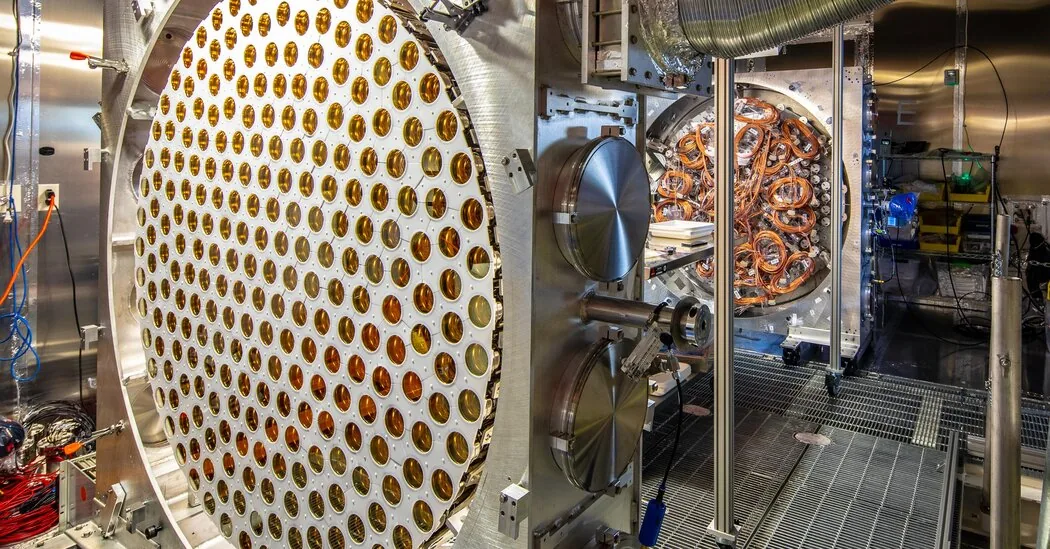
Physicists operating the LZ Dark Matter Experiment, located deep underground at the Sanford Underground Research Facility in South Dakota, have announced a puzzling new result. After years of meticulous data analysis, the team has recorded a peculiar signal generated by a single particle interaction that does not align with any known subatomic phenomena. The discovery, detailed in a recent paper, has generated significant interest within the scientific community, though researchers are cautious about definitive conclusions.
The LZ experiment is designed to detect dark matter, the elusive, invisible substance whose gravitational influence is crucial to understanding the structure and evolution of galaxies. Billions of dollars and countless hours have been invested worldwide into instruments capable of sensing the faint interactions expected from dark matter particles. This latest finding represents a potentially significant deviation from background noise or anticipated signals.
"At this point, we’re interested to get feedback from the wider scientific community," said Richard Gaitskell, the spokesperson for the LZ collaboration. "After doing so much work internally, we felt ready to talk to the rest of the world about the results." The researchers emphasize that while the signal is anomalous, it is not yet a confirmed detection of dark matter itself. Instead, it signifies an event that defies current explanations within the Standard Model of particle physics.
Potential Implications for Physics
The implications of this unexplained event are profound, potentially opening new avenues of research or challenging existing theoretical frameworks. Physicists have long theorized about the existence of particles beyond the Standard Model, and dark matter is a prime candidate for such a discovery. If this signal is not dark matter, it could point to new fundamental particles or forces that have yet to be identified.
The sheer volume of data collected by the LZ detector, a massive vessel filled with ultra-pure liquid xenon, is designed to filter out cosmic ray interference and other terrestrial background noise. Its sensitivity allows scientists to search for the rare occasions when a WIMP (Weakly Interacting Massive Particle) or another hypothetical dark matter candidate might collide with an atomic nucleus. The experiment's underground location shields it from most cosmic radiation, enhancing its ability to detect these faint signals.
This result comes at a time when several large-scale dark matter experiments, including LZ, XENONnT, and SuperCDMS, are actively collecting data. The collaboration plans to conduct further analysis and potentially refine their experimental setup to gather more information about the anomalous signal. The scientific world will be watching closely as the LZ team and other researchers work to decipher the meaning behind this intriguing cosmic whisper.