
Jupiter's Role in Early Earth's Life Ingredients Revealed by NASA Study
New NASA-supported research suggests Jupiter's formation significantly influenced the distribution of phosphorus and nitrogen, key elements for life, in the early solar system and on Earth.

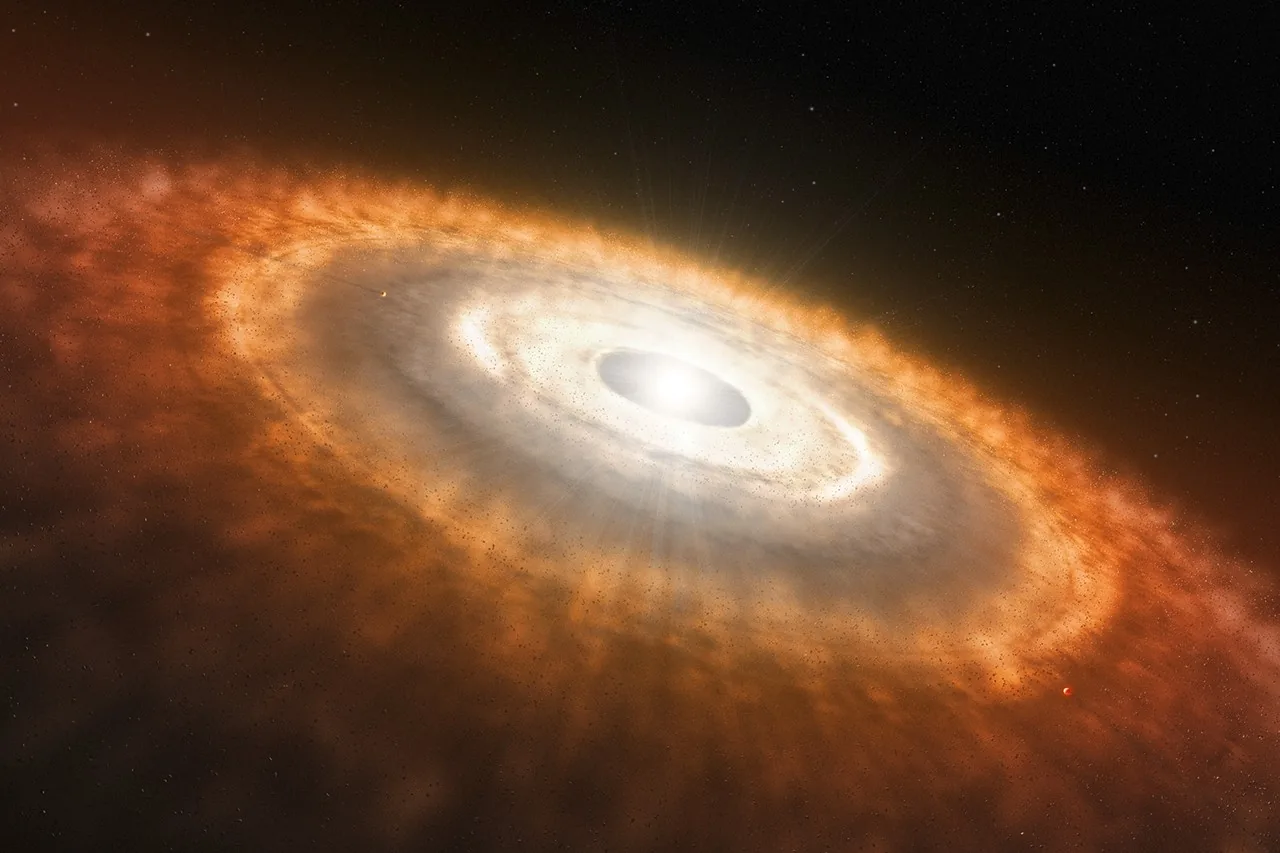
New research, backed by NASA, offers a novel perspective on how early Earth may have acquired the essential elements for life, highlighting a pivotal role for Jupiter in their distribution across the nascent solar system. The study, published in the journal Science Advances, analyzed the ratios of phosphorus to nitrogen in iron meteorites and chondrites to reconstruct the elemental makeup of the solar system over 4.5 billion years ago.
Our solar system began as a swirling disk of gas and dust around the proto-Sun. From this cosmic nursery, planets, moons, and eventually life emerged. Two elements, nitrogen and phosphorus, are considered crucial building blocks for life. In the solar system's infancy, this material coalesced into planetesimals, which frequently collided in the chaotic environment. These collisions created fragments that eventually formed planets and moons, with some surviving today as asteroids and meteorites. These ancient remnants act as time capsules, offering scientists direct insights into the conditions of the early solar system before Earth fully formed.
Iron meteorites, dense metallic objects primarily composed of iron and nickel, originate from the solar system's first generation of planetesimals. Chondrites, on the other hand, are stony meteorites derived from a second generation of planetesimals that formed approximately 2 to 3 million years later. Understanding the composition and origin of these different meteorite types is vital for astrobiologists seeking to pinpoint when and how Earth became habitable.
Jupiter's Gravitational Influence Shaped Elemental Distribution
A key debate among scientists concerns the origin of Earth's essential life elements, particularly phosphorus and nitrogen. Previously, some theories posited that chondrites from the outer solar system delivered these vital ingredients late in Earth's formation. However, this new study presents a different scenario. By employing laboratory experiments and sophisticated geochemical modeling, researchers mapped the phosphorus-nitrogen (P/N) ratios across the early solar system. Their findings revealed distinct differences between the first and second generations of planetesimals.
Experiments indicated that the first generation of planetesimals had a higher P/N ratio in the outer solar system, with this ratio decreasing closer to the Sun. This trend reversed in the second generation, which exhibited higher P/N ratios in the inner solar system. Scientists theorize that an outward flow of material during the formation of the first planetesimals enriched the outer solar system's P/N ratio. Subsequently, the formation and immense gravitational influence of Jupiter fundamentally altered this distribution.
"For our own solar system, Jupiter's presence and growth history, indeed, seem to have played a critical role in determining the distribution of the basic chemical ingredients necessary for habitable worlds," stated Rajdeep Dasgupta of Rice University in Houston, the senior author of the study. He added that it remains an open question whether a life-essential element budget similar to Earth's can be established without a Jupiter-like planet in planetary system populations.
The study's geochemical accretion modeling further suggests that Earth's current P/N signature is best explained by material originating from inner solar system planetesimals, whether they were related to iron meteorites or chondrites. "The study suggests that Earth acquired its inventory of the life-essential elements phosphorous and nitrogen primarily from the inner solar system, without requiring a significant contribution from outer solar system chondrites," explained lead author Debjeet Pathak, a graduate student at Rice University.
This research provides critical context for understanding planetary habitability and the conditions that led to life on Earth. The intricate interplay between planetary formation and the availability of key elements underscores the complexity of life's origins.