
New Jersey Meteorite Holds Life's Building Blocks From Ancient Proto-Planet
A meteorite that crashed through a New Jersey home contains amino acids and carbon compounds, crucial ingredients for life. The discovery offers insights into early solar system chemistry.

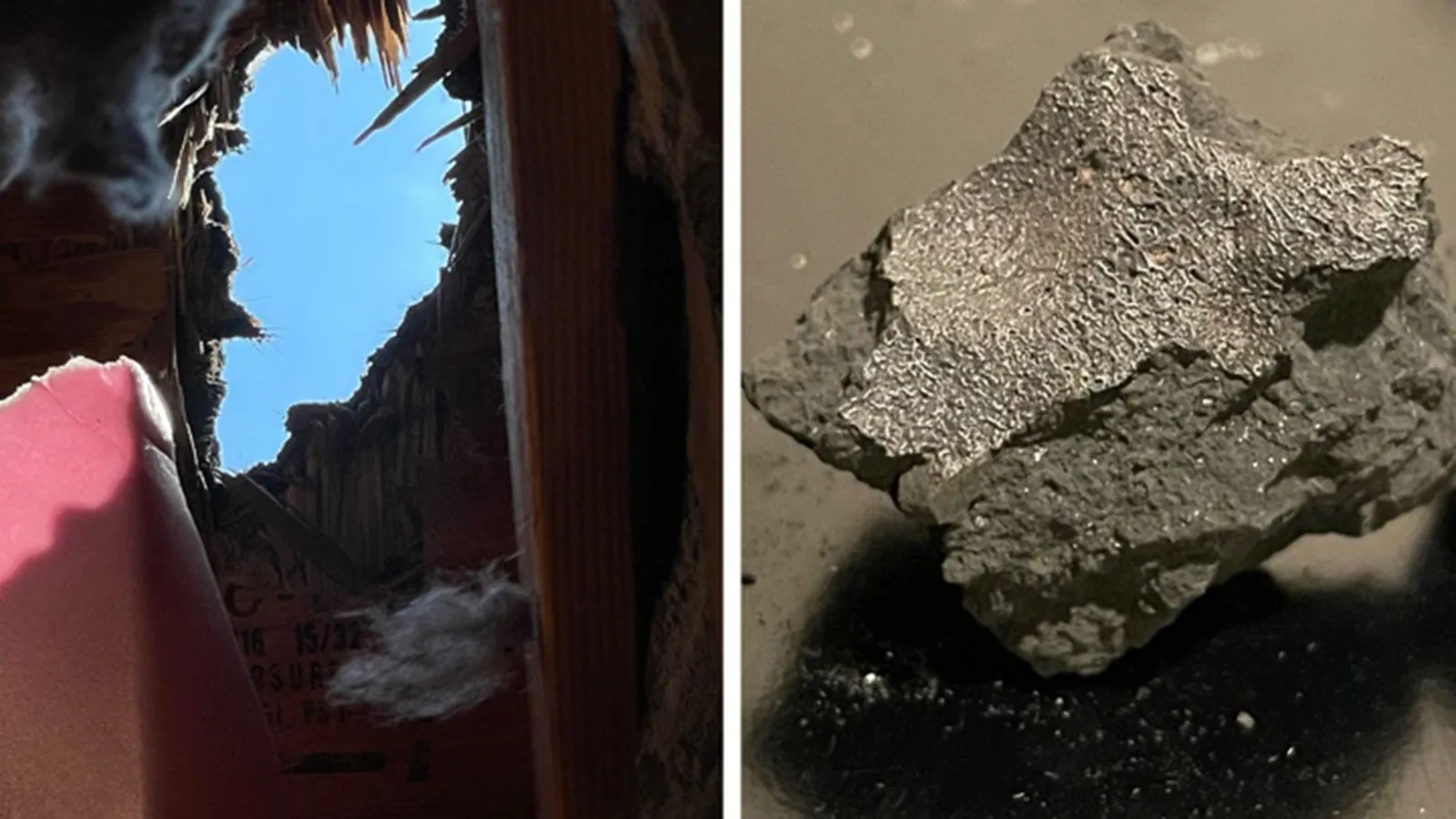
Scientists have identified the fundamental building blocks of life, including amino acids and carbon compounds, within a meteorite that spectacularly breached a New Jersey residence two years ago. The analysis reveals the space rock originated from a primitive, possibly incompletely formed, planet in our solar system, and its contents may mirror the primordial chemistry that seeded life on Earth.
The discovery stems from a new study examining fragments of the meteorite, which fell through the roof of a home in Hillsborough, New Jersey, on July 16, 2024. The homeowner, whose identity was not released, acted swiftly to preserve the extraterrestrial material. Following the loud crash and a strong, sulfurous odor, the individual collected numerous black fragments and dust using disposable gloves and aluminum foil, storing them in glass jars. This quick action was lauded by lead researcher Peter Jenniskens, a meteor astronomer affiliated with the SETI Institute and NASA's Ames Research Center, as critical for the scientific investigation.
"I was at home at the time, heard a loud crash and found a hole in the ceiling of the master bedroom," the homeowner stated in a release from the SETI Institute. "I smelled a strong, sulfur-like odor and saw many black fragments, along with debris and black dust that covered my bed, carpet and surrounding areas."
Forensic examination of these precious fragments suggested they originated from near the surface of a small, primitive asteroid. The study indicates this body experienced concentrated salty fluids, a chemical process previously undocumented on such "protoplanet" worlds. "A forensic study of the fragments revealed that they contained preserved bits from near the surface of a small primitive asteroid where it experienced concentrated salty fluids — a process not previously known from this type of protoplanet world," Jenniskens explained.
Meteorite's Journey and Composition
The research, published on July 15 in the journal Science Advances, also meticulously reconstructed the meteorite's trajectory. On the morning of July 16, 2024, over 60 observers across New York, New Jersey, and surrounding Northeastern states witnessed a brilliant meteor. This object was later confirmed to be traveling at approximately 32,000 mph (51,500 km/h). The atmospheric entry generated a shock wave, which was felt by at least 16 individuals in New York and New Jersey. The space rock fragmented in the atmosphere, with eyewitness reports ceasing around 22 miles (35 kilometers) above the ground. Newark Liberty International Airport's Doppler weather radar briefly detected falling debris.
Only fragments from one recovered meteorite, subsequently named Hillsborough after the town, were identified. The American Meteor Society played a crucial role in tracing the meteor's origin, utilizing data from its cameras in Northford, Connecticut, and Douglassville, Pennsylvania, along with a doorbell camera in Wayne, New Jersey. Mike Hankey, operations manager at the American Meteor Society and a co-author of the study, confirmed the findings. "The path traced back to low in the asteroid belt."
The Hillsborough meteorite is significant as it is only the second stony meteorite of its kind ever documented during a fall event. Subsequent analysis revealed the rock's interior was rich in ancient brines, or salt. Scientists have classified this unique specimen as a type of carbonaceous chondrite, a class of meteorites known for their primitive composition and potential to harbor organic compounds.
This discovery is particularly exciting for astrobiologists and planetary scientists. Carbonaceous chondrites are considered some of the most primitive objects in the solar system, retaining chemical signatures from its earliest history. The presence of complex organic molecules, like amino acids, within such a pristine sample provides invaluable data for understanding the conditions present during the formation of planets and the potential for life to arise elsewhere in the universe. The specific conditions identified within the Hillsborough meteorite—salty fluids interacting with primitive materials—offer new avenues for research into prebiotic chemistry and the processes that might have led to life's emergence on Earth.