
JWST Spots Massive Black Hole Challenging Cosmic Growth Theories
The James Webb Space Telescope has discovered a supermassive black hole 50 million times the mass of the Sun, existing just 700 million years after the Big Bang. This finding challenges current astrophysical models of black hole formation and galaxy evolution.

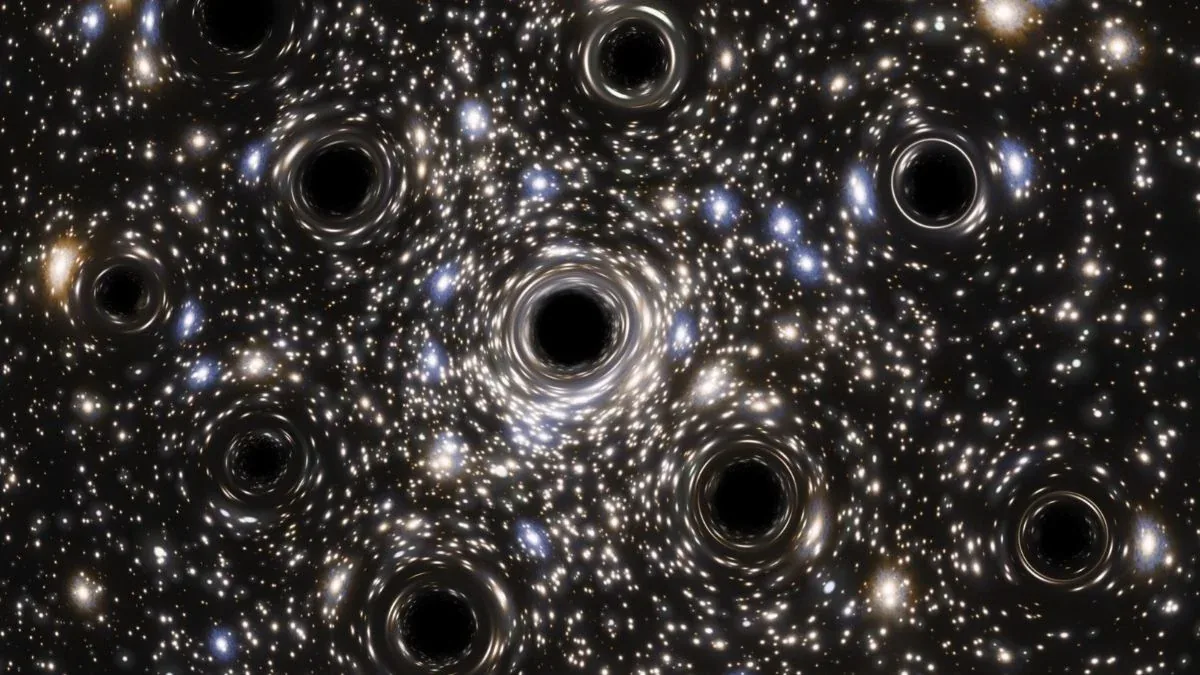
Astrophysicists using the James Webb Space Telescope (JWST) have identified a supermassive black hole, designated Abell2744-QSO1, with a mass approximately 50 million times that of our Sun. Remarkably, this black hole appears to have formed and grown to its immense size astonishingly early in the universe's history, within the first 700 million years after the Big Bang. This discovery directly contradicts established astrophysical models that propose a more gradual growth process for black holes.
The conventional understanding posited that stellar-mass black holes, formed from collapsing stars, would slowly accumulate mass by accreting surrounding matter and merging with other black holes. Galaxies themselves merge, drawing their central black holes into co-evolution. This hierarchical process was believed to be the primary driver for the formation of the supermassive black holes (SMBHs) observed at the centers of galaxies today. However, the existence of Abell2744-QSO1 challenges this narrative.
A Paradigm Shift in Cosmic Understanding
The finding stems from observations of a distant object known as a "Little Red Dot" (LRD), which is being gravitationally lensed and magnified by the galaxy cluster Abell 2744, also called Pandora's Cluster. This lensing effect allows astronomers to study the LRD in greater detail than would otherwise be possible. Initial assessments suggested Abell2744-QSO1 was a gas cloud hosting a SMBH of about 40 million solar masses. However, a new, direct measurement using JWST's Near-Infrared Spectrograph (NIRSpec) has refined this estimate to 50 million solar masses.
"This is a remarkable finding," stated Roberto Maiolino, a lead author on one of the two new papers detailing the discovery and affiliated with the Kavli Institute for Cosmology at the University of Cambridge. "It's a paradigm shift, a total revisiting of the classical scenarios of how black holes form and grow." The research appears in two distinct scientific journals: "A direct black-hole mass measurement in a little red dot at high redshift" in Nature, and "A black hole in a near pristine galaxy 700 Myr after the big bang" in the Monthly Notices of the Royal Astronomical Society. Both papers share lead authors Ignas Juodžbalis and Roberto Maiolino from Cambridge.
The direct mass measurement was crucial. Previously, black hole mass estimates in the early universe relied on indirect methods and assumptions derived from observations of local galaxies. "Before now, all of the mass measurements of black holes in the early Universe have been indirect, based on assumptions from what we know about them in the local Universe," explained co-author Francesco D'Eugenio of Cambridge University. "We didn't know if those assumptions really apply to the distant Universe." The JWST's capabilities allowed researchers to analyze the gravitational influence of the black hole on the surrounding gas, providing a more definitive mass determination.
What's more, the SMBH constitutes a significant fraction of its host galaxy's total mass, a proportion vastly different from what is observed in galaxies in the present-day universe. The authors noted in their Nature paper that QSO1 "lies orders of magnitude above the local scaling relations and is approximately 1 dex more overmassive than even the most extreme sources found by JWST so far." This suggests that either the black hole formed exceptionally quickly or the galaxy itself is unusually underdeveloped, or perhaps both. This finding is particularly puzzling given that the galaxy appears to be "chemically unevolved," meaning it has not yet undergone the extensive star formation and stellar deaths that typically enrich galaxies with heavier elements.
The discovery of such a massive black hole so early in cosmic history necessitates a re-evaluation of **black hole formation** theories. It prompts questions about whether the seeds for these colossal objects were much larger than previously thought, or if there are unknown, rapid mechanisms for **black hole growth** that operate in the nascent universe. The JWST's continued observations are expected to shed more light on these early cosmic behemoths and the processes that shaped them, potentially rewriting fundamental chapters of **astrophysics**.