
JWST Uncovers How Early Black Holes Fueled Their Rapid Growth
The James Webb Space Telescope has provided unprecedented insights into the feeding habits of supermassive black holes, revealing a self-regulating cycle of growth and restraint that explains their rapid expansion in the early universe.

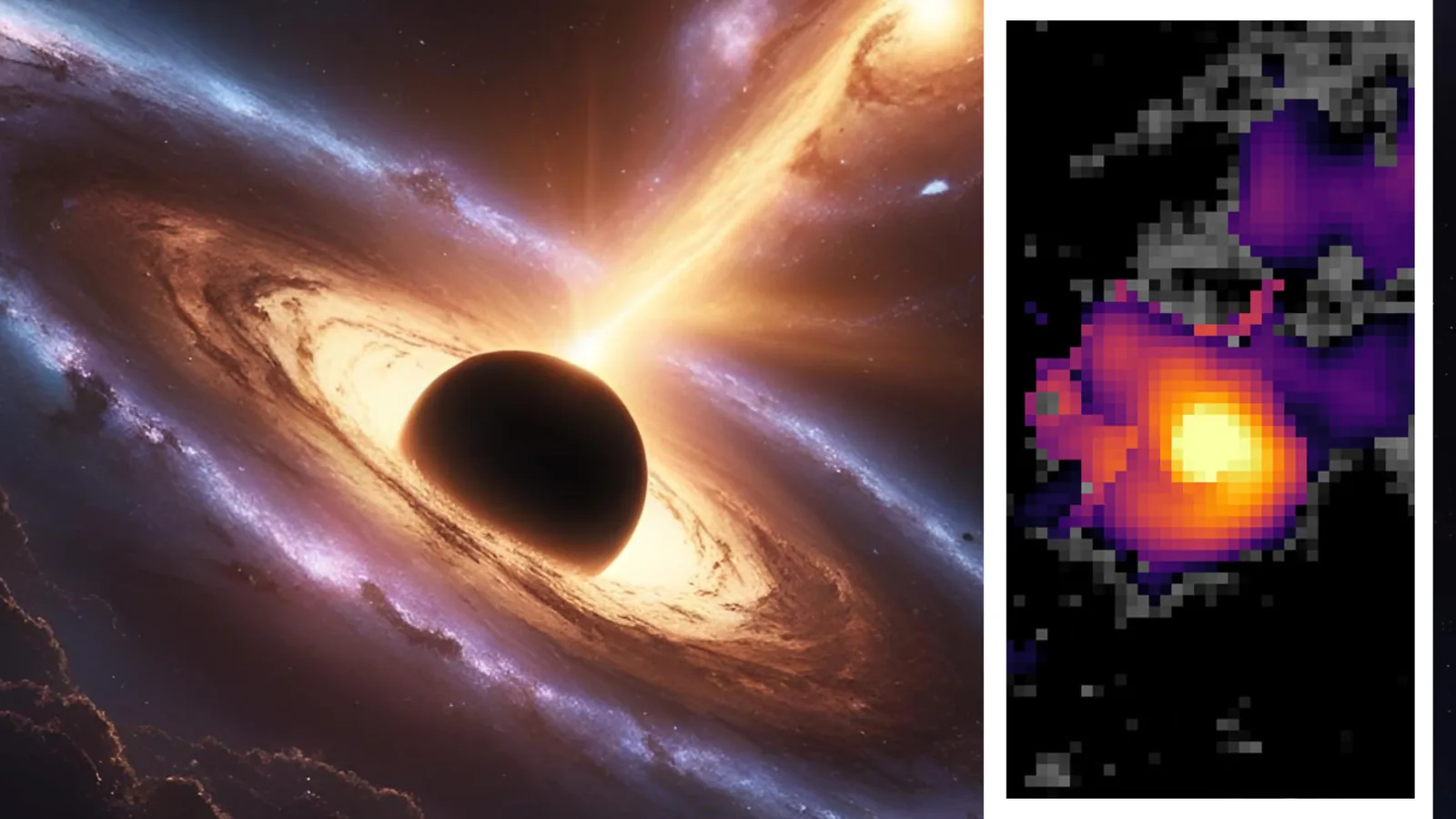
Astronomers using the powerful James Webb Space Telescope (JWST) have observed compelling evidence detailing how supermassive black holes, millions to billions of times the mass of our sun, sustain themselves and grow, particularly in the nascent stages of the universe. These findings are critical for understanding galaxy evolution, as these cosmic behemoths can dramatically influence their host galaxies by expelling gas essential for star formation. The observations tackle a long-standing puzzle: how these black holes became so massive so soon after the Big Bang, when theoretical models suggested a slower growth process.
While many large galaxies harbor dormant black holes, some are highly active, consuming vast amounts of surrounding gas and dust. These ravenous eaters power bright regions known as active galactic nuclei (AGN). A perplexing aspect for scientists has been spotting these enormous black holes in existence less than a billion years after the Big Bang. Conventional theories propose that black holes grow by accretion, a process that should take a significant amount of time, yet the early universe shows evidence of supermassive black holes already in place. Furthermore, faster-growing black holes, those consuming more matter, are also expected to eject material, theoretically limiting their own growth in a self-imposed diet.
A Cyclical Pattern of Feeding and Fasting
One leading explanation suggests a cyclical process: black holes expel gas, slowing their growth, but this ejected matter eventually cools and falls back toward the galactic center. This material then forms vast, filamentary structures, some stretching thousands of light-years, which then accrete onto the black hole, reigniting its feeding and growth. This renewed activity triggers powerful jets that once again expel gas, temporarily halting accretion and initiating another period of 'dieting.' This continuous loop of feasting and fasting could explain the rapid mass accumulation observed in early cosmic epochs. However, direct observational links between these gas filaments and feeding black holes remained elusive until now.
"What JWST is revealing is that black holes may be the ultimate cosmic recyclers," stated Julie Hlavacek-Larrondo, team leader from the Université de Montréal, in a press release. "They release enormous amounts of energy that heat their surroundings, yet that same gas can later cool into thin filaments that fall back inward and feed the black hole again. We are finally seeing this self-sustaining cycle in action." This direct observation of the cycle resolves a key uncertainty in astrophysical models of black hole growth.
To investigate this phenomenon, the JWST focused on NGC 4696, a galaxy at the center of the Centaurus Cluster, located a relatively nearby 145 million light-years away. This galaxy is known to host an active galactic nucleus. Previous observations by the Hubble Space Telescope had detected an unusual, hook-shaped swirl of gas near NGC 4696's central supermassive black hole. The JWST's advanced infrared capabilities allowed for a much more detailed mapping of the gas dynamics at the galaxy's core. These new observations revealed that this gaseous feature is approximately 800 light-years wide and comprised of gas moving at speeds up to 1.3 million miles per hour (600 kilometers per second).
Significantly, this swirling gas structure appears directly connected to an extensive filament of material actively flowing towards the central supermassive black hole. This connection provides the crucial visual evidence for the theorized gas infall that fuels rapid black hole growth. The discovery not only sheds light on how these colossal objects achieved their size in the early universe but also reinforces the interconnectedness of black holes and their host galaxies. Understanding these processes is fundamental to comprehending the overall evolution of cosmic structures, from the smallest galaxies to the largest galaxy clusters.