
Mars's Southern Hemisphere Hides Massive Heat Anomaly, New Study Finds
New research reveals a significant temperature difference beneath Mars's surface, with the southern hemisphere being much hotter. This anomaly could explain past volcanic activity and magnetic field loss.

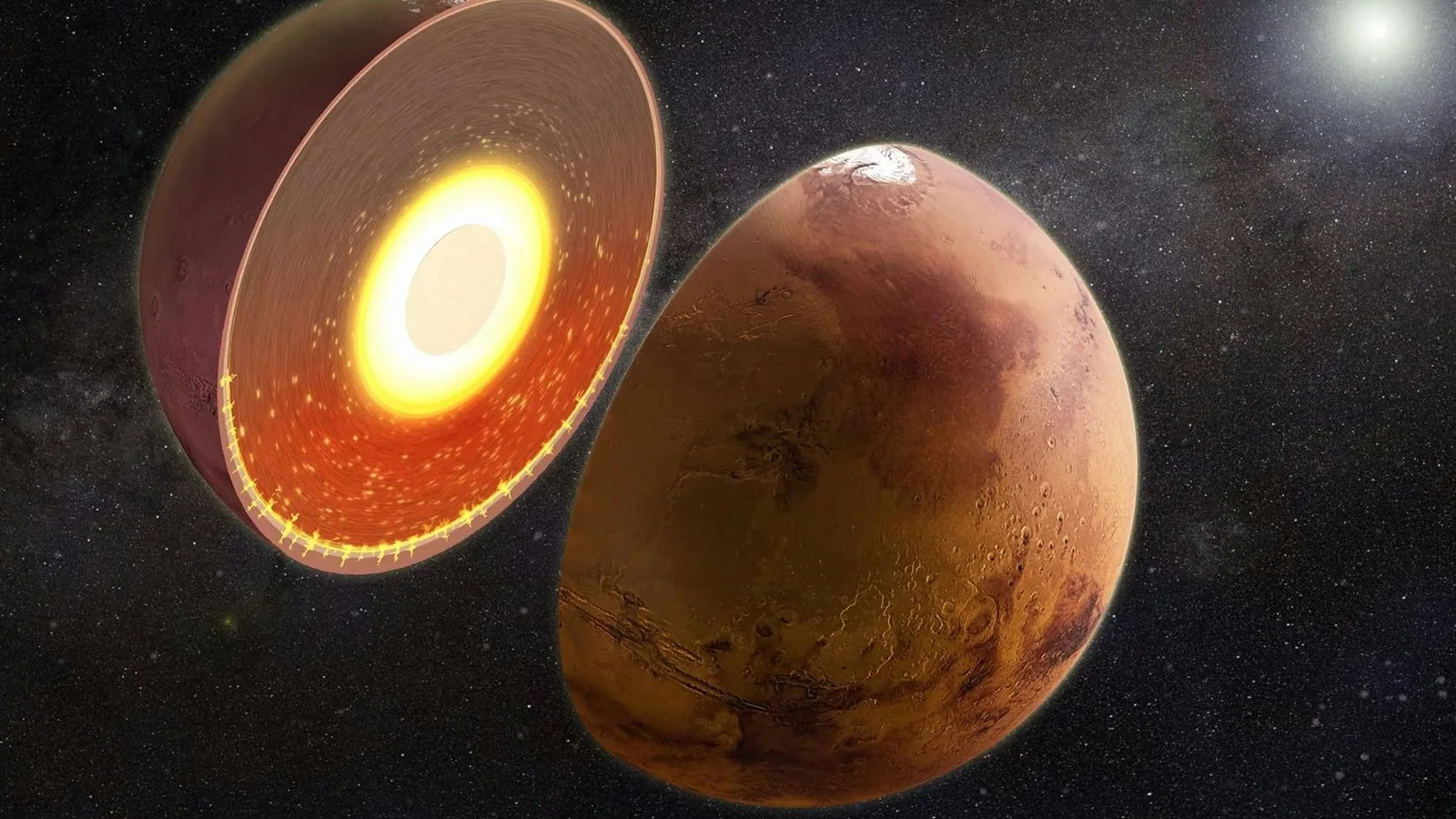
Scientists have uncovered compelling evidence of a massive thermal anomaly deep within the southern hemisphere of Mars, suggesting the Red Planet's interior is far from uniform. New research indicates temperatures beneath the southern highlands are as much as 750 degrees Fahrenheit (400 degrees Celsius) hotter than those in the northern hemisphere, deepening the mystery surrounding the stark dichotomy between Mars's smooth northern plains and rugged southern terrain.
The findings, published in a recent study, challenge traditional assumptions about planetary interiors. "Scientists usually assume that the interiors of planetary bodies are generally spherically symmetric, but this is not necessarily true," stated Alexander Berne, the lead author of the study and formerly of Caltech, now with the University of Arizona. Berne and his team employed a novel technique called 'tidal tomography,' analyzing archival data from NASA's Mars Global Surveyor, Mars Odyssey, and Mars Reconnaissance Orbiter spacecraft. By scrutinizing subtle variations in spacecraft orbital velocities, which reflect gravitational field differences, they were able to construct a detailed model of Mars's internal structure and temperature.
The technique accounts for the sun's gravitational influence as Mars traverses its elliptical orbit. The observed deviations in the gravitational field were substantial enough to indicate that the Martian mantle beneath the southern hemisphere is significantly warmer, potentially still partially molten. This internal heat disparity has profound implications for understanding Mars's geological history, volcanic activity, and potential for past habitability.
Surface and Interior Echoes of an Asymmetrical Planet
The north-south asymmetry on Mars is already well-established on its surface. The northern hemisphere is dominated by vast, low-lying plains, which some scientists theorize may have once harbored an ocean. In contrast, the southern hemisphere features a significantly thicker crust, averaging about 15.5 miles (25 kilometers) more than the north, and is characterized by extensive cratered highlands. This striking surface difference is now paralleled by a deep interior contrast.
"The dichotomy that we see between north and south is important to understand because it gives information about processes that may have influenced the hydrology of Mars, including the formation of basins that may have held water," explained Amirhossein Bagheri, a co-author from Caltech. The hotter southern mantle could also resolve other long-standing Martian puzzles. Data from NASA's InSight lander, which concluded its mission in December 2022, showed that seismic waves dissipated more rapidly in the southern regions, a phenomenon consistent with higher subsurface temperatures.
Furthermore, the warmer southern interior could shed light on the enigmatic magnetic anomalies detected in the south. While Mars currently lacks a global magnetic field, it possessed one over four billion years ago. If significant heat upwelling from the southern mantle pushed temperatures above the 'Curie temperature' in iron-bearing minerals near the surface, it could have demagnetized the crust, leaving behind the mysterious magnetic remnants observed today.
The exact origin of this profound north-south divide remains an active area of research. One leading hypothesis suggests a colossal ancient impact event over four billion years ago, which may have created the northern lowlands as a massive impact basin. Such an impact could have expelled significant internal heat, causing the northern mantle to cool more rapidly than the south. An alternative explanation posits that the thicker southern crust acted as a more effective insulator, trapping heat within the mantle. Future missions equipped with higher-resolution gravity mapping capabilities could potentially test these hypotheses by detecting magma intrusions beneath the surface, which would be expected if mantle heat were prevented from escaping by a thick crust.
Berne emphasized that the tidal tomography technique is not limited to Mars and could be instrumental in studying the internal structures of other celestial bodies, including Mercury and the moons of Jupiter. "As we get more gravity data, we can determine the three-dimensional intricacies of a planet's interior structure," Berne noted. "These inferences in turn give us a blueprint for designing future missions and scientific exploration of these worlds." Understanding these internal processes is crucial for piecing together the formation and evolution of planets across the solar system.