
Milky Way's Violent Flip Revealed: 10 Billion Year Old Galaxy Collision
Astronomers have uncovered evidence suggesting the Milky Way underwent a dramatic 'disc flip' over 10 billion years ago after a massive collision with a dwarf galaxy, reshaping our galaxy.

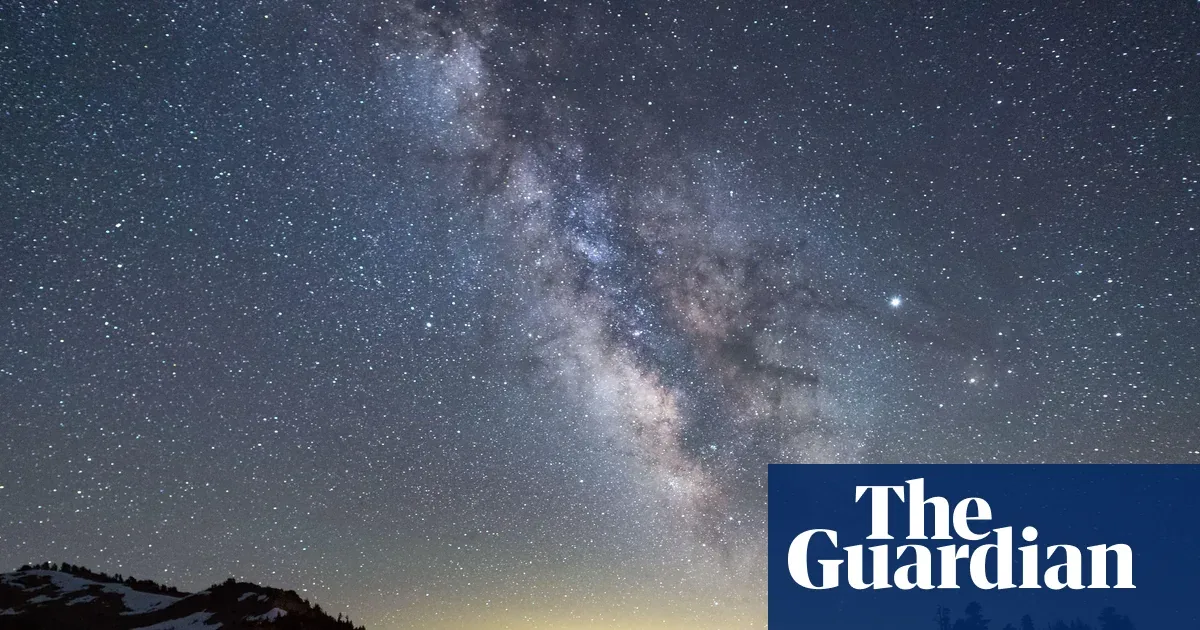
Astronomers have uncovered compelling evidence that the Milky Way galaxy experienced a dramatic cosmic upheaval approximately 10 billion years ago, when a head-on collision with a smaller dwarf galaxy, dubbed the Gaia Sausage, likely caused its entire disc to flip on its side. This cataclysmic event predates the formation of our solar system and fundamentally reshaped the structure of our galactic home.
The groundbreaking findings, presented at the Royal Astronomical Society's National Astronomy Meeting in Birmingham, emerged from sophisticated supercomputer simulations conducted by researchers at Durham University. These simulations demonstrated that Milky Way-like galaxies impacted by a galaxy the size of the Gaia Sausage were highly likely to undergo a significant "disc flip," reorienting the galactic disc by more than 90 degrees.
"It probably takes at least a few hundred million years," said lead researcher Kirill Batrakov of the extensive process. The team initiated their investigation into the puzzlingly slow rotation of stars within the Milky Way’s halo, a vast, spherical region surrounding the main galactic disc. Typically, halo stars are remnants of smaller galaxies that merged with the Milky Way over eons. However, these stars orbit the galactic center much slower—around 25 kilometers per second—compared to the roughly 220 kilometers per second orbital speed of stars in the main galactic disc.
Galactic Scars and Slow Orbiters
The simulations revealed a crucial link between head-on galactic collisions and the slower halo star orbits. Galaxies that sustained such direct impacts, similar to the described encounter with the Gaia Sausage, subsequently exhibited this characteristic slow rotation in their stellar halos. This provided a compelling explanation for the long-standing astronomical mystery.
The initial hints of this colossal collision surfaced in 2018 through observations from the European Space Agency’s Gaia mission. Astronomers mapped the trajectories of stars within the Milky Way, identifying some stars on unusually elongated, sausage-shaped orbits. Tracing these orbits backward revealed they originated from a dwarf galaxy that was torn apart upon impacting the Milky Way's core. These extreme stellar paths served as the definitive 'smoking gun' for the collision, leading to the dwarf galaxy's distinctive name.
Scientists now recognize this merger as the Milky Way's last major galactic merger, a pivotal event that created the central bulge of our galaxy and significantly influenced the formation of the surrounding stellar halo. Despite being classified as a dwarf galaxy, the Gaia Sausage was immense, possessing a mass exceeding 10 billion times that of our sun, including stars, gas, and dark matter.
While the Gaia Sausage collision was a defining moment, the Milky Way continues to evolve. In a few billion years, it is expected to merge with the Large Magellanic Cloud, another dwarf galaxy. A less dramatic merger is currently underway with the much smaller Sagittarius dwarf galaxy, which is not anticipated to cause the kind of profound structural changes seen in the ancient Gaia Sausage encounter.
"It’s not as massive as the Gaia Sausage was, so it is not going to influence the Milky Way as much, and the Milky Way itself is far more massive now than it was back then," Batrakov explained, highlighting the difference in scale and impact compared to the ancient collision. The understanding of this ancient event provides crucial insights into the dynamic history and ongoing evolution of our galaxy.