
Wildfire Evacuates NASA Deep Space Network Complex Near Madrid
A wildfire near Madrid forced the evacuation of NASA's Deep Space Network complex on Friday, temporarily halting operations at a crucial global tracking site. Support has been rerouted to California.

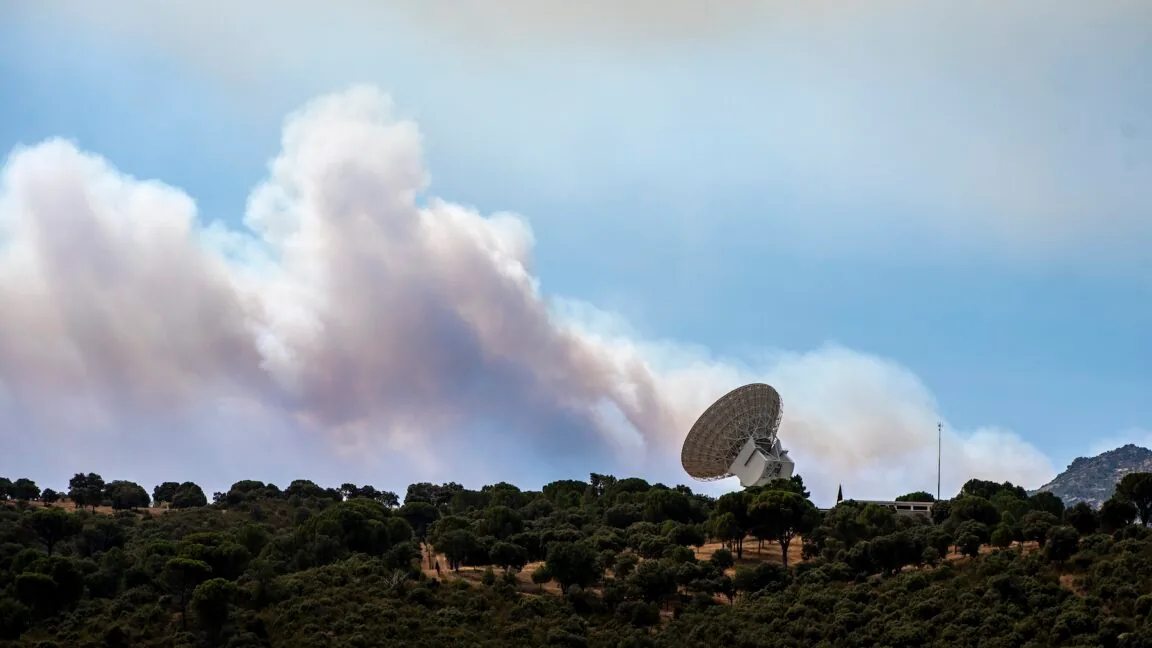
A fast-moving wildfire encroached upon NASA's Deep Space Communications Complex near Madrid on Friday, prompting an immediate evacuation and temporary suspension of activities at a critical global tracking facility. The complex, located approximately 40 miles west of the Spanish capital, is a vital component of NASA's Deep Space Network (DSN), which provides continuous communication with spacecraft across the solar system.
The DSN operates a trio of globally distributed facilities – in Goldstone, California; Canberra, Australia; and near Madrid – to ensure constant contact with missions as Earth rotates. These stations support over 40 scientific endeavors, ranging from lunar exploration and the James Webb Space Telescope to distant probes like the Voyager spacecraft. The Madrid site, distinguished by its large 70-meter radio dish and several smaller 34-meter antennas, was visibly threatened by flames and smoke plumes captured in images from the area.
A NASA spokesperson confirmed the evaluation of the Spanish facility "due to ongoing wildfires in the region." The agency stated that any potential damage would be assessed once it was safe to do so. Mission operations were seamlessly transferred to the Goldstone Deep Space Communications Complex in California, ensuring uninterrupted service for NASA's fleet of spacecraft. The Deep Space Network is managed by NASA's Space Communications and Navigation program and the Jet Propulsion Laboratory.
Network Resilience Tested by Fire and Damage
This incident highlights the vulnerabilities of essential space infrastructure to terrestrial events. The safety of personnel was cited as the highest priority by NASA officials, who are coordinating with local Spanish authorities and the U.S. Embassy. While the Madrid site was down, NASA's website showed activity from the Australian and California complexes communicating with probes such as Voyager 2 and Juno.
Compounding the situation, the Goldstone DSN's largest 70-meter antenna has been offline since last year following an accident that caused it to over-rotate, damaging internal components and leading to water contamination. Repairs, projected to cost between $4.1 million and $4.6 million, are being combined with planned upgrades and are expected to keep that antenna out of service until 2028. This leaves the DSN with fewer operational high-capacity antennas than usual, particularly crucial for upcoming high-demand missions.
The Madrid complex's absence, however, does not immediately jeopardize major upcoming missions like the Artemis program. The next Artemis mission is still several years away, with Artemis III not scheduled until at least 2028. These lunar missions require substantial DSN resources for telemetry and imagery, especially those involving human spaceflight. The current challenges underscore the need for robust redundancy and rapid response capabilities within NASA's global communication infrastructure.
The wildfires impacting Spain have been exacerbated by a summer heatwave and prolonged drought conditions, creating tinderbox environments across the region. Spanish authorities reported ordering the evacuation of over 19,000 people from towns in the mountains west of Madrid, deploying significant resources to combat the blazes. Nearby, a separate deep space tracking station operated by the Spanish government and the European Space Agency, the Cebreros facility, was also evacuated due to the fires, according to reports.