
NASA Declares Mars MAVEN Orbiter Officially Deceased After Radio Silence
NASA has officially declared its MAVEN Mars orbiter dead after repeated attempts to reestablish contact failed. The spacecraft went silent in December 2025 following a mysterious incident behind the Red Planet.

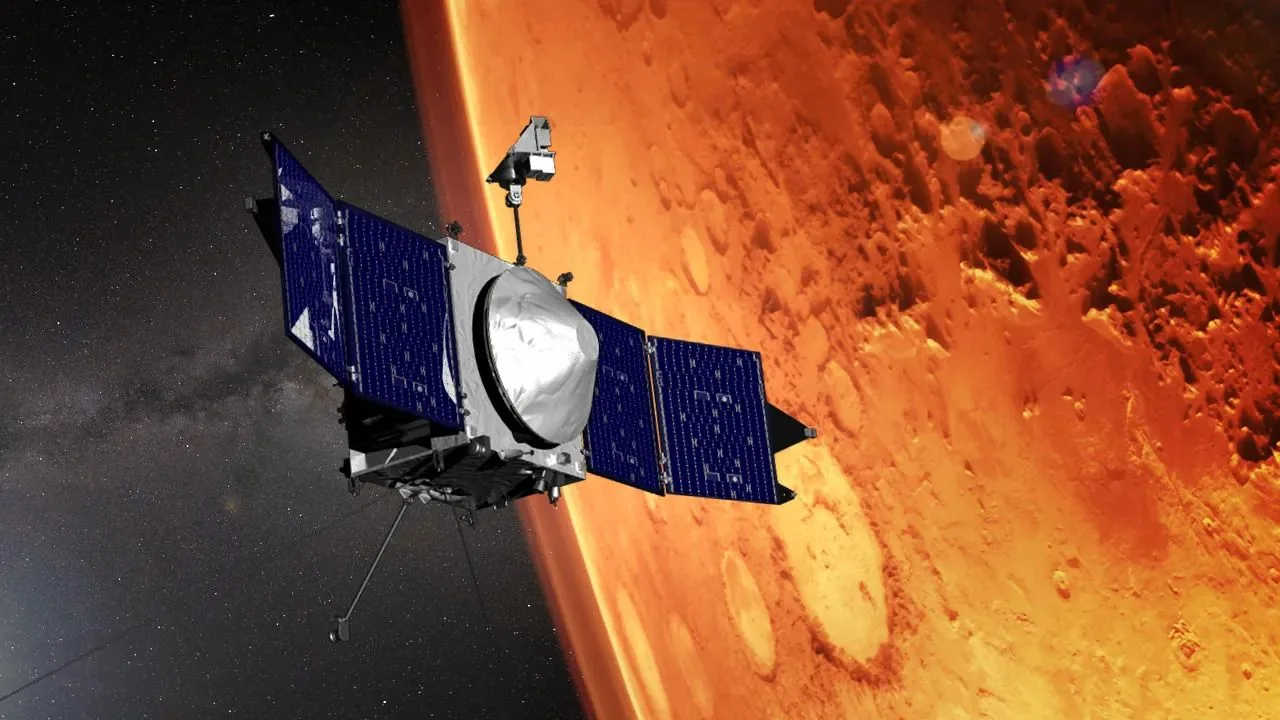
NASA has announced the official end of the Mars Atmosphere and Volatile EvolutioN (MAVEN) mission, declaring the Red Planet orbiter defunct after months of unsuccessful efforts to regain communication. The solar-powered spacecraft, a key player in understanding Martian atmospheric evolution, went silent on December 6, 2025, when its orbit carried it behind Mars. Upon emerging, telemetry indicated the satellite had entered safe mode and was spinning uncontrollably, leading to a power loss, according to a NASA review board in February 2026. A press briefing was scheduled for June 3, 2026, to detail the mission's conclusion.
The MAVEN mission, which launched in November 2013, was designed to study the Martian atmosphere's thinning and its interaction with the solar wind. Its original one-year mission was significantly extended, allowing it to gather crucial data for over a decade. This longevity made it one of NASA's longest-serving Mars orbiters, contributing significantly to scientific understanding even after its operational silence began.
Orbiter's Mysterious Demise and Legacy
The exact cause of the incident that led to MAVEN's operational failure remains under investigation by NASA. The spacecraft's final transmission was received before it disappeared behind Mars, and subsequent attempts to reestablish contact after its reappearance proved fruitless. The loss of MAVEN marks the end of an era for Mars exploration, reducing the number of active NASA orbiters at the Red Planet.
Currently, only two NASA orbiters remain in operation around Mars: the Mars Odyssey, launched in 2001, and the Mars Reconnaissance Orbiter (MRO), which began its mission in 2005. Both of these spacecraft are also operating well beyond their designed mission lifetimes, underscoring the enduring performance of NASA's deep space assets. MAVEN also served as a vital communications relay for the rovers operating on the Martian surface, a role now covered by the remaining active spacecraft, including Odyssey, MRO, and European missions like Mars Express and the Trace Gas Orbiter.
"The data collected from MAVEN will continue to provide valuable insight into Mars for decades to come," stated Louise Prockter, director of NASA's Planetary Science Division, in the agency's official announcement. The orbiter was the first dedicated instrument package designed to analyze atmospheric loss and its relationship with solar wind stripping. Its findings have been instrumental in building models of planetary climate evolution and understanding the potential for past habitability on Mars.
The end of the MAVEN mission, while a loss for active Mars observation, signifies a successful, long-term scientific endeavor. The data archives from its extensive operations will continue to be a rich resource for planetary scientists worldwide. NASA's ongoing commitment to Martian exploration remains robust, with future missions planned to further unravel the mysteries of the Red Planet.