
NASA Psyche Spacecraft Uses Mars Flyby for Gravity Boost and Instrument Check
NASA's Psyche spacecraft captured a stunning time-lapse video during a recent flyby of Mars. The mission used the planet's gravity for a significant speed boost and tested its scientific instruments.

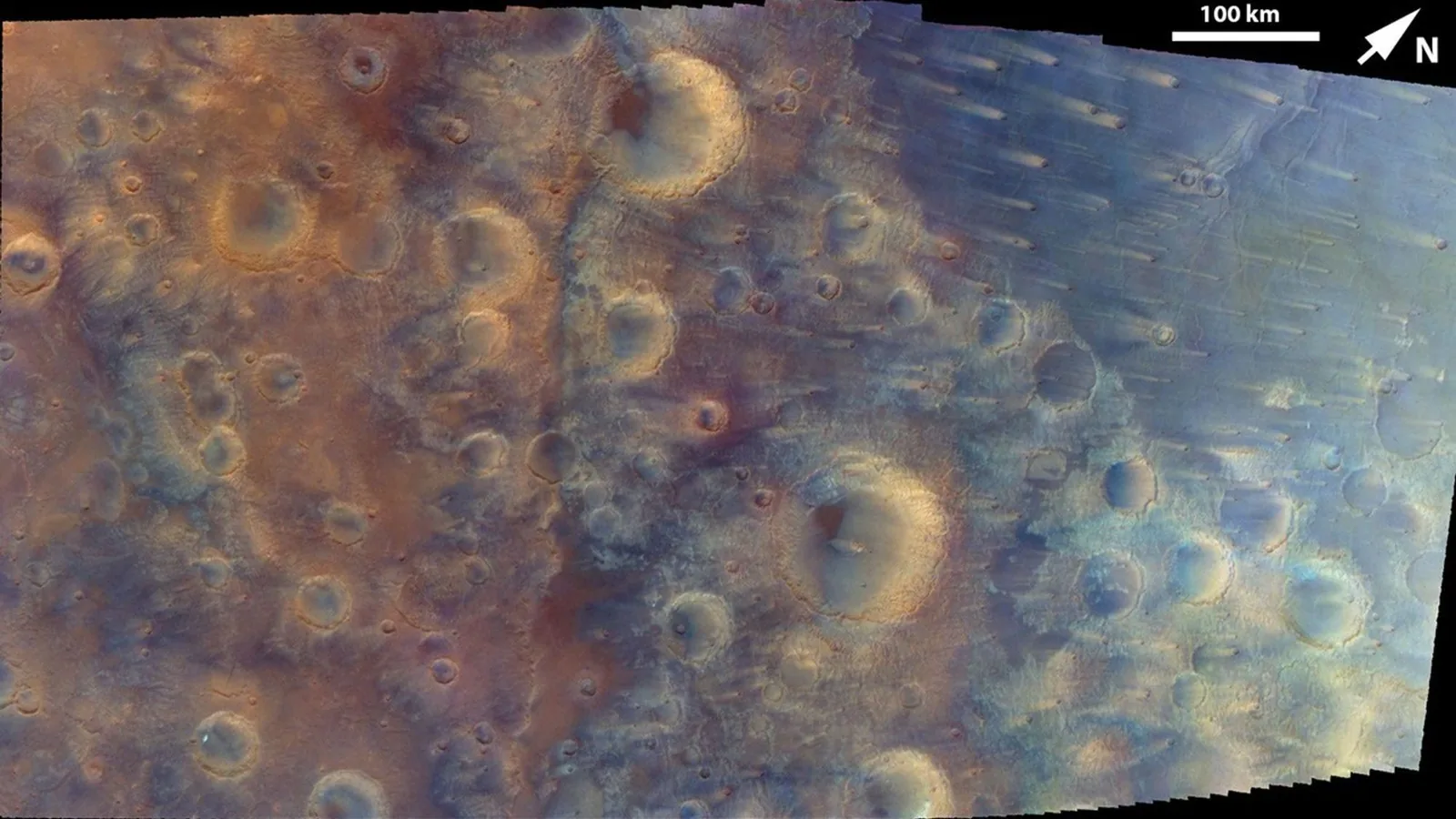
NASA's Psyche spacecraft captured a dramatic series of images, compiled into a time-lapse video, during a close flyby of Mars in May. The encounter not only provided a valuable gravity assist to propel the spacecraft towards its ultimate destination but also served as a critical test for its scientific instruments. On May 15, Psyche passed within approximately 2,864 miles (4,609 kilometers) of the Martian surface, leveraging the planet's gravitational pull to increase its velocity and refine its trajectory for a planned rendezvous with the metal-rich asteroid Psyche in 2029.
"This gravity assist was years in the making, and the navigation team nailed it — Psyche flew by Mars on exactly the trajectory we needed to set us on a path to rendezvous with the asteroid in the summer of 2029," said Bob Mase, Psyche's project manager at NASA's Jet Propulsion Laboratory in California. The spacecraft approached Mars at a steep angle relative to the sun, initially observing the planet as a slim crescent with only 4 percent of its disk illuminated. As Psyche drew nearer, the captured images revealed the planet's surface in increasing detail, showcasing numerous craters and the prominent south polar ice cap before the spacecraft moved past.
Instrument Calibration and Validation
Beyond its navigational significance, the Mars flyby offered a unique opportunity to calibrate and validate Psyche's sophisticated suite of scientific instruments. By aiming its instruments at a celestial body as extensively studied as Mars, mission engineers could verify their readiness for the asteroid exploration ahead. "We didn't anticipate big discoveries, given how extensively the planet has been studied, but we did complement Mars science with the data we collected through Psyche's unique perspective," explained Lindy Elkins-Tanton, principal investigator for the Psyche mission at the University of California, Berkeley. This scientific scrutiny confirmed that all three of the spacecraft's primary instruments performed as expected.
The gamma-ray and neutron spectrometer, designed to analyze the elemental composition of asteroid Psyche, detected a predicted surge of escaping neutrons upon closest approach. This confirmed the instrument's operational status. Similarly, the mission's magnetometer, intended to seek evidence of asteroid Psyche being the metallic core of a protoplanet, registered its first magnetic signature from a planetary body since its launch in 2023. It successfully detected the bow shock, the boundary where the solar wind interacts with Mars' magnetic field.
Psyche's twin multispectral cameras also successfully completed their calibration tests. These cameras captured the imagery for the recent time-lapse video and also identified Mars' small moons, Phobos and Deimos, from a distance. "Spotting the moons served as a practice for the satellite search that we'll use at the asteroid Psyche to look for any moonlets there," stated Jim Bell, a planetary scientist at Arizona State University and lead for the multispectral imager instrument team.
With its instruments thoroughly vetted and its trajectory locked, Psyche is now on course for its anticipated arrival at the metal-rich asteroid in the summer of 2029. The spacecraft is reported to be in excellent condition. "The spacecraft is in great shape, and we're on schedule to resume sustained thrusting with the solar-electric propulsion system later this fall," Mase added. The successful Mars flyby marks a significant milestone in the multi-year journey to explore the unique asteroid, offering insights into planetary formation.