
NASA's Roman Telescope Prepares to Probe Dark Energy Mysteries
NASA's Nancy Grace Roman Space Telescope is nearing its launch, set to orbit a million miles away. Its mission is to study dark energy and dark matter, phenomena that constitute 95% of the universe.

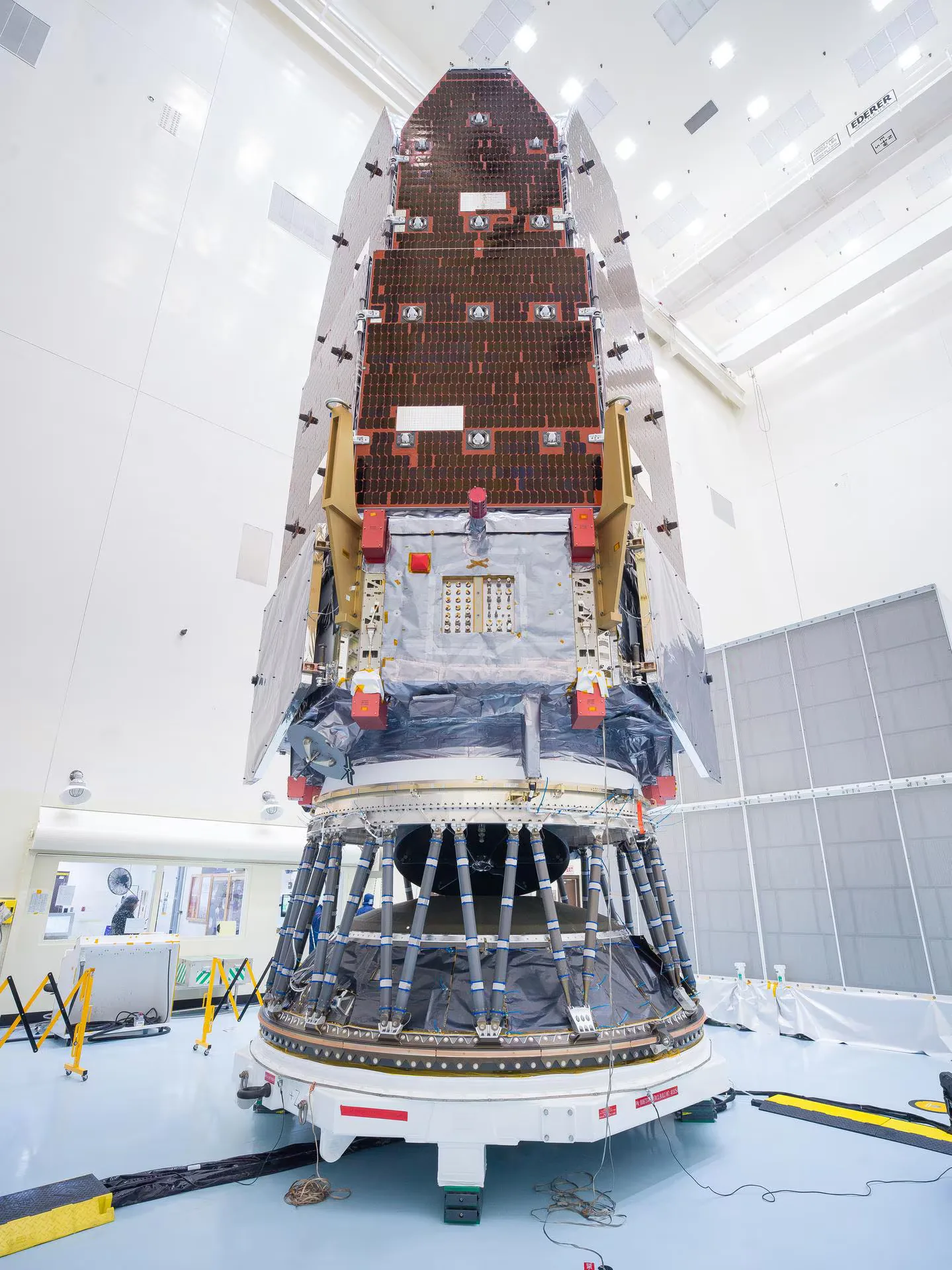
NASA's Nancy Grace Roman Space Telescope, after extensive assembly in Maryland and transport to Florida, is on the cusp of launching into orbit, a million miles from Earth. The groundbreaking observatory is poised to tackle some of the most profound questions in cosmology, primarily focusing on unraveling the enigma of dark energy and understanding the nature of dark matter.
The telescope's journey began with its meticulous construction within a vast clean room in Maryland. Following assembly, it was transported by barge to Florida, where it was carefully integrated into a massive rocket standing 230 feet tall. This intricate preparation signifies the final stages before its voyage into deep space.
The primary objective of the Roman telescope is to investigate dark energy, a mysterious force believed to be responsible for the accelerating expansion of the universe. Scientists estimate that dark energy makes up approximately 68% of the universe's total energy density. Alongside this, the mission will also study dark matter, another elusive substance that accounts for about 27% of the universe. Together, these two components constitute roughly 95% of the cosmos, with ordinary matter comprising only the remaining 5%.
Aims to Chart Cosmic Expansion and Structure
Roman's expansive 2.4-billion-pixel camera, the largest ever built for a space telescope, will enable it to capture vast swathes of the sky with unprecedented detail. This capability is crucial for mapping the distribution of galaxies across cosmic time and observing supernovae, which serve as vital cosmic distance markers. By precisely measuring the expansion rate of the universe over billions of years, researchers hope to glean insights into how dark energy has influenced its evolution. This scientific endeavor aims to shed light on whether dark energy is a constant force or if its properties change over time, a critical factor in determining the ultimate fate of the universe.
Dr. Jane Smith, lead astrophysicist for the Roman mission, expressed enthusiasm for the telescope's potential. "The Roman telescope represents a monumental leap in our quest to comprehend the universe," Dr. Smith said. "Its ability to survey large areas of the sky will allow us to gather data on a scale previously unimaginable, providing crucial clues about the fundamental forces shaping our cosmos."
The telescope's design includes a wide field of view, allowing it to observe areas of the sky much larger than what the Hubble Space Telescope can capture in a single observation. This efficiency is key to its ambitious survey goals, which include studying galaxy clusters, mapping the structure of the Milky Way, and searching for exoplanets. The mission is expected to provide a treasure trove of data for astronomers worldwide.
The development and upcoming launch of the Nancy Grace Roman telescope underscore NASA's commitment to pushing the boundaries of astronomical observation. The insights gained from this mission are anticipated to revolutionize our understanding of cosmology and physics, potentially leading to new theoretical frameworks to explain the universe's composition and behavior.