
NASA's Roman Telescope Primary Mirror Passes Final Inspection
NASA engineers have completed the final inspection of the Nancy Grace Roman Space Telescope's primary mirror. The 7.9-foot mirror is crucial for capturing detailed cosmic panoramas and is on track for a September launch.

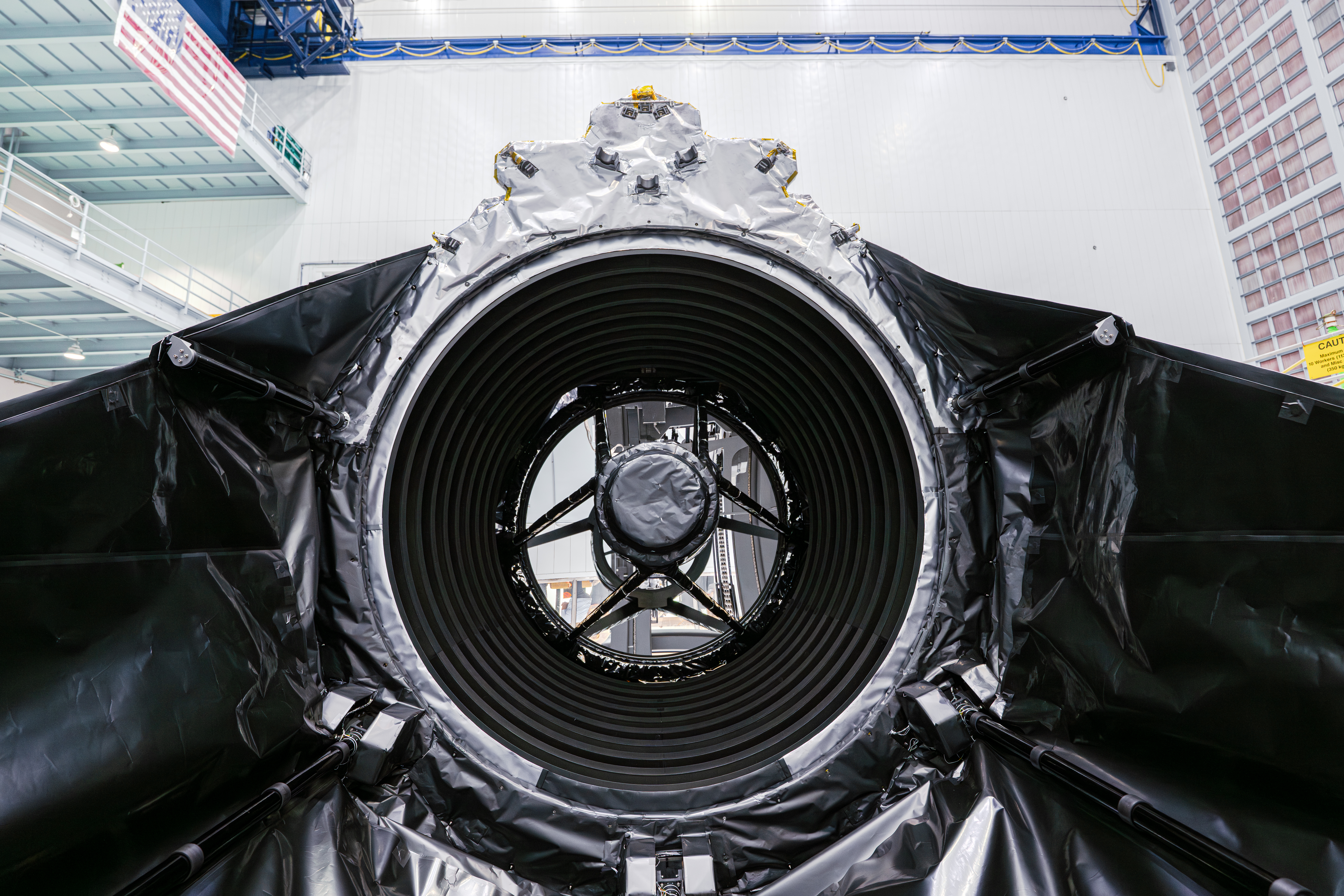
Engineers at NASA’s Goddard Space Flight Center in Greenbelt, Maryland, have conducted the final, critical inspection of the primary mirror for the upcoming Nancy Grace Roman Space Telescope. This 7.9-foot (2.4-meter) component is designed to gather and focus light from distant celestial objects, enabling the Roman telescope to deliver unprecedented views of the universe. The successful inspection means the observatory remains on schedule for its planned early September launch.
"The Roman engineering team laid eyes on the telescope for the final time before it, in turn, becomes the eyes of humanity, revealing the wonders of the cosmos," said J. Scott Smith, the Roman telescope manager at NASA Goddard. "It is a profoundly humbling moment to witness the culmination of hard work from so many dedicated individuals, teams, and partner organizations, including L3Harris." On May 20, technicians carefully oriented the observatory and deployed a protective hood that will be stowed during its journey into space. This was followed by a detailed visual examination to ensure no contaminants had settled on the mirror surfaces during prior testing and to verify its alignment remained undisturbed.
"We developed a method of using a high-resolution camera equipped with a very powerful zoom lens to do a multi-purpose inspection," explained Bente Eegholm, optics lead for Roman’s Optical Telescope Assembly at NASA Goddard. "The mirror passed with flying colors, keeping the mission on track for an early September launch." The team meticulously scrutinized the optical path, tracing the journey light will take to the Wide Field Instrument detector array, and confirmed that the alignment was maintained following a recent observatory shake test designed to simulate launch vibrations.
Mirror Precision and Materials
Eegholm emphasized the extreme precision required for the telescope's components: "In order to gather very sensitive measurements of objects strewn throughout space, all of Roman’s components have to be ultraprecise. The primary mirror certainly delivers on that precision." The mirror's reflective surface is coated with a layer of silver less than 400 nanometers thick—approximately 200 times thinner than a human hair. This silver coating was chosen for its exceptional reflectivity in the near-infrared spectrum, crucial for Roman's scientific objectives.
This specific coating contrasts with those used on other prominent NASA telescopes. The Hubble Space Telescope's mirror, for instance, is coated with aluminum and magnesium fluoride to optimize its performance with visible and ultraviolet light. Similarly, the James Webb Space Telescope utilizes a gold coating tailored for its observations of longer-wavelength infrared light. Roman's mirror surpasses demanding smoothness requirements, with an average surface irregularity measuring just 1.2 nanometers—more than twice as smooth as mandated.
The mirror is constructed from a specialty ultralow-expansion glass, a material chosen for its resistance to deformation caused by temperature fluctuations. This is vital for maintaining image quality, as any warping of the primary mirror would distort the scientific data collected. "We’re really proud of the amazing optical system we’ve delivered for the Roman mission alongside our partners at L3Harris," stated Josh Abel, lead Optical Telescope Assembly systems engineer at NASA Goddard. "Now that it’s assembled, aligned, and all shined up, we’re ready to go." The telescope is now preparing for its transit to NASA’s Kennedy Space Center in Florida for final launch preparations. Scientists anticipate the telescope will begin transmitting revolutionary cosmic images within months of reaching orbit.