
NASA's Roman Telescope Mirror Clears Final Inspection Ahead of August Launch
NASA's Nancy Grace Roman Space Telescope has completed its final mirror inspection, passing with flying colors. The observatory is now en route for an August 30 launch from Florida.

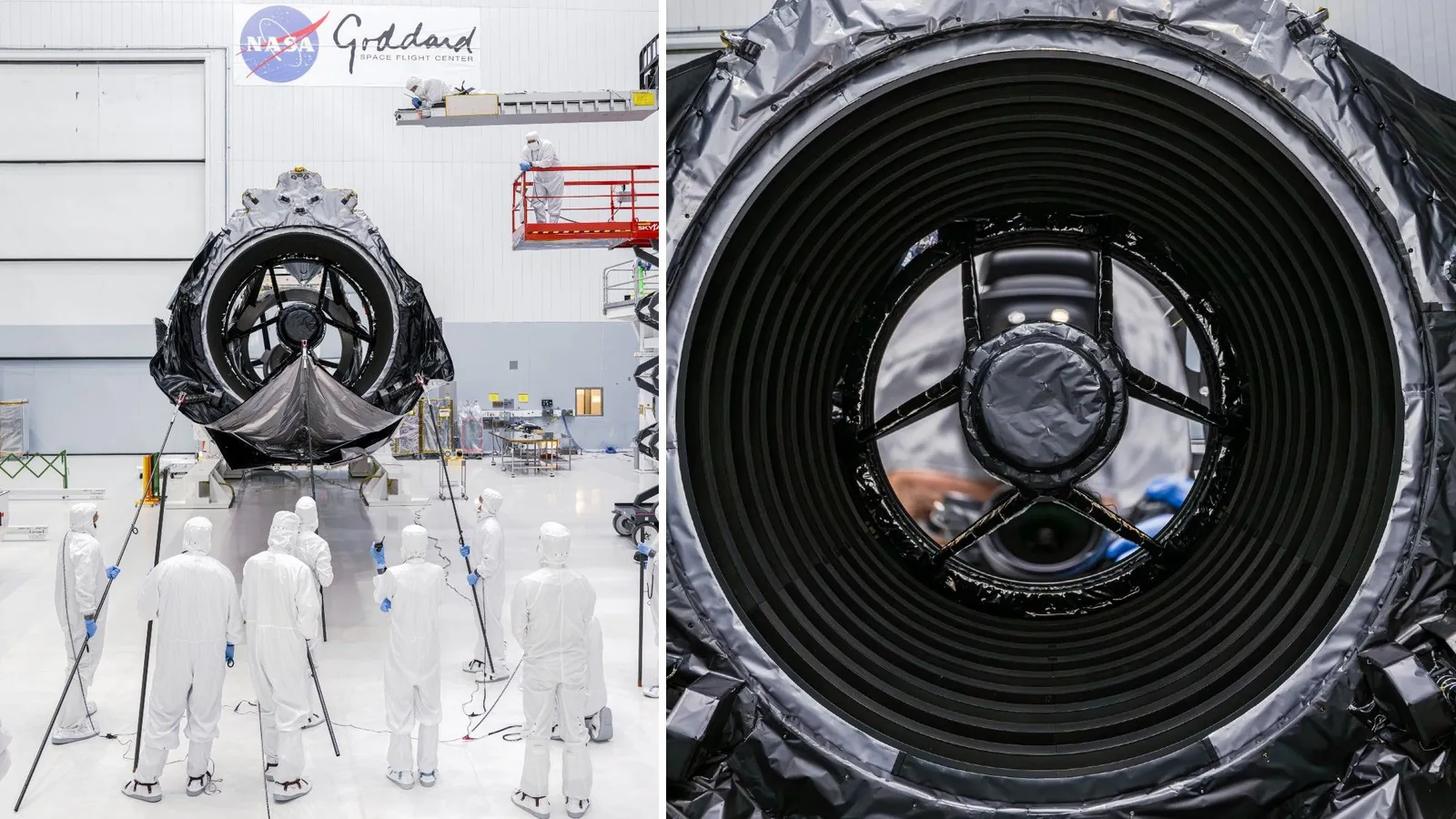
NASA's much-anticipated Nancy Grace Roman Space Telescope has undergone its final visual inspection, successfully confirming its primary mirror is ready for the journey to space. The observatory is now poised for launch from the Kennedy Space Center in Florida, with the earliest target date set for August 30. This critical milestone follows NASA's announcement in April that the telescope itself was complete, leading engineers to conduct a thorough final check of its most vital component: the primary mirror.
"The Roman engineering team laid eyes on the telescope for the final time before it, in turn, becomes the eyes of humanity, revealing the wonders of the cosmos," stated J. Scott Smith, Nancy Grace Roman Space Telescope Manager at NASA's Goddard Space Flight Center in Maryland. "It is a profoundly humbling moment to witness the culmination of hard work from so many dedicated individuals, teams and partner organizations." The telescope's 7.9-foot-wide (2.4 meters) primary mirror is crucial for its mission to collect and focus light from distant cosmic objects, enabling unprecedented scientific discoveries.
Bente Eegholm, the optics lead for Roman's Optical Telescope Assembly at NASA Goddard, emphasized the mirror's importance: "In order to gather very sensitive measurements of objects strewn throughout space, all of Roman's components have to be ultraprecise. The primary mirror certainly delivers on that precision." Engineers meticulously examined the mirror on May 20, implementing a series of steps to ensure no unexpected issues had arisen during prior testing phases.
Mirror Inspection and Component Checks
The inspection process involved carefully orienting the telescope on its side and deploying a protective "hood." This shielding, designed to guard the mirror in space, will be stowed during transit to Florida and for the launch itself. In this protected configuration, engineers conducted a visual sweep to guarantee that no debris had accumulated on the mirror's surface. Following this, the team verified the mirror's alignment and the integrity of its optical path, ensuring everything remained precisely as intended. This thoroughness is essential for the telescope's ambitious scientific goals, which include mapping the distribution of dark matter and studying exoplanets.
A significant part of the telescope's pre-launch preparations included a "shake test." This rigorous procedure simulates the intense vibrations of a rocket launch to ensure the observatory can withstand the journey. The final mirror inspection specifically aimed to confirm that this shake test had not dislodged any components. To achieve this, engineers traced the path light will travel from the mirror to the telescope's primary scientific instrument, the Wide Field Instrument. "We developed a method of using a high-resolution camera equipped with a very powerful zoom lens to do a multi-purpose inspection," Eegholm explained. "The mirror passed with flying colors, keeping the mission on track for an early September launch."
The successful completion of these final checks marks a pivotal moment for the Nancy Grace Roman Space Telescope mission. This observatory, named in honor of the pioneering astrophysicist Nancy Grace Roman, promises to revolutionize our understanding of the universe. Its wide field of view, comparable to that of the Hubble Space Telescope but covering 100 times more area, will enable astronomers to survey vast regions of the sky. This capability is particularly vital for the telescope's two main science themes: investigating the cause of the universe's accelerated expansion and exploring the diversity of planets beyond our solar system. The successful mirror inspection is a testament to the dedication and precision of the NASA team and its partners, bringing the observatory closer to fulfilling its groundbreaking scientific potential.